
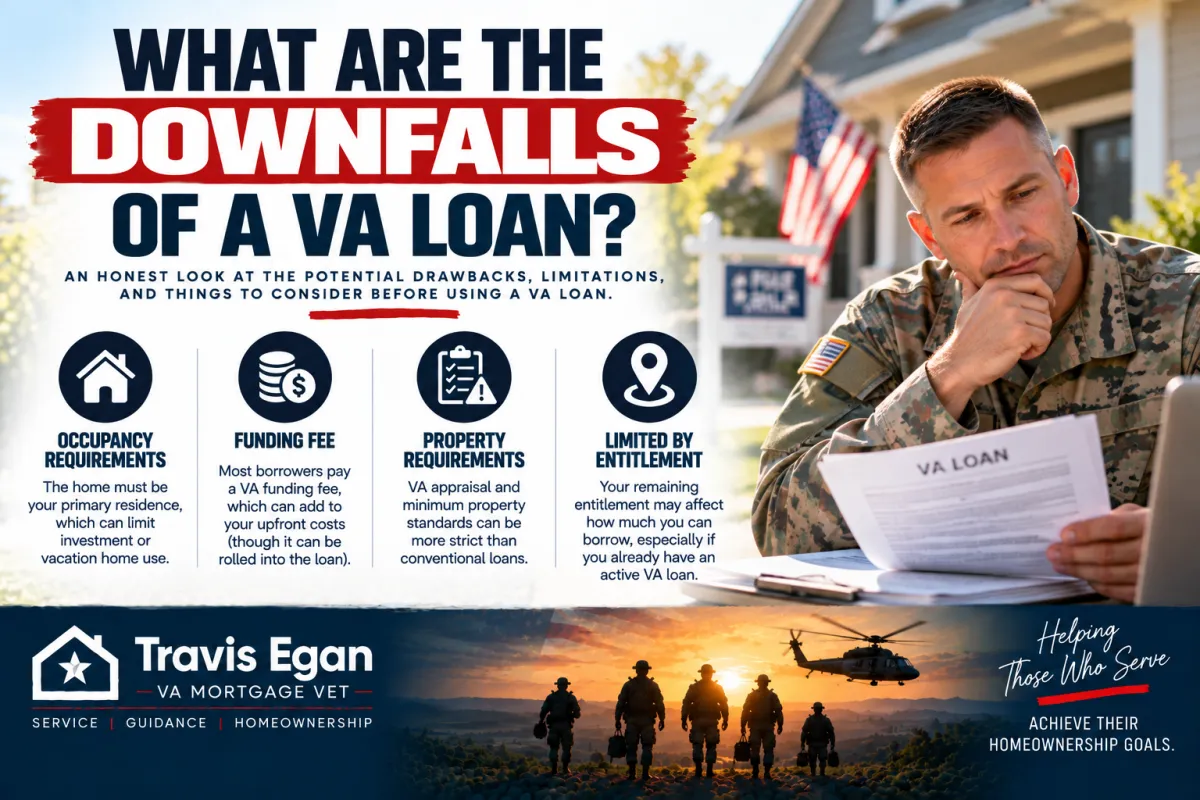
What Are the Downfalls of a VA Loan?
A VA loan is one of the strongest home financing benefits available to service members, veterans, and surviving spouses. It requires no down payment, no private mortgage insurance, limited closing costs, and competitively low interest rates. It is not a perfect fit for every borrower or every property, though. The main disadvantages of a VA loan are the funding fee for borrowers who are not exempt, property and appraisal requirements, owner-occupancy restrictions, limits on which properties qualify, entitlement complications if you already have a VA loan, closing costs that still exist, and lingering seller misconceptions about VA financing.
What Are the Disadvantages of a VA Loan?
Most friction with a VA loan comes from rules that protect the program, not the loan itself. The VA partially guarantees the loan, which means it accepts some of the risk a lender would normally carry. In exchange, the VA attaches conditions to how the loan is used, what property can secure it, and how much the borrower pays in certain fees.
Those conditions show up in a handful of places:
A one-time VA funding fee for borrowers who are not exempt from it
A VA appraisal that includes Minimum Property Requirements, not just a value opinion
An owner-occupancy requirement that rules out pure investment use
Property eligibility limits, including some condo and multi-unit scenarios
Entitlement math that can require a down payment in some repeat-use situations
Closing costs that still exist even though the down payment does not
Seller or agent assumptions that a VA offer is harder to close
Each of these is real, and each has a context where it doesn't matter much. The rest of this article breaks them down so you can judge which ones actually affect your purchase.
The VA Funding Fee: Who Pays It and Why It Matters
The VA funding fee is a one-time cost that many borrowers pay at closing. It exists to keep the program running without a monthly mortgage insurance charge, which is the trade-off that makes VA loans attractive in the first place. The fee is not universal. Certain borrowers qualify for an exemption, and the VA publishes the criteria that determine who qualifies and who doesn't.
If you do owe the fee, the amount is calculated as a percentage of the loan and can be as high as 3.30%, depending on the loan type and the borrower's circumstances. Because the calculation depends on your specific situation, confirm the number with your loan officer or the VA rather than relying on a generic estimate.
The fee is also frequently financed into the loan. That solves a cash problem and creates a debt problem. Financing the fee means you don't bring that money to the closing table, but it also increases your loan balance, which increases the interest you pay over the life of the mortgage. On a long-term loan, a fee that looks small at closing becomes noticeably larger by the time you pay it off.
Don't assume you owe the funding fee, and don't assume you are exempt. Verify your status before comparing VA financing with a conventional offer, because the answer changes the math significantly.
VA Appraisal Requirements and Minimum Property Requirements
A VA-approved appraiser does two jobs on a VA purchase. The appraiser establishes the property's market value and checks whether the home meets the VA's Minimum Property Requirements. Those requirements cover basic safety, structural soundness, and livability. The goal is to prevent a veteran from financing a home that is unsafe or not in reasonable condition.
One point causes more confusion than any other: a VA appraisal is not a home inspection. The appraisal protects the lender and the VA. It does not tell you whether the furnace is about to fail, whether the roof has two years left, or whether the plumbing has a hidden problem. If you want that information, you pay for a separate inspection from an inspector you choose.
What Happens If the VA Appraisal Comes In Low
When the appraised value lands below the agreed purchase price, the loan amount is generally based on the lower number. You have a few paths from there. You can request a Reconsideration of Value if you believe the appraiser missed comparable sales or made an error. You can go back to the seller and renegotiate the price. You can pay the difference in cash, where allowed. Depending on how your purchase contract is written, you may also have grounds to walk away. Your agent and loan officer should walk you through which option fits your contract and your budget.
Appraisal Timing and Cost Vary by Market
VA appraisal timelines are not fixed. How quickly an appraisal is completed depends on the appraiser's schedule, the market, and how busy the local pipeline is at that moment. The same is true of the fee. In some markets, VA appraisals move at a similar pace to conventional appraisals; in others, they take longer. Treat timing as a market condition rather than a permanent feature of the program.
Owner-Occupancy Requirements Limit How You Use the Loan
VA purchase loans are built for a borrower's primary residence. The program expects you to live in the home rather than treat it as a vacation property or a pure investment. That single rule removes VA financing from consideration for buyers whose actual goal is a second home, a rental property, or a short-term investment they never intend to occupy.
If you plan to buy a home near Fort Campbell and live in it, the occupancy rule costs you nothing. If you plan to buy a property you will rent out from day one, a VA purchase loan is the wrong tool, and you will need to look at conventional or other financing instead. This is one of the clearest disadvantages because it is not a cost you can absorb. It is a structural limit on what the loan can do.
Entitlement Complications for Repeat VA Borrowers
A persistent myth is that you can only have one VA loan at a time. That is not accurate. Veterans who already hold a VA loan may still be able to use VA financing again. What changes is how much entitlement you have left.
Remaining entitlement can affect the transaction in practical ways. In some situations, it requires a down payment to complete the purchase, and in others, it shapes how the lender structures the loan. If you still own a home financed with a VA loan, or you sold one and aren't sure how your entitlement was restored, have your loan officer check your Certificate of Eligibility and entitlement balance before you make an offer. Getting that answer early prevents surprises later in the process.

Closing Costs Still Exist on a VA Loan
No down payment does not mean no costs. VA loans carry closing costs like any other mortgage, including lender fees, title work, escrow items, and prepaid expenses. The program does limit certain closing costs that can be charged to the borrower, which is where the "limited closing costs" reputation comes from, but it does not eliminate them.
The funding fee can often be financed into the loan. Most other closing costs cannot simply be rolled in. Sellers and builders may contribute toward allowable costs, subject to VA rules, which is one of the most useful negotiating levers a VA buyer has. Ask your loan officer for a breakdown of what you will need in cash and what you can negotiate with the seller before you write an offer.
Seller Perception: A Market Problem, Not a Loan Problem
Some sellers and real estate agents still believe VA loans are harder, slower, or more likely to fail because of appraisal and property requirements. In competitive situations, that belief can affect how the seller receives your offer, especially if they're comparing it to a conventional offer with similar terms.
This is important to frame correctly. Seller perception is a market issue, not an inherent defect in the VA loan program. A VA offer is not automatically weaker than a conventional offer. A well-structured VA offer with a prepared buyer, a strong pre-approval, and a loan officer who communicates clearly can compete effectively. The problem is the assumption, and you can address it with information.
VA Loan Disadvantage Comparison Table
Potential VA Loan Disadvantage | Why It Matters | When It May Not Be a Problem |
|---|---|---|
VA funding fee | Adds a one-time cost; financing it increases the loan balance and total interest paid. | If you qualify for an exemption, or you can pay the fee at closing without straining cash reserves |
Appraisal and Minimum Property Requirements | Repairs or condition issues can delay or complicate the purchase; a low value can change your financing. | If the home is in good condition and the appraised value supports the purchase price |
Owner-occupancy requirement | Rules out vacation homes and pure investment properties | If you intend to live in the home as your primary residence |
Entitlement limits | Repeat VA borrowers may face a down payment or a restructured loan | If you have full entitlement available, or your remaining entitlement covers the purchase |
Property eligibility | Some condos and certain property types may not qualify without additional steps. | If you are purchasing a standard single-family home that meets VA requirements |
Closing costs | Cash is still required at closing even with no down payment | If you have funds set aside or negotiate seller contributions toward allowable costs |
Seller misconceptions | Your offer may be judged on assumptions rather than terms | If the listing agent knows VA loans, or your loan officer communicates the timeline up front |
Are the Disadvantages of a VA Loan Worth It?
There is no blanket answer to that question. Whether VA financing is the better choice depends on your specific numbers, and the comparison usually comes down to a few key variables.
The funding fee comes first. If you are exempt, one of the loudest objections to VA financing disappears entirely. If you are not exempt, you must weigh the fee against what you would pay for mortgage insurance on a conventional loan with a low down payment.
Your available cash matters next. A VA loan removes the down payment requirement, preserving savings and closing reserves, but closing costs don't disappear. If you have limited cash, the VA structure is often easier to manage. If you have substantial cash, a conventional loan may give you more flexibility on property type and may reduce long-term costs depending on your rate.
Interest rate matters as well. A VA loan does not automatically carry a lower rate than a conventional loan in every scenario, and it can carry a higher rate in some cases. Compare the rate with the cost of mortgage insurance, the funding fee, and how long you expect to keep the loan.
Property type is another deciding factor. If the home you want is a condo that isn't approved for VA financing, or a property that wouldn't pass the appraisal requirements, the VA path may be impractical no matter how good the terms are.
Your credit profile, your current entitlement, and how long you plan to stay in the home also shape the answer. A borrower who plans to sell in three years is running a different calculation than a borrower who plans to hold the home for fifteen.
The Benefits That Sit on the Other Side of the Scale
Any honest comparison has to include what VA loans do well. Qualifying borrowers don't need a down payment. Private mortgage insurance isn't required. Closing costs are limited in ways that conventional loans are not. Interest rates are typically competitive. VA loans also carry no prepayment penalty, so you can pay the mortgage off early or make extra payments without being charged for it.
For many military families, those advantages outweigh the drawbacks. The point is not that VA loans are bad. The point is that you should know what you are choosing so the decision is deliberate rather than assumed.
Frequently Asked Questions
Do all VA borrowers pay the funding fee?
No. Many borrowers pay a one-time VA funding fee, but certain borrowers qualify for an exemption based on their circumstances. The VA publishes the criteria that determine exemption status. Because the fee can be financed into the loan and increase your balance, confirm whether you owe it before you compare VA financing with a conventional loan offer.
Is a VA appraisal the same as a home inspection?
No, and the difference matters. The VA appraiser establishes market value and checks whether the property meets the VA's Minimum Property Requirements for safety and livability. That protects the lender and the VA. It does not evaluate the condition of major systems the way a professional home inspection would. Order a separate inspection if you want that level of detail.
Can I use a VA loan to buy an investment property?
A VA purchase loan is intended for a borrower's primary residence, not a vacation home or a pure investment property. If you plan to buy a rental you never intend to occupy, VA purchase financing isn't the right fit, and you should explore other loan types. Occupancy rules are one of the program's clearest limits.
Can I get a second VA loan if I already have one?
Possibly. Veterans who already hold a VA loan may still be able to use VA financing again. What changes is your remaining entitlement, which can affect the transaction structure and may require a down payment in some situations. Have your loan officer check your Certificate of Eligibility and entitlement balance before you make an offer.
What if the VA appraisal comes in below the purchase price?
You have several options. You can request a Reconsideration of Value if you believe the appraisal missed relevant comparable sales. You can renegotiate the price with the seller. You can pay the difference where that is permitted and affordable. Depending on your contract terms, you may also be able to exit the purchase. Your agent and loan officer can help you choose.
Why do some sellers avoid VA offers?
Some sellers and agents assume VA loans are slower or more likely to fail because of appraisal and property requirements. That is a market perception, not an inherent weakness in the program. A prepared VA buyer with a strong pre-approval and a loan officer who communicates the process can present an offer that competes on its actual terms.
Missed the last post? Can You Use a VA Loan for a Second Home? Rules for Military Families. For more on VA home loans.