
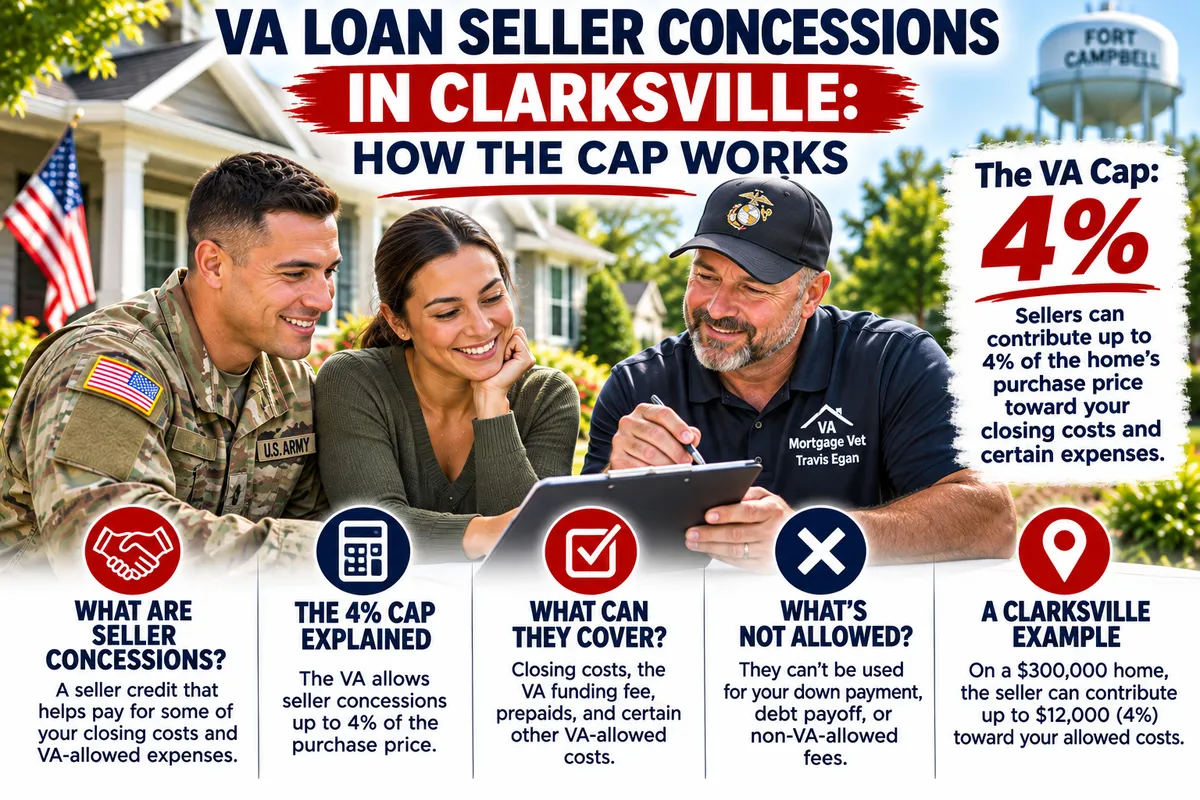
VA Loan Seller Concessions in Clarksville: How the Cap Works
A VA loan can get a Clarksville buyer into a home with no down payment, but closing costs do not disappear. Title work, lender fees, prepaid escrows, and other charges still land on the closing disclosure, and that cash is due at closing. Seller concessions are one of the few tools that move part of that bill to the other side of the table. The mechanics are not complicated, but the numbers repeated around Fort Campbell are often stale or half right. Here is how the rule actually reads and how it plays out in a Clarksville contract.
What a Seller Concession Is on a VA Loan
A seller concession is a credit the seller agrees to give the buyer at closing. The buyer and seller negotiate it in the purchase contract, not the lender, and it functions like a discount on the seller's net proceeds rather than a gift to the buyer. On a VA loan, the concession is tied to the buyer's own transaction costs: money the buyer would otherwise bring to the closing table in cash.
Two things separate a VA concession from a simple price reduction. First, the credit has to be an allowable use under VA guidelines and acceptable to the lender underwriting the file. Second, the amount is capped. A seller cannot agree to cover an unlimited amount of the buyer's costs, even if both parties sign off on it, because the cap is a loan program rule, not a private agreement between two people.
In practice, a concession lowers the cash a veteran needs at closing. It does not lower the contract price, and it does not change the loan amount unless the parties also renegotiate price.
The Cap, and Why You Hear Two Different Numbers
This is where most of the confusion lives. Older VA guidance sources point to a 4 percent limit on seller concessions toward a buyer's closing costs, and that 4 percent figure is still repeated in plenty of places. More recent sources describe VA seller concessions reaching 7 to 8 percent, and at least one industry voice has argued directly that the flat 4 percent cap is misleading veterans.
Both numbers are in circulation, which is exactly why a buyer should not build an offer around a figure pulled from a forum thread or a five-year-old blog post. The limit that applies to your file is the one your underwriter applies, and that answer should come in writing from your loan officer before the contract is signed. A Clarksville buyer who assumes 4 percent and leaves room on the table, or assumes 8 percent and writes an offer the lender will not fund, ends up renegotiating under time pressure.
Ask two direct questions: what percentage applies to this loan today, and what dollar amount does that produce on this specific property? Those are different questions, and the second one matters at the closing table.

The Cap Is Based on Appraised Value, Not List Price
Seller concessions are calculated as a percentage of the home's appraised value, not the listing price and not automatically the contract price. That distinction changes the math any time the appraisal and the negotiated price pull apart.
If the appraisal comes in at or above the contract price, the cap is generally figured from that supported value. If the appraisal is lower than the price the buyer and seller agreed on, the dollar ceiling on concessions can be smaller than the buyer expected because the percentage is applied to the lower appraised amount. A buyer who planned on a specific credit amount can find that the maximum allowable credit shrank along with the appraisal.
This is one more reason to keep the appraisal timeline in view. On a Clarksville purchase tied to a PCS report date, a low appraisal can compress both the negotiation window and the closing schedule.
What Seller Concessions Can Cover
VA guidelines allow seller concessions to be applied to specific categories of buyer costs. The list is not open-ended, and the lender reviews the final settlement statement to confirm the credit went where it was supposed to go.
Allowable use | What it does for the buyer |
|---|---|
Closing costs | Reduces the cash the buyer brings to the closing table for lender and transaction fees. |
Prepaid expenses | Helps cover items collected in advance, such as escrow deposits and related prepaids. |
Discount points | Pays to lower the loan interest rate, which affects the payment over the full term. |
Discount points deserve a separate look because they behave differently from the rest. Closing cost credits save cash once. Points paid by the seller change the loan rate, which affects the monthly payment and the total interest paid over the life of the mortgage. A buyer who plans to stay in the home for years may get more long-term value from a points credit than from an equivalent credit applied to one-time fees.
How the Negotiation Looks in Clarksville
Sellers in the Clarksville and Fort Campbell area look at net proceeds, not gross price. A credit toward the buyer's closing costs reduces the seller's bottom line much like a price cut, so a concession request is a real ask, not a formality. Listing agents will price it accordingly when they advise their client on which offer to accept.
In practice, buyers usually have two ways to structure the same economic outcome. One is to negotiate a lower purchase price. The other is to hold the price and ask the seller to cover a defined amount of closing costs. The second option often appeals to sellers who have a number in mind for their sale price, and it appeals to buyers who need cash on hand for the move rather than a slightly smaller mortgage.
Military buyers connected to Fort Campbell often value the cash side of that trade more heavily. A PCS move already pulls money toward moving costs, deposits, and the gap between two households. Preserving cash at closing can matter more than shaving a small amount off the loan balance. The right answer depends on your orders, your savings, and how long you expect to keep the home.
Timing affects leverage as well. A seller facing a closing deadline may weigh a clean, well-qualified VA offer differently than one with more contingencies attached, even if the concession request is identical.

When the Appraisal Comes in Low
If the appraisal does not support the contract price, the buyer and seller can negotiate a price adjustment or another concession, provided the lender and the contract allow it. That is the standard path, and it is negotiated rather than automatic.
For a VA buyer, the conversation has an extra layer because the concession cap moves with appraised value. A seller who agrees to reduce the price may also be asked to hold a credit in place, and the lender must confirm the revised structure still fits within the limit. Getting the lender involved before the parties sign an amendment avoids a second round of changes.
What Concessions Do Not Solve
A seller credit is not a substitute for qualification. With a qualifying VA loan, a buyer may not need a down payment when the purchase price, appraisal, entitlement, and lender approval all support it. A concession does not create entitlement, does not fix an appraisal gap, and does not replace underwriting approval. It only shifts a defined slice of the buyer's closing costs to the seller.
Concessions also do not protect a buyer from overpaying. If the agreed price is above what the appraisal supports, a credit toward closing costs does not close that gap. The buyer still has to solve the difference through price negotiation, additional cash, or another structure the lender approves.
Finally, a concession is a contract term. If the seller agrees to it in the offer and then the deal is amended, the credit has to survive that amendment and still be reflected on the final closing disclosure. Verbal assurances from an agent are not the same as contract language the underwriter will accept.

Getting the Number Right Before You Write the Offer
Start with your lender, not the listing. Ask for a written breakdown of your estimated closing costs and prepaids on the specific property, then ask what concession amount the loan program allows on that file. With both numbers in hand, you can decide how much of the gap you want the seller to cover and how that request fits into your overall offer strategy.
Then put the request in the contract as a clear figure or percentage, and confirm with your loan officer that the language matches what underwriting will accept. A VA loan in the Clarksville market can still close with minimal cash from the buyer, but the concession has to be structured correctly from the first page of the offer rather than patched together at the closing table.
Frequently Asked Questions
Is the VA seller concession limit 4 percent or higher?
You will find both answers in circulation. Older guidance sources cite 4 percent, while more recent sources describe limits of 7 to 8 percent. The figure that applies to your purchase is the one your lender confirms in writing for your specific file. Ask before you write the offer rather than assuming either number is current.
Can a seller pay all of my closing costs on a VA loan?
Only up to the allowed cap. Seller concessions can cover closing costs, prepaid expenses, and discount points, but the total credit cannot exceed the program limit for that property. If your closing costs exceed the cap, you cover the remainder unless you renegotiate the price or structure.
Does the concession limit use the purchase price or the appraised value?
The cap is a percentage of the home's appraised value, not the listing price or automatically the contract price. That means the dollar limit can change if the appraisal differs from the agreed price. Confirm the calculated amount with your lender once the appraisal is in, before the parties finalize any amendment.
Can we renegotiate if the appraisal comes in below the contract price?
Yes, the buyer and seller can negotiate a price adjustment or other concession when the lender and the contract permit it. This is a negotiated outcome, not an automatic right. Bring your loan officer into the conversation early so the revised structure still fits within the concession limit before anyone signs.
Should I ask for a lower price or a closing cost credit?
Both produce a similar result for the seller's net proceeds, so the choice usually comes down to your cash position and how long you plan to keep the home. Buyers who need cash on hand for a move often prefer the credit. Buyers focused on the long-term loan balance may prefer the price reduction.
Missed the last post? VA Loan Entitlement After Using It Once: What Happens Next. For more on VA home loans.