
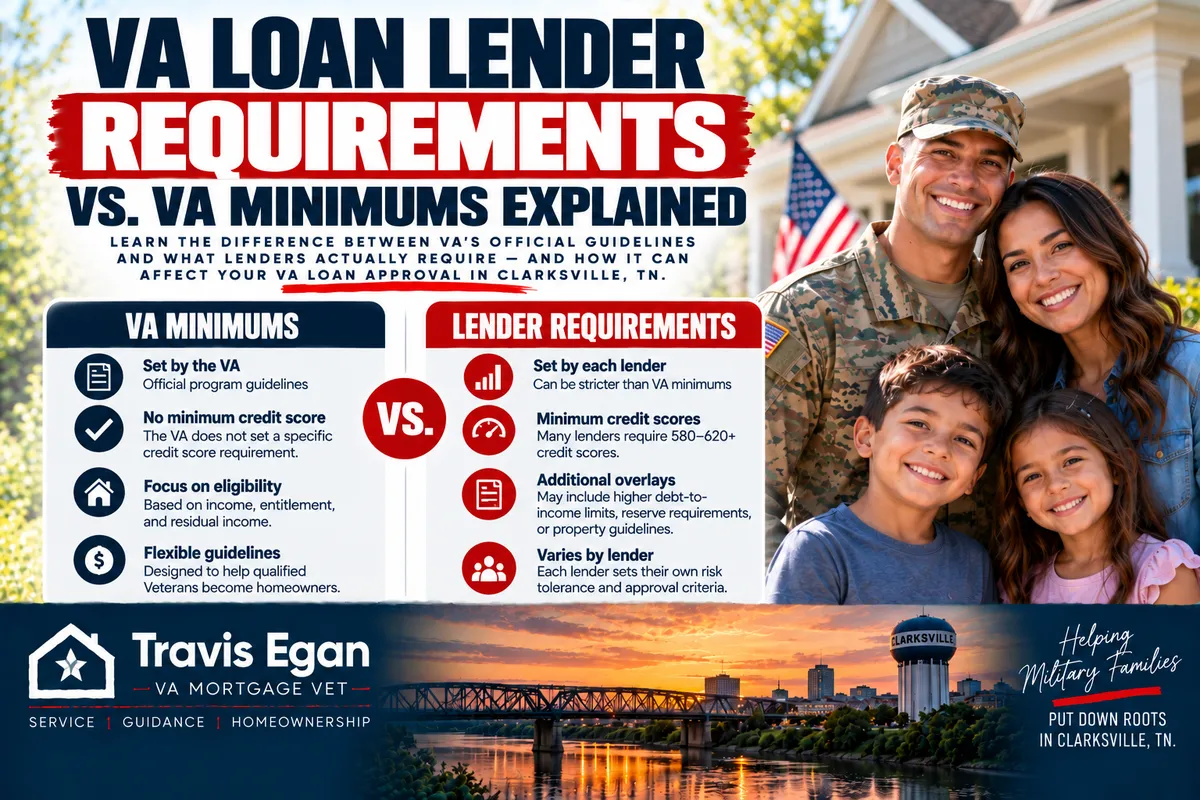
VA Loan Lender Requirements vs. VA Minimums Explained
Two different rulebooks decide whether your VA loan closes. The Department of Veterans Affairs writes one of them. Your lender writes the other. When a borrower gets turned down or surprised at the closing table, it is usually because they only read the first book.
The VA home loan program is a guaranty, not a direct government loan. The VA backs part of the loan if you default. A private lender funds the money. That split is the reason a loan can meet every VA standard and still fail a lender's internal checklist.
Two Sets of Rules Apply to Every VA Loan
The VA publishes program rules covering who is eligible, what the loan can be used for, and what the government will and will not require. Lenders then layer their own underwriting standards on top. Those lender standards are sometimes called overlays, and they are legal as long as they do not directly contradict VA program rules.
Independent mortgage brokers, banks, and credit unions all set their own tolerances. Two lenders can review the same borrower, the same Certificate of Eligibility, and the same property and reach different conclusions.
What the VA Actually Sets
Eligibility for the guaranty, proven with a Certificate of Eligibility, or COE
The primary residence requirement
The fact that VA itself does not require a down payment
The likelihood that an upfront funding fee applies
What Your Lender Sets
Lenders can and do set their own underwriting requirements. That includes credit score minimums, whether a down payment is required for a particular borrower, how much documentation they want, and how they analyze your income and debts. The VA hands lenders a framework. Lenders decide how tightly to read it.
Credit Score: Where the Gap Is Widest
This is the most common source of confusion. VA loan credit score requirements vary by lender, and most require a 620 FICO score to qualify. That 620 number is a lender convention, not a VA mandate. One reported example is Freedom Mortgage, which requires a minimum credit score of just 550 to qualify for a VA loan.
What that means in practice: if you have a 580 score, you are not automatically locked out of a VA loan. You are locked out of certain lenders. The same file can be denied at one shop and approved at another.
Requirement | Set by the VA | Set by the lender |
|---|---|---|
Credit score | No single VA minimum appears in the guidance reviewed here | Commonly 620 FICO, with at least one lender reported as low as 550 |
Down payment | Not required by VA | Lenders may require a down payment for some borrowers |
Occupancy | Primary residence required | Verified again during underwriting |
Eligibility proof | Certificate of Eligibility | Lender collects the COE with your application |
Funding fee | Likely applies upfront | Handled through the loan process |
Down Payment: VA Says Zero, Lenders Can Say Otherwise
The zero down payment promise is real, but it belongs to the VA side of the ledger. Lenders may require down payments for some borrowers using the VA home loan guaranty. The VA itself does not require a down payment.
When would a lender ask for money down? Usually when something in the file needs to be offset. It might be credit history, a debt load, or another factor the lender's underwriter wants compensated for. This is exactly the kind of overlay borrowers do not discover until they are deep into a file.
The practical takeaway: zero down is the program standard, not a guarantee from every lender. Ask the question early, in writing, before you fall in love with a house.
The Occupancy Rule Applies to Everyone
If you want to use a VA loan to purchase a home, that home must be your primary residence. That means you and your family must intend to live there. When applying for a VA home loan, applicants must show they intend to live in the property.
Second homes and investment properties don't qualify for the program. This is one area where the VA rule and the lender rule pull in the same direction. Your lender will confirm your intent to occupy, and that confirmation follows the loan file.
For military families, this matters during a permanent change of station. A PCS move is a classic primary residence event because you are relocating to live near your new duty station, not buying a rental.
The Certificate of Eligibility Is the Entry Ticket
To qualify for a VA loan, you will need to provide your lending institution with a Certificate of Eligibility. The COE documents that you meet the guaranty's service requirements.
The COE is not the same thing as loan approval. It confirms eligibility for the program. Your lender still reviews your credit, income, assets, and the property. Borrowers sometimes assume the COE means the hard part is over. It means the door is open, not that you are through it.

The Funding Fee Is a VA Item, Not a Lender Fee
VA loan requirements include proving eligibility, using the home as your primary residence, and likely paying an upfront funding fee. Because it sits on the VA side of the process, a lender can't waive or negotiate the funding fee. Certain borrowers may have different obligations, so confirm your specific situation with your lender or with the VA directly rather than assuming.
Rules People Attribute to the VA That You Should Verify
A few claims circulate widely and are not confirmed in the official guidance reviewed for this article. Two examples are the so-called 4% rule and the 1% rule for VA loans. Another is a neat list of what disqualifies you from a VA loan.
Do not build a plan around any of those. If you hear a specific formula or threshold from a loan officer, ask where it comes from. A responsible answer distinguishes between a VA program rule, a lender overlay, and a rule of thumb someone picked up in a Facebook group.
The same caution applies to any percentage, dollar figure, or cutoff you cannot trace back to an official source. Verify it before you sign anything.

How to Prepare Before You Talk to a Lender
Request your Certificate of Eligibility to confirm you qualify for the program.
Pull your credit scores so you know which lenders are realistic options.
Ask each lender directly about overlays, including any credit score minimum above the VA standard and any scenario where a down payment would be required.
Confirm you intend to occupy the home as your primary residence.
Plan for the upfront funding fee in your budget.
Run your own payment math with a mortgage calculator so you are comparing options, not reacting to whichever number gets quoted first.
If you are moving to the Fort Campbell area, the timeline adds pressure. A PCS date does not move, and lender overlays take time to work through. Starting the eligibility and credit review early keeps the financing from becoming the bottleneck.
Frequently Asked Questions
Does the VA require a 620 credit score?
The VA does not publish a single minimum credit score in the guidance reviewed here. Lenders can and do set their own underwriting requirements, and many require VA borrowers to have a credit score of 620 or higher. That 620 figure is a lender standard, so a borrower below it should ask other lenders rather than assume the VA loan is off the table.
Can a lender require a down payment on a VA loan?
Yes. Lenders may require down payments for some borrowers using the VA home loan guaranty, even though the VA itself does not require a down payment. Most VA buyers put nothing down. If a lender asks you for money down, ask exactly which factor in your file prompted it and whether another lender would treat the same file differently.
Can I use a VA loan to buy a rental property or second home?
No. To use a VA loan, the home must be your primary residence, meaning you and your family intend to live in it. Second homes and investment properties don't qualify. Your lender will document that intent during underwriting, so buying with plans to rent it out right away does not fit the rules.
What is the 4% rule for VA loans?
The 4% rule is not confirmed in the official guidance reviewed for this article, so treat any version of it with caution. It is typically described as a cap tied to certain costs or concessions, but the details vary by source. Ask your lender to identify whether a figure is a VA program rule, a lender overlay, or simply a rule of thumb.
What should I get first, the COE or a lender?
Get the Certificate of Eligibility first. To qualify for a VA loan, you will need to provide your lender with a COE, and having it in hand lets them give you a real answer instead of a hypothetical one. From there, compare at least two lenders on overlays, not just on rate.
The short version is that the VA decides whether you are eligible to use the guaranty, and your lender decides whether it will fund your specific file. Knowing which rulebook you are reading at any given moment keeps a surprise from becoming a denial, and it lets you compare lenders on the standards that actually shape your approval.
Missed the last post? Buying a Home While Stationed Overseas: Fort Campbell VA Guide. For more on VA home loans.