
VA Loan Entitlement After Using It Once: What Happens Next
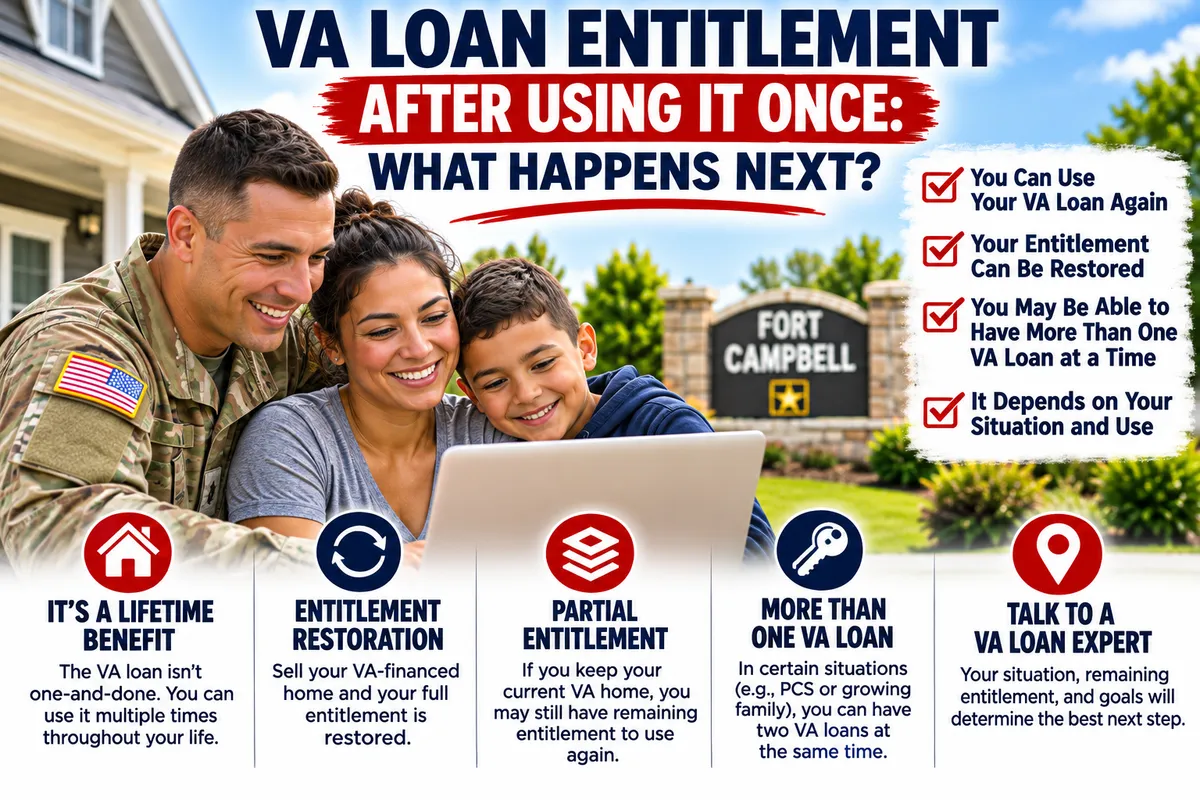
No. Using a VA loan once does not permanently eliminate your VA loan entitlement or close the door on the VA home loan benefit. The VA home loan benefit can generally be used more than once as long as you meet the applicable requirements. What changes after the first use is how much entitlement you have available. Depending on what happened with the previous VA loan, you may have full restored entitlement, partial remaining entitlement, or entitlement that is still tied up in an existing VA loan. Each situation has its own path forward.
Do I Lose My VA Loan Entitlement After Using It Once?
The short answer is that you do not lose the benefit itself after using it once. You use up a portion of your guaranty, and that portion can often be restored or reused later.
A VA loan is not a one-time payment or a single-shot voucher. It is a benefit backed by the VA's guaranty to the lender. Once you have used it, the VA tracks how much of that guaranty is committed. If the first loan is still open, part of your entitlement is occupied. If the first loan is paid off and the property is sold, that entitlement can commonly be restored. If the loan is paid off but you still own the home, there may be a one-time restoration option available.
That is why two veterans who both used a VA loan five years ago can have very different amounts of entitlement available today. The deciding factors are what happened to the first loan, whether the property was sold, and whether you notified the VA or asked it to update the record.
What Is VA Loan Entitlement, Really?
Entitlement is the amount of guaranty the VA provides to your lender. It is not cash that gets handed to you at closing. It is not a down payment fund. It is also not the same thing as a loan limit. Entitlement is the backstop that lets a lender approve a VA loan with more favorable terms than it might otherwise offer.
The VA publishes a simple way to estimate how much entitlement a loan uses. Multiply the VA loan amount by 0.25.
VA loan entitlement formula: Loan Amount × 0.25 = Entitlement You've Used
So if you borrowed a set amount on your first VA loan, roughly one quarter of that amount represents the guaranty committed to that loan. The rest of your entitlement may still be available, depending on your situation and current limits.
This is why conversations about entitlement can get confusing. A borrower hears "entitlement" and pictures a savings account. In practice, it works more like a reserved portion of a guarantee that follows the loan, not the person.
Full, Remaining, and Restored Entitlement in Plain Language
Most confusion about reusing a VA loan comes from mixing up three terms. They describe different stages of the same benefit.
Type of entitlement | What it means | Typical situation |
|---|---|---|
Full entitlement | Your full guaranty is available because no active VA loan is holding any of it. | You have never used a VA loan, or a previous VA loan was paid off and entitlement was restored. |
Remaining entitlement | Part of your guaranty is still committed to an existing VA loan, and the unused portion may support another loan. | You still own a home financed with a VA loan and want to buy another primary residence. |
Restored entitlement | The entitlement tied to a prior VA loan has been released back to you. | The prior VA loan was paid in full, and the property was sold, or a one-time restoration was applied. |
Bonus entitlement, sometimes called secondary or second-tier entitlement, can help when a VA loan is over $144,000 or when you are carrying multiple VA loans at once. It is an additional layer that may allow a second VA loan to move forward while the first remains open.
Can I Use My VA Loan Benefit More Than Once?
Yes. There is no lifetime limit on how many times an eligible borrower can use the VA home loan benefit, as long as the applicable eligibility, entitlement, occupancy, credit, income, and lender requirements are met. Veterans, active-duty service members, and surviving spouses who qualify can use the benefit for a first home, a later home, or a home after a permanent change of station.
Each new use must still stand on its own. The lender will review the new loan the same way it reviews any VA loan application. That includes confirming you have enough entitlement available, that you intend to occupy the home as your primary residence, and that your credit and income support the payment.
Reusing the benefit is not a loophole. It is a normal part of how the VA home loan program is designed to work for people who move, relocate, or change their housing situation over a career.

How Entitlement Is Normally Restored After You Sell
The most common restoration path is straightforward. You sell the home that was financed with a VA loan, and the VA loan is paid in full at closing. Once that happens, the entitlement tied to that loan is generally released back to you.
Restoration is not always automatic in practice. The record must reflect that the loan was paid off, and that can take time or require a specific request. A borrower who is ready to buy again should not assume the old entitlement has already been released. Requesting an updated Certificate of Eligibility is the reliable way to see what the VA currently shows as available.
A common entitlement code is 05, which indicates the entitlement was restored after a previous VA loan. Seeing that code on a Certificate of Eligibility is a useful signal that the prior loan has been cleared from your record.
One-Time Restoration of Entitlement
A separate option exists for a veteran who paid off the prior VA loan in full but still owns the property. In certain circumstances, that borrower may be able to request a one-time restoration of entitlement without selling the home.
The typical route is to pay off the VA loan by refinancing into an eligible non-VA loan type. The VA loan is satisfied, the property stays in the veteran's name, and the entitlement can be restored once. This is specifically a one-time restoration. It is not a repeatable tool, and using it does not create an unlimited supply of entitlement.
After that one-time restoration has been used, future restoration can require disposal of properties previously financed with VA loans. In other words, the next round of entitlement may only come back when a VA-financed property is sold, and the loan is paid off. That makes the decision worth planning carefully rather than treating it as a quick fix.
What Happens If the Buyer Assumes Your VA Loan?
An assumable VA loan can attract a buyer, but it creates a specific problem for the seller's entitlement. If the buyer takes over the loan and is not a qualified veteran substituting their own entitlement, your entitlement may remain tied to that loan even after you have moved out.
Selling the home does not automatically restore your entitlement in an assumption scenario. The entitlement can stay committed because the VA guaranty is still attached to the loan, and the loan is still outstanding. That can limit how much entitlement you have available for your next purchase.
There is a path out. A qualified veteran buyer can substitute their own entitlement for the seller's entitlement, which releases the seller. Without that substitution, the seller should expect the entitlement to stay occupied until the loan is paid off or otherwise resolved.
Can I Have Two VA Loans at the Same Time?
In some situations, yes. A borrower may be able to keep an existing VA-financed home and use remaining entitlement to purchase another primary residence. This can happen with PCS moves, relocations, or other legitimate changes in residence, where keeping the first home makes financial sense and the new home becomes the primary residence.
Remaining entitlement and county loan limits can affect whether a down payment is required on the new loan. When a large share of entitlement is already committed, the lender has less guaranty to work with on the second loan, and that gap can translate into a down payment requirement. The exact outcome depends on the numbers, the location, and the lender's review, so you can't estimate it from memory.
Bonus entitlement is often the piece that makes two simultaneous VA loans possible. It can apply when a VA loan is over $144,000 or when multiple VA loans are carried at once.
Example: A Fort Campbell Service Member Keeps the First Home
Consider a service member who bought a home with a VA loan at a previous duty station. Orders arrive for Fort Campbell, and the family decides to keep the first home rather than sell in a soft market. They want to buy another primary residence in the Clarksville area near the post.
The first VA loan is still open, so a portion of entitlement is still committed. The conversation then centers on how much entitlement remains, what the county loan limit looks like for the new purchase, and whether the numbers leave a gap that requires a down payment. Bonus entitlement may come into play. The family may also weigh renting out the first home against selling it outright.
Nothing about this scenario guarantees approval or a zero-down outcome. It is a planning exercise. The right answer depends on the remaining entitlement, the purchase price, the local limit, and the lender's underwriting. Starting that review early, before making an offer, gives the family room to adjust instead of scrambling at the last minute.
Example: Selling, Paying Off, and Using the Benefit Again
Now consider a veteran who bought a home with a VA loan several years ago, then decided to sell. The home closes, the VA loan is paid in full from the proceeds, and the veteran requests an updated Certificate of Eligibility. The record shows restored entitlement, often reflected with code 05.
Later, with full entitlement available again, the veteran buys a new primary residence using the VA benefit a second time. Because the prior loan was cleared, the new purchase doesn't carry the old guaranty, and the entitlement picture is much cleaner than it would have been if the first home had been kept.
The difference between this example and the previous one is not luck. It is the status of the first loan. Selling and paying it off released the entitlement. Keeping it open left part of the guaranty committed.
What Happens After Foreclosure, Short Sale, or Another VA Loss?
A foreclosure, short sale, or other loss does not permanently prevent a veteran from using a VA loan again. It does, however, affect entitlement. The entitlement associated with the loss may not be fully restored until the amount of the VA loss is repaid.
That means a borrower who went through a loss may have less available entitlement than expected. In some cases, the remaining piece can still support a future purchase, and the loss amount can be addressed directly. Either way, the situation calls for a thorough review of the record rather than assuming the benefit is gone for good.
Timing, credit recovery, and lender requirements will also shape what is possible and when. A conversation with a VA lender who can pull the current entitlement picture is more useful than guessing.

Why the Certificate of Eligibility Matters
The Certificate of Eligibility, usually called the COE, shows how much entitlement is currently available. It tells the story of your prior VA loans and what has and hasn't been released.
Borrowers who have used VA financing before should have their lender obtain an updated COE before assuming how much entitlement remains. An old COE may not reflect a recent payoff, a restoration, or a change tied to an assumed loan. Relying on stale information can lead to unrealistic expectations about down payment or purchase price.
This step is quick, and it prevents a lot of avoidable confusion later in the process.
How Do I Restore My VA Loan Entitlement?
Restoration usually falls into one of a few common situations. Knowing which one applies to you makes the process much easier to plan.
Sell the property and pay the VA loan in full. This is the most common path, and it releases the entitlement tied to that loan.
Use the one-time restoration after paying off the VA loan while keeping the home, typically by refinancing into an eligible non-VA loan type.
Complete a substitution of entitlement when a qualified veteran buyer assumes the loan and substitutes their own entitlement for the seller's.
Repay the amount of a prior VA loss when a foreclosure, short sale, or similar event left entitlement committed.
In each case, the practical next step is the same. Ask your lender to pull an updated Certificate of Eligibility, review what it shows, and build the plan around the real number rather than an estimate. If you are near Fort Campbell and working through a PCS timeline, starting that review early keeps the purchase from being held up by paperwork.
Frequently Asked Questions
Can I use my VA loan again after selling my first home?
In most cases, yes. When the first home sells, and the VA loan is paid in full, the entitlement tied to that loan is generally released. Request an updated Certificate of Eligibility so your lender can confirm the restored amount before you start shopping. Restoration is not always automatic, so verifying the record early avoids surprises.
Does selling a home with an assumed VA loan restore my entitlement?
Not automatically. If a buyer assumes your VA loan without substituting their own entitlement, your entitlement may remain tied to that loan even after you have moved. A qualified veteran buyer who substitutes entitlement can release you. Otherwise, expect the entitlement to stay committed until the loan is paid off.
How much VA entitlement have I already used?
A common estimate is the loan amount multiplied by 0.25. That figure represents the guaranty committed to the loan. It is an estimate, not an official balance. Your lender can pull an updated Certificate of Eligibility to show exactly what the VA currently records as available for your next purchase.
Can I get another VA loan after a foreclosure or short sale?
Possibly. A foreclosure or short sale does not permanently end the benefit. Entitlement associated with the loss may not be fully restored until the amount of the VA loss is repaid, which can reduce what is available. Credit, income, timing, and lender requirements also matter, so review your record with a VA lender before ruling anything out.
Missed the last post? Does a VA Loan Require a Home Inspection? Tennessee Buyer Guide. For more on VA home loans.