
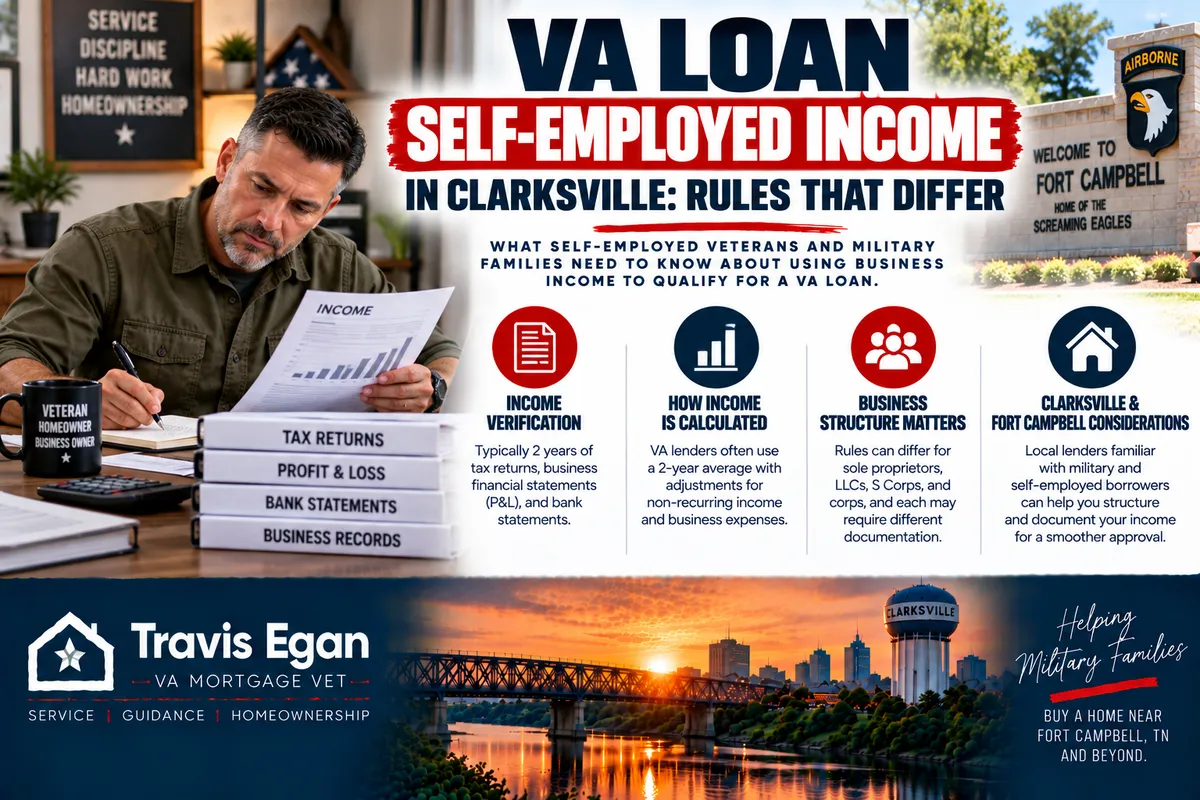
VA Loan Self-Employed Income in Clarksville: Rules That Differ
Self-employment is a normal path around Fort Campbell. Service members separate and start a company, veterans take contract work after retirement, and spouses build businesses that move with the mission. When one of those borrowers applies for a VA loan in Clarksville, the file is reviewed differently than a W-2 file, and the difference shows up in the paperwork long before it shows up at the closing table.
The short answer is that self-employed veterans can get a VA loan. VA loans will consider self-employment income as long as you can document it, show consistency, and meet the program's guidelines. The work falls into two parts: proving the income and calculating it. That is where VA loan self-employed income rules in Clarksville diverge from what a salaried buyer experiences.
Why Self-Employment Income Gets a Closer Look
Self-employment income can be less consistent than salaried income, and that inconsistency often triggers additional scrutiny from a lender. A salaried borrower is generally verified with pay stubs and W-2 forms. A self-employed borrower is verified through federal tax returns and business documents, so the underwriter reads the business's history, not just a recent pay rate.
The question under the file is simple even when the answer is not: is this income stable, documented, and likely to continue? Everything in the self-employed file supports that one conclusion. Files that answer it clearly move faster.
The Two-Year History Standard
In most cases, self-employed applicants will need two years of tax returns and other critical business documents to verify their income. That is the baseline many lenders use because two years of filings show the business is established and earnings are likely to continue.
Two years in business and two years of returns are related but not identical. A borrower who has owned a company for three years but only filed self-employment income on the last return may still have a gap to explain. Most VA lenders want two years of self-employed income to review, so a strong first year helps, but it doesn't carry the file on its own.
How Lenders Average Two Years of Income
Most VA lenders will average two years of self-employed income rather than using the most recent year alone. Averaging smooths out a single unusual year, but it also cuts in both directions. A declining year lowers the qualifying figure. A rising year can hold the qualifying figure below what the business currently earns.
This is one of the most misunderstood parts of the process for veterans who left service and grew a business quickly. Ask the loan officer how the specific lender treats the average and what documentation would support a different approach. The method matters as much as the number.
Who Counts as Self-Employed on a VA Loan
The label is broader than some borrowers expect. Business ownership, contract work, and independent trade income are usually reviewed on the self-employed side rather than the salaried side.
How you earn | How the income is usually underwritten |
|---|---|
Sole proprietor | Self-employed analysis using tax returns and business documents |
Owner with meaningful business ownership | Self-employed analysis, with business returns reviewed alongside personal returns |
Paid mainly on 1099 income | Typically underwritten as self-employed income rather than salary |
The Documents That Carry the File
Documentation is the deciding factor in nearly every self-employed approval. The standard package starts with two years of federal tax returns, including business returns if the business files separately, plus other critical documents a lender uses to verify the reported income is real and ongoing.
Two years of personal federal tax returns with all schedules.
Business tax returns for the same years if the business files its own return.
Business documentation that verifies the income reported on those returns.
1099 forms for borrowers whose income arrives mainly as contract pay.
A current profit and loss statement or similar business record when the lender requests one.
Exact lists vary by lender and by how the business is structured, so confirm the checklist with your loan officer early rather than assembling documents after an offer is accepted.
Net Income Is What Counts, Not Gross Revenue
Self-employed VA buyers still undergo a tax-return-based income analysis. That means the qualifying figure is derived from the returns, and the returns report net income after business deductions. Invoice revenue isn't the number the underwriter can use.
Veterans who run lean businesses often write off significant expenses, and those deductions lower both taxable income and qualifying income. A borrower who feels profitable month to month may look modest on paper. That gap is worth reviewing with a tax professional and a loan officer before the application is submitted, because it shapes both the price range and the strategy.
Shorter Histories and Specialized Training
Two years is the standard, not an absolute wall. Some one-year cases can work when the borrower has strong prior related work history or specialized training that supports continued income. A veteran who spent years in a technical military field and now contracts in the same field presents a stronger one-year case than a borrower who changed industries entirely.
These files require more explanation and more supporting paperwork, and the outcome depends on the lender's review. Plan for the conversation instead of assuming either answer.
What This Means for Clarksville and Fort Campbell Borrowers
Clarksville buyers connected to Fort Campbell often have easy-to-document income and a self-employed spouse whose income is not. In a community property state with a steady flow of relocating families, that mix is routine, but lenders still have to underwrite it on its own terms.
If you are moving to the area on orders and your spouse owns a business, the self-employed side of the file still has to stand alone with returns and business documents. Retirement income and disability income are evaluated under separate rules. Gather the business paperwork before house hunting so the pre-approval reflects full household income instead of only part of it.
Common Reasons Self-Employed Files Stall
Most delays come from paperwork issues, not eligibility issues. Files commonly stall when business returns are missing, when only one year of self-employed income is documented, when income has declined year over year without explanation, or when large deductions pull net income below what the borrower expected.
Deposits that don't match reported income are another common snag for contractors. The fix is preparation: know what the returns say before the underwriter reads them, and be ready to explain any year that looks different from the others.
Preparing Before You Apply
Pull two full years of personal and business returns, including all schedules.
Collect 1099 forms and business records that match the income on those returns.
Review net income rather than gross revenue to set a realistic price range.
Ask how the lender averages multiple years and what a declining year does to the file.
Get the document checklist in writing before you start touring homes.
Self-employed veterans regularly qualify for VA financing. The borrowers who move fastest treat documentation as part of the mission and hand over a complete file the first time.
Frequently Asked Questions
Can self-employed veterans get a VA loan in Clarksville?
Yes. Self-employed veterans can get a VA loan, and VA loans will consider self-employment income as long as it is documented, consistent, and meets program guidelines. Lenders review tax returns and business documents to confirm the income is stable and likely to continue. The process takes more paperwork than a salaried file, not a different loan program.
How many years of tax returns will I need?
In most cases, self-employed applicants need two years of tax returns plus other critical business documents to verify income. Most VA lenders want two years of self-employed income and will average it. A single strong year helps the file but usually does not carry it alone, so plan to supply both years.
What if my business income dropped last year?
A declining year typically lowers the averaged qualifying income, which can reduce the lender's approved price range. It does not automatically end the application. Be ready to explain the cause, provide current business records, and ask the loan officer how that lender treats the average before you commit to a purchase price.
Does 1099 income count as self-employment for a VA loan?
Usually yes. Borrowers paid mainly on 1099 income are typically underwritten with self-employed analysis rather than as salaried employees. That means the file includes tax returns and business documentation. If most of your income arrives as contract pay, expect the self-employed review even if you do not think of yourself as a business owner.
Can I qualify with less than two years of self-employment?
Sometimes. Shorter histories can work in some one-year cases when the borrower has strong prior related work history or specialized training. These files need more explanation and depend on the lender's review, so ask directly and provide documentation that connects your military background to your current business income.
Missed the last post? VA Loan Occupancy Rules: How Long Do You Have to Live There? For more on VA home loans.