
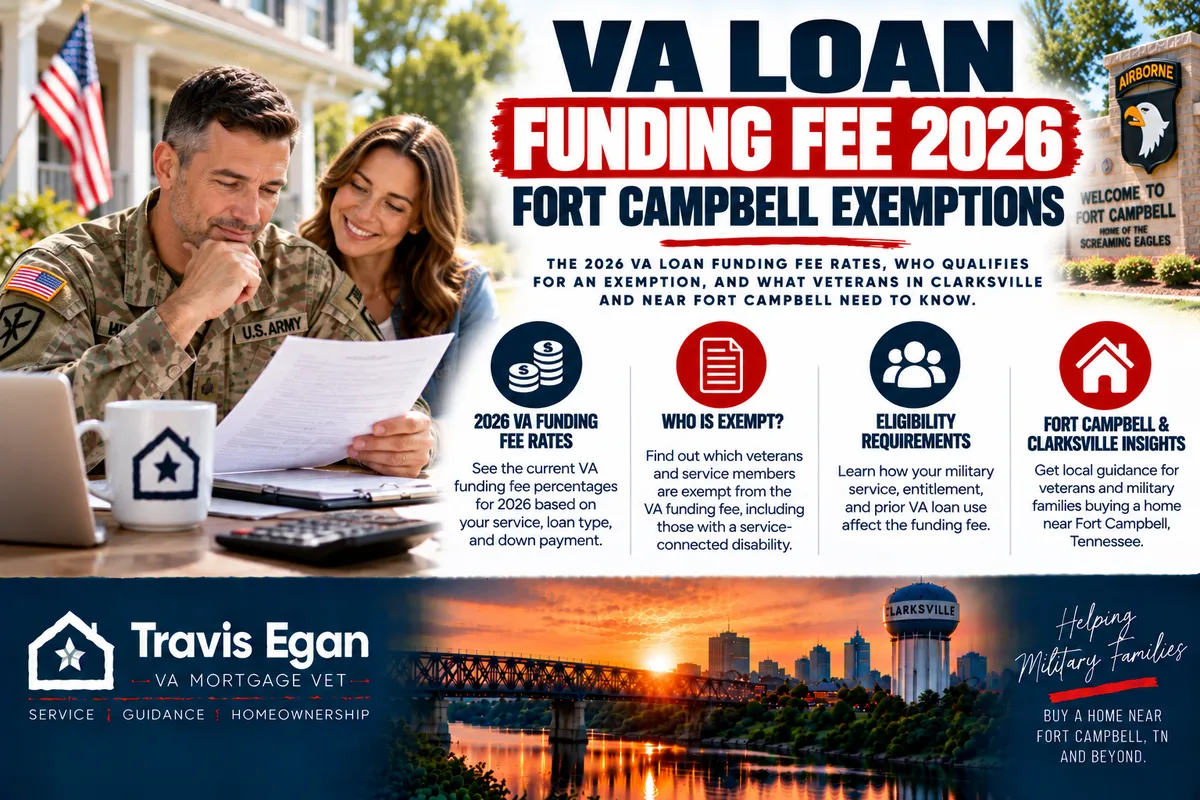
VA Loan Funding Fee 2026: Fort Campbell Exemptions
Most Fort Campbell buyers know the VA loan requires no down payment and no monthly mortgage insurance. What catches people off guard is the VA funding fee, a one-time charge the lender collects at closing. On a $190,000 loan at 1.5%, that is $2,850. Many service members don't hear this until later: a large share of veterans never pay it because exemptions wipe the fee out entirely.
Here is how the 2026 numbers work for buyers in Clarksville and the surrounding Fort Campbell area who qualify to skip the fee, and what your real options are if you don't.
What the VA Funding Fee Actually Is
According to the VA, the funding fee is a one-time payment made by the veteran, service member, or survivor on a VA-backed or VA direct home loan. It lowers the cost of the program for U.S. taxpayers because VA loans don't require a down payment and don't carry monthly mortgage insurance.
Two details matter more than most borrowers realize:
The VA charges the fee and the lender collects it, so it shows up in your closing costs, not as a separate bill mailed to you later.
The fee applies only to the loan amount, not the purchase price. A $190,000 loan at 1.5% produces a $2,850 fee, regardless of what the home sold for.
In plain terms, it is a percentage of what you borrow, calculated once, paid once. It isn't an annual charge, and it won't reappear on your monthly statement.
What Fort Campbell Borrowers Pay in 2026
The percentage varies by borrower. Published 2026 rate breakdowns show the fee stepping down as your down payment grows. These are the tiers as listed in current rate charts:
Down payment | Funding fee rate listed for 2026 |
|---|---|
Less than 5% down | 3.3% |
5% up to 10% down | 1.5% |
10% down or more | 1.25% |
Your exact category depends on your own loan amount and entitlement history, and rate charts separate first-time use from repeat use, so confirm the number that applies to you before you lock. Ask your loan officer to show the fee in writing as a dollar figure, not just a percentage, because a percent of a loan amount is easy to underestimate.
Consider what that looks like on a typical Fort Campbell purchase. At the 1.5% tier, the fee on a $190,000 loan is $2,850. On a larger loan, the same percentage costs more in dollars. That is why the exemption conversation matters so much before you start house hunting, not after you've signed a contract.
Who Is Exempt From the VA Funding Fee in 2026
Two groups are clearly identified in VA guidance and 2026 program summaries: veterans with a service-connected disability, and eligible surviving spouses. If you fall into either category, the fee does not apply to your loan.
Veterans With a Service-Connected Disability
This is the exemption most Fort Campbell borrowers ask about, and the rule is broader than many expect. The exemption applies regardless of your disability rating percentage. A 10% rating and a 100% rating both produce the same result on the funding fee: you do not pay it.
Veterans with any level of VA disability compensation are completely exempt, and the savings are meaningful. Reported figures put the typical savings at $4,300 to $10,000 on a purchase. That is money that stays in your pocket at closing or goes toward reserves, moving costs, or a rate buydown instead.
Eligible Surviving Spouses
Eligible surviving spouses are also exempt from paying the VA funding fee. If you are using a surviving spouse entitlement, document the exemption during the loan application rather than discovering it at closing, so bring it up on day one with your lender.
How Common the Exemption Really Is
Many borrowers assume the fee is unavoidable because they didn't receive a disability rating or because no one mentioned the exemption during their first VA loan. The data tells a different story. According to VA data, since 2021, more than half of veterans who obtained a VA-guaranteed home loan were exempt from paying the funding fee.
That means the exemption is not an edge case. It is close to the norm. If you have any VA disability compensation or are an eligible surviving spouse, you shouldn't pay the funding fee at closing.
How to Avoid the Funding Fee When You Do Not Have an Exemption
This is where honesty matters. All VA loans are subject to the funding fee unless an exemption or waiver applies. If you don't meet the exemption criteria, there is no legitimate workaround, lender-shopping trick, or negotiation that removes it. Any offer that claims otherwise deserves hard questions.
You can control how much the fee costs you. Three practical moves:
Confirm your exemption status early. If you have a service-connected disability rating, tell your loan officer before the file goes in. If a rating decision is in process, raise it at the start so the loan can be structured correctly instead of patched together under a deadline.
Look at the down payment tiers. Moving from under 5% down to the 5% to 10% band changes the rate. Moving to 10% or more drops it to 1.25%. On some loan sizes, the money you put down could cost less over time than the fee you avoid, but that trade-off depends on your cash reserves, so run the numbers both ways.
Ask how the fee is being collected. The VA charges it and the lender collects it. Get a written closing cost breakdown that shows the funding fee as a line item in dollars, and decide in advance whether that cash is coming from savings or being handled another way.
For PCS timelines, this planning window is short. A buyer relocating to Fort Campbell on orders may have a few weeks to sort financing. Knowing your exemption status before you make an offer is the fastest way to avoid surprises.
Is the Funding Fee Tax-Deductible in 2026?
As of 2026, the fee is also tax-deductible for eligible borrowers. The word "qualify" is doing a lot of work in that sentence. Deductibility depends on your individual tax situation, and mortgage-related deductions follow specific rules.
Treat this as a question for a tax professional who can look at your full return, not as a line item to assume. If deductibility factors into your decision, get that answer before closing rather than after you file.

Putting the Fee in Perspective for a Fort Campbell Purchase
A funding fee of a few thousand dollars feels large at the closing table, and it is a real cost worth planning for. It also sits against the backdrop of what the VA loan already saves you. There is no required down payment and no monthly mortgage insurance premium, and that mortgage insurance piece is often the bigger long-term number on a comparable conventional loan.
The practical sequence for anyone buying near post is straightforward. Find out whether your exemption applies. Get the fee quoted as a dollar amount for your specific loan. Compare the down payment tiers if you have cash available. Then build the closing costs into your budget alongside moving expenses, deposits, and the ordinary costs of settling into a new duty station.
If you are not sure where you land, that is a fifteen-minute conversation, not a mystery to solve alone in the week before closing.
Frequently Asked Questions
Does every VA loan in 2026 come with a funding fee?
All VA loans are subject to the VA funding fee, though some borrowers are entitled to a fee waiver. The fee is charged by the VA and collected by the lender at closing. Veterans with a service-connected disability and eligible surviving spouses do not pay it, which is why the exemption should be checked before you budget for closing costs.
Do I need a 100% disability rating to skip the VA funding fee?
No. The exemption applies regardless of your disability rating percentage. Whether you have a 10% rating or 100%, you do not pay the funding fee. Any level of VA disability compensation puts you in the exempt category, and the typical savings run $4,300 to $10,000 on a purchase.
Can a larger down payment lower the funding fee?
Yes. Published 2026 rate breakdowns show the fee dropping as your down payment grows: 3.3% with less than 5% down, 1.5% with 5% to 10% down, and 1.25% with 10% or more down. The exact rate depends on your loan amount and entitlement situation, so confirm your category in writing.
How many veterans actually avoid the funding fee?
More than you might expect. According to VA data, since 2021, more than half of veterans who obtained a VA-guaranteed home loan were exempt from paying the funding fee. The exemption is common, not rare, so confirm your status rather than assuming you owe it.
Can I deduct the VA funding fee on my taxes in 2026?
As of 2026, the fee is tax-deductible for eligible borrowers. Qualification depends on your individual tax circumstances, so a tax professional should review your full return. Confirm deductibility before closing if it affects your budget or your choice between loan structures.
Missed the last post? VA Loan $0 Down in Clarksville TN: Real Closing Costs. For more on VA home loans.