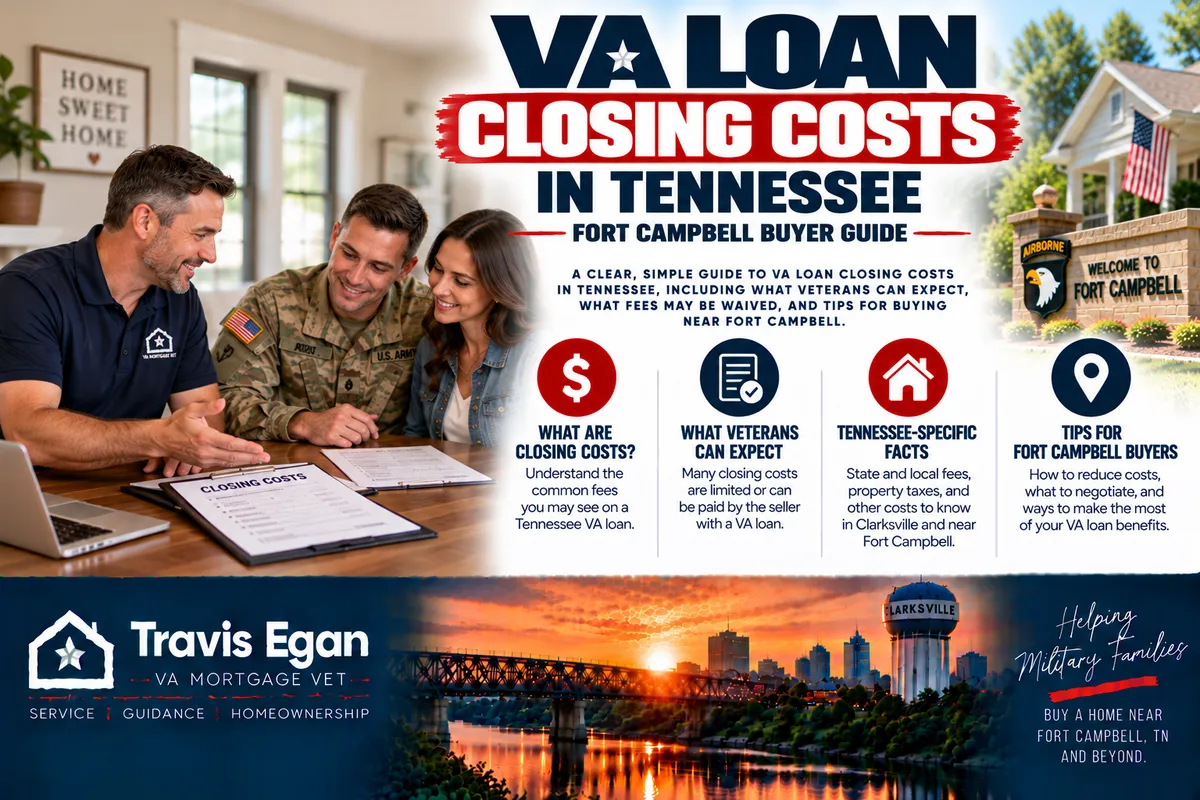
VA Loan Closing Costs in Tennessee: Fort Campbell Buyer Guide
A VA loan can let a Fort Campbell buyer buy a home with no down payment, but no down payment isn't the same as no cash. Closing costs are fees paid at or before closing, and they often catch military families off guard during a PCS move. The percentages are manageable once you know them. The trouble usually comes from not planning for them at all.
Here is what closing costs look like on a VA loan in Tennessee, where the money goes, and how to build them into a budget that already includes a move and a timeline.
What Closing Costs Actually Are
Closing costs include a variety of fees paid at or before closing on a home loan. They are separate from your down payment and cover the work that must happen before a lender will fund the loan. Some of that money goes to the lender. Some goes to outside companies handling title work, the appraisal, and government recording. Another portion covers items that have to be paid up front, such as interest and insurance.
The mix differs by lender and by property, which is why a written, itemized estimate matters more than any single rule of thumb. Ask for that list early, before you fall in love with a house.
Typical VA Loan Closing Cost Ranges
VA closing costs typically run between 3 and 5 percent of your loan amount, but the actual figure varies by the home's location and price. Broader closing cost averages sit lower, generally between 1.5 and 2.5 percent of the total loan amount. In Tennessee, published figures put the average at about $3,120 for a $200,000 mortgage.
Reference point | Typical range or figure | How to use it |
|---|---|---|
VA loan closing costs | 3% to 5% of the loan amount | Budgeting range for VA buyers |
Average closing costs across loan types | 1.5% to 2.5% of the loan amount | General benchmark for comparison |
Tennessee average | About $3,120 on a $200,000 mortgage | State-level reference point |
Those ranges are not measuring the same thing, so treat them as guardrails rather than a quote. If the numbers land in different places, plan with the higher one. As your loan amount grows, the dollar figure grows with it even when the percentage holds steady.
The Line Items Behind the Total
When the estimate arrives, it will read like a list of names you have never heard. Sort them into groups and the page gets easier to read.
Lender costs. Loan origination fees are the lender's charge for taking the application, processing it, and getting it to the closing table.
Third-party costs. Title work, the appraisal, and government recording fees are paid to the companies and offices that do those specific jobs.
Prepaid items. Interest owed before your first payment, the first year of homeowner's insurance, and deposits that fund your escrow account for taxes and insurance.
Some of these items are fixed by the parties performing the work. Others may be negotiable depending on the lender and the transaction, so ask which is which instead of assuming the whole list is untouchable.
Do Not Confuse Cash to Close With Your Monthly Payment
Payment estimates and closing cost estimates answer two different questions, and mixing them up is a common source of stress. A sample VA loan closing cost calculator lists principal and interest at $2,556, property taxes at $525, home insurance at $192, HOA fees at $0, and a total monthly payment of $3,273. That is your monthly obligation.
Closing costs are a one-time amount due at closing. Taxes and insurance also appear there in advance because the lender collects an initial balance for the escrow account. That means a buyer can look at a $3,273 monthly payment, feel comfortable, and still be short at the closing table if nobody walked them through the cash side of the transaction.
Why Fort Campbell Buyers See Different Numbers
VA closing costs vary by the home's location and price, and the area around Fort Campbell brings both variables into play. Each property brings its own title situation and any HOA obligations.
Price movement matters as much. The same percentage applied to a larger loan amount produces a larger dollar figure, so a buyer stretching into a bigger house should expect the closing cost line to stretch with it. Location and price, not luck, explain most of the gap between one buyer's total and another's.
How Much Should a Buyer Set Aside?
Start with the VA range of 3 to 5 percent of the loan amount and treat the top of it as your working number. That leaves room for variability in location and price without leaving you scrambling the week before closing.
Then pressure test it. Ask your loan officer for an itemized estimate based on a specific price point and a specific address, since general averages cannot account for one property's title work or insurance quote. Compare estimates from more than one lender on the same property, and ask directly which fees can be negotiated and which are set by outside parties.
Buyers who receive a written estimate early have time to adjust. Buyers who see the number for the first time at closing have no options.

Where a VA Specialist Helps
Closing costs on a VA loan are not complicated once they are laid out clearly, and that is the entire job. Travis Egan is a VA mortgage specialist and Marine Corps veteran based in Clarksville, serving active-duty service members, veterans, and military families connected to Fort Campbell. He focuses on VA purchase loans with $0 down, PCS relocation support, and fast approval timelines through his affiliation with Loan Factory.
Buyers who want a head start can use the site's mortgage calculators, including the rent versus own, refinance, affordability, and VA residual income tools, or request the free VA Homebuyer's Guide. Getting an itemized closing cost estimate before you start touring homes is the simplest way to keep a PCS move on schedule and avoid surprises at the closing table.
Frequently Asked Questions
How much are VA loan closing costs in Tennessee?
VA closing costs typically range from 3 to 5 percent of the loan amount, and the figure varies by the home's location and price. Published Tennessee data puts average closing costs around $3,120 for a $200,000 mortgage. Ask your lender for an itemized estimate on the specific property you are considering rather than relying on a state average.
Are closing costs the same thing as a down payment?
No. A down payment reduces the amount you borrow. Closing costs are a separate group of fees paid at or before closing for services like loan origination, title work, the appraisal, and prepaid interest and insurance. A VA loan can require no down payment while still carrying closing costs that must be paid in cash.
Why do closing costs differ from one Fort Campbell home to another?
VA closing costs vary according to the home's location and price. Two properties can have different tax and insurance costs, title work, and association obligations. A higher purchase price also produces a higher dollar amount when the same percentage is applied, so the estimate should always be tied to a specific address.
What is included in the closing costs on a VA loan?
Closing costs cover a variety of fees paid at or before closing. Lender costs include loan origination fees. Third-party costs go to the companies handling title work, the appraisal, and recording. Prepaid items include interest due before your first payment, the first year of homeowner's insurance, and deposits that fund your escrow account.
When should I ask for a closing cost estimate?
Ask before you start shopping seriously. An itemized estimate tied to a realistic price point tells you how much cash to have ready. It gives you time to compare lenders on the same property—waiting until the closing disclosure arrives leaves very little room to adjust a budget that already includes a move.
Missed the last post? Do I Need a Realtor to Use My VA Loan? For more on VA home loans.