
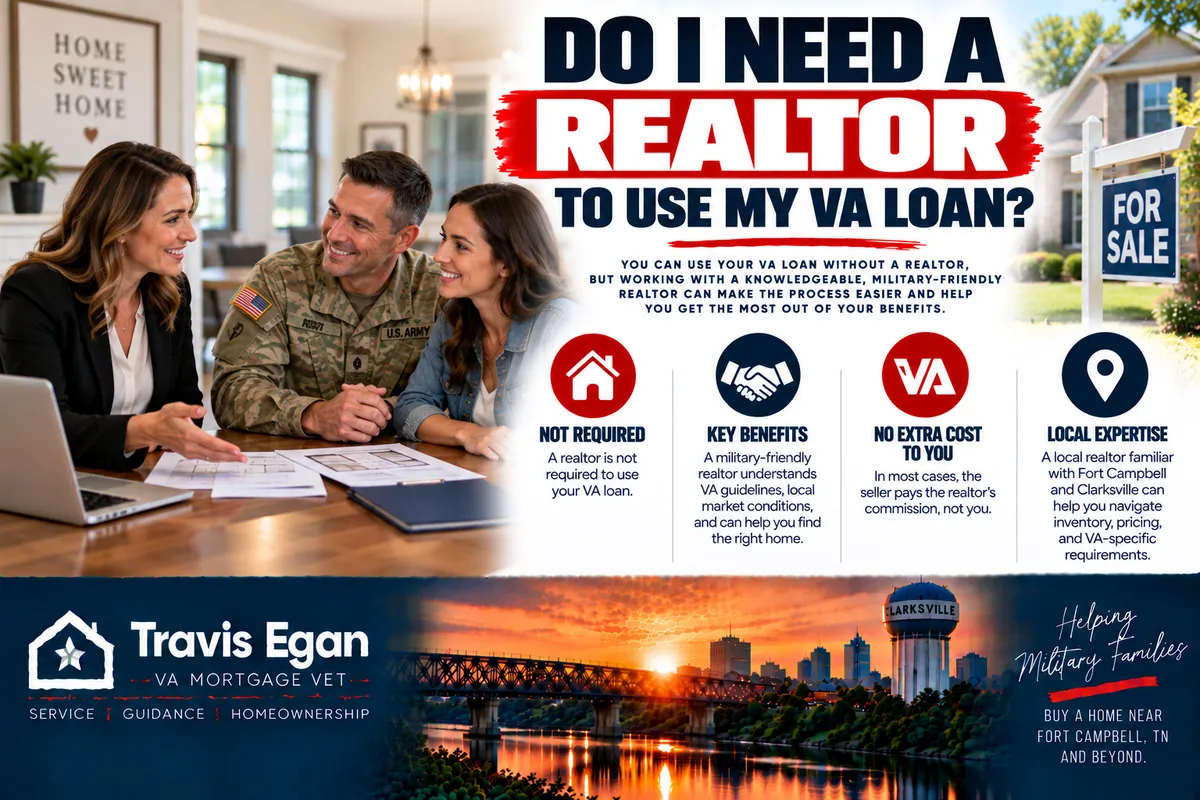
Do I Need a Realtor to Use My VA Loan?
No, you are not generally required to use a Realtor or a real estate agent to buy a home with a VA loan. A VA borrower can purchase a home without an agent, including in a for-sale-by-owner transaction. That said, VA-financed purchases involve appraisal requirements, property condition standards, contract negotiations, closing costs, seller concessions, and timelines that many buyers have never handled before. An experienced buyer's agent can carry much of that weight, especially for a first VA purchase or a purchase made from another state during a PCS move.
The short answer is that representation is a choice, not a loan condition. The longer answer is about what that choice costs you in time, risk, and leverage.
Do I Need a Realtor for a VA Loan?
The VA loan program itself does not require a buyer to be represented by a Realtor or a licensed real estate agent. Your lender generally doesn't require one either. The loan is approved based on your eligibility, your finances, and the property, not on who helped you find the house.
The program does require a transaction that meets VA and lender standards. That includes an appraisal, property condition standards, title work, and a contract that satisfies state requirements. Someone has to manage those pieces. In most purchases, a buyer's agent handles that and works alongside the loan officer, the title company, and the listing side.
Many loan officers and agents suggest talking to a lender before you talk to an agent. That order makes sense because a lender can tell you what you qualify for and flag entitlement or income questions before you start touring homes. It does not lock you into any agent.
Realtor vs. Real Estate Agent: A Quick Distinction
Realtor is a professional designation, not a synonym for every licensed agent. A Realtor is a licensed real estate professional who belongs to the National Association of Realtors and agrees to its code of ethics. Plenty of licensed real estate agents are not Realtors.
Practically, the label matters less than the person's track record with VA financing. When you interview agents, ask how many VA transactions they have closed and how recently. Some buyers specifically look for an agent who is a veteran or who has personally used a VA loan, though that is a preference rather than a requirement.
What a Buyer's Agent Actually Does in a VA Purchase
The job goes well beyond opening doors. On a VA purchase, a buyer's agent typically handles search work, paperwork, negotiation, and coordination.
Helping you find properties that fit your budget, commute, and timeline, including homes likely to meet VA property standards.
Writing and negotiating the offer, including price, closing cost assistance, seller concessions, repair requests, and contingency periods.
Coordinating inspections and helping you interpret what the inspection report means for your decision.
Helping manage appraisal-related issues, including communicating with the lender and the listing side when the appraisal comes back with conditions or a value question.
Communicating with the lender, title company, and other parties to keep documents and deadlines on track.
Tracking contractual deadlines and reminding you what is due, when, and to whom.
Transaction task | With a buyer's agent | Buying without an agent |
|---|---|---|
Property search | Agent filters listings and flags likely VA issues | You research and screen homes yourself |
Offer and negotiation | Agent drafts terms and negotiates on your behalf | You draft and negotiate directly with the seller |
Inspections | Agent schedules and helps interpret results | You schedule and interpret results |
Appraisal issues | Agent coordinates between lender, appraiser, and seller | You coordinate every party yourself |
Deadlines and closing | Agent tracks dates and pushes the file forward | You track dates and chase documents |

Does Using an Agent Change VA Loan Eligibility?
No. Using an agent does not change your VA loan eligibility in either direction. Hiring a buyer's agent doesn't make you more qualified, and skipping one doesn't make you less qualified.
Eligibility still rests on the same ground whether an agent is involved or not. You must meet VA and lender requirements for eligibility and entitlement, income, credit, occupancy, and the property itself. The property must satisfy VA appraisal and property condition standards. A real estate agent can help you prepare for those requirements, but the agent does not approve loans, calculate entitlement, or decide whether a home passes.
Can I Buy a Home With a VA Loan Without a Realtor?
Yes, a buyer may be able to purchase a home with a VA loan without an agent, including in a for-sale-by-owner transaction—nothing about the financing blocks that path. The tradeoff is workload and risk.
Without representation, you take on more responsibility for the purchase contract, negotiations, deadlines, inspections, appraisal issues, title coordination, and closing logistics. You also read disclosures and ask the seller's side the questions an agent would normally ask. That is manageable for a buyer who already knows the local market and the VA process. It is harder for a first-time buyer, a buyer shopping from another state, or a buyer on a compressed PCS timeline.
For-Sale-by-Owner Transactions and VA Loans
A seller who is not represented by an agent does not prevent you from using a VA loan. FSBO sellers can and do accept VA offers. The transaction still has to meet VA, lender, title, appraisal, and state requirements, and those requirements don't relax just because no agent is on the listing side.
In practice, an FSBO purchase usually means more direct communication with the seller and more paperwork falling to you, the title company, and your loan officer. Confirm early that the seller is willing to work through the VA appraisal process and any repair conditions the appraisal may generate. If either side is represented, make sure everyone knows who is communicating with whom.
VA Appraisal and Minimum Property Requirements
VA loans require an appraisal, and it must address property condition through the VA's Minimum Property Requirements. Those requirements confirm a home is safe, structurally sound, and sanitary enough to finance. A home that looks fine to a buyer can still come back with appraiser conditions.
An agent who understands VA transactions can help you spot obvious property-condition concerns before you spend money on inspections, the appraisal, and other transaction costs. That is screening, not approval. A real estate agent isn't the appraiser and doesn't determine whether a home meets VA requirements. Only the assigned appraiser and the lender's review process make that call. The agent's value is in helping you avoid obvious trouble and in responding quickly when the appraisal raises an issue.

VA Offer Strategy and Competing With Other Buyers
An experienced agent can help you structure an offer, negotiate seller-paid costs when appropriate, and respond to appraisal issues without panicking. That includes knowing when to ask for closing cost assistance, how to frame repair requests, and when to hold firm.
There is also a myth worth putting down. A VA offer is not automatically weaker than a conventional offer. Well-prepared VA offers win in competitive situations every day. An offer weakens when the contract is vague, the buyer is unprepared, or an agent on either side doesn't understand the appraisal process. An agent who has closed VA transactions can present your offer confidently and answer a listing agent's questions instead of leaving them unresolved.
Buyer-Agent Compensation and Representation
Compensation and buyer-representation agreements may vary by brokerage, market, transaction, and state. No single rule applies everywhere, and you should not assume the seller always covers your agent's fee or that a VA borrower will never have any agent-related costs.
Before you sign anything, read the representation agreement and ask how the compensation structure works. Ask who pays what, what happens if the seller offers nothing toward your agent's compensation, and whether any amount could land on your side of the settlement statement. If a number is unclear, get it explained before you sign and confirm it with your loan officer so it lines up with your loan estimate and your available funds.
Can My Lender Recommend a Real Estate Agent?
You can ask your lender, your military community, friends, family, or local professionals for referrals, and many buyers do. You are free to choose your own agent, and nothing requires you to use an agent who is affiliated with or recommended by your lender.
A referral is a starting point, not an obligation. Interview more than one agent, ask about VA experience and recent closings, and pick someone whose communication style fits the way you work. If you are buying near Fort Campbell or anywhere else around a military installation, ask directly about PCS timelines and out-of-state buyers.

What Should I Look for in a Realtor for a VA Loan?
Look for experience with VA financing first, then fit. A short list of things to evaluate:
VA experience: how many VA purchases they have closed and how recently.
Appraisal and property requirement knowledge: they can explain what commonly triggers conditions and how they respond.
Military PCS familiarity: they understand compressed timelines, remote house hunting, and closings that have to line up with orders.
Lender communication: they answer the loan officer, send documents, and flag problems early.
Local market knowledge: pricing, neighborhoods, and what your budget actually buys.
Experience with active-duty buyers purchasing from another state or while deployed, including video tours and remote document signing.
Three Scenarios Worth Comparing
A first-time VA buyer using an experienced agent
A first-time buyer with no transaction history behind them usually benefits most from representation. The agent screens listings for obvious property condition problems, explains the appraisal process, tracks deadlines, and keeps the lender and title company moving. The buyer still makes the decisions and handles the disclosures, but the process is structured for them rather than left to trial and error.
A buyer purchasing from out of state during a PCS move
A buyer relocating on orders often shops a market they have never lived in, on a timeline they don't fully control. An agent who works with military families can arrange video walkthroughs, coordinate inspections, and flag properties that may struggle with the VA appraisal before the buyer commits. The lender and agent both need to be reachable and responsive, because the closing date is often tied to a report date.
A buyer who goes without an agent on a FSBO purchase
A confident buyer who knows the market can absolutely buy a FSBO home with a VA loan and no agent. The work shifts onto them: drafting the contract, negotiating repairs, tracking deadlines, coordinating with the appraiser, and pushing title and closing forward. That path can work well, but it can also stall when an appraisal condition comes up, and no one is sure who should call whom.
Frequently Asked Questions
Do VA loans require a real estate agent?
No. The VA loan program doesn't require a buyer to use a Realtor or licensed real estate agent, and your lender generally doesn't require one either. You can buy with a VA loan without representation, including from a for-sale-by-owner seller, though you take on more of the contract, appraisal, and closing work yourself.
Can I use a VA loan to buy a for-sale-by-owner home?
Yes. A seller who is not represented by an agent does not prevent you from using a VA loan. The transaction still needs to satisfy VA, lender, title, appraisal, and state requirements. Confirm early that the seller will work through the appraisal process and any repair conditions that come out of it.
Does using a Realtor change my VA loan eligibility?
No. Representation has no effect on eligibility. You still must meet VA and lender requirements for eligibility and entitlement, income, credit, occupancy, and the property itself, including VA appraisal and property condition standards. An agent can help you prepare for those requirements but does not approve the loan or decide whether a home qualifies.
Can my lender tell me which agent to use?
Your lender can offer referrals, and you can ask for them. Your lender cannot require you to use a specific agent or one affiliated with the lender. Treat every referral as a suggestion, interview a few agents, and evaluate their VA experience before you commit to a representation agreement.
Should I talk to a lender or an agent first?
Many loan officers and agents suggest starting with a lender. A lender can review your eligibility, entitlement, income, and credit before you start touring homes, which makes your search more focused. That conversation does not obligate you to use any particular agent, and you can still choose your own representation afterward.
Missed the last post? VA Loan Home Requirements in Clarksville: Room Checklist. For more on VA home loans.