
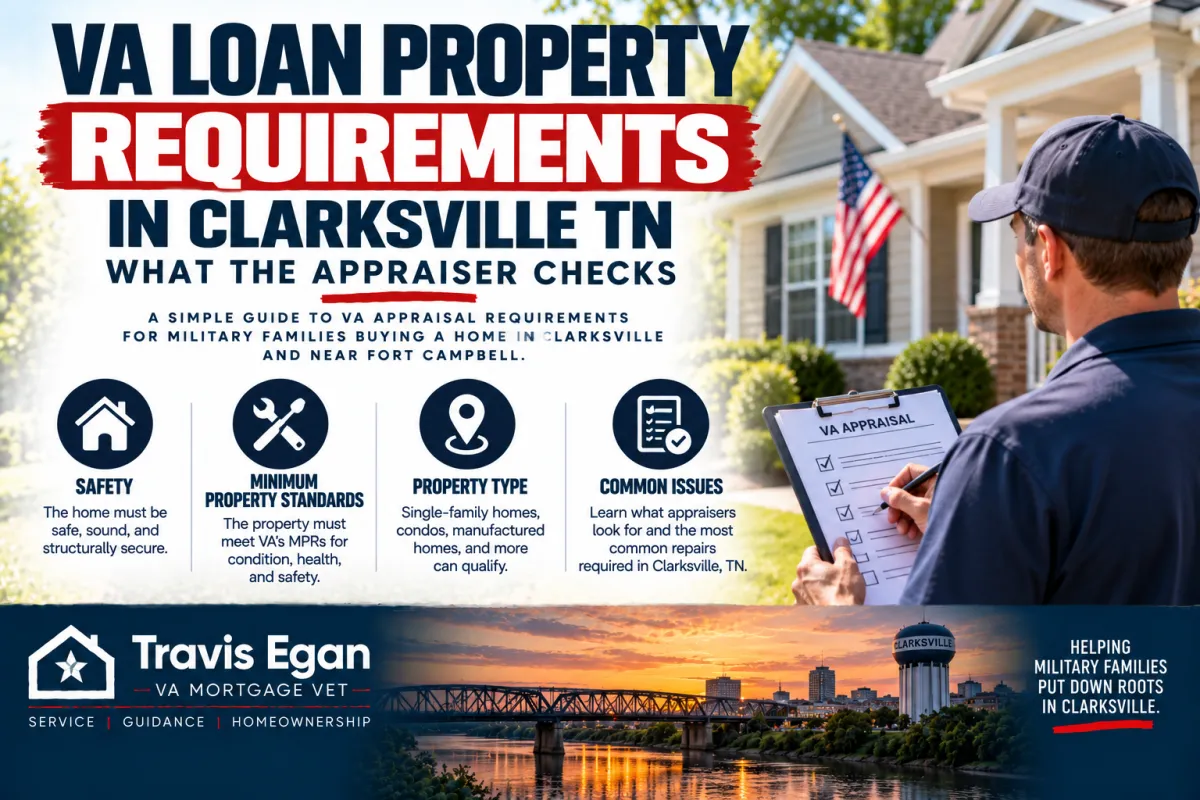
VA Loan Property Requirements in Clarksville TN: What the Appraiser Checks
Buying a home near Fort Campbell with a VA loan comes with a benefit set that is hard to match. The Department of Veterans Affairs outlines no down payment, no mortgage insurance, and favorable loan terms. What surprises plenty of first-time VA buyers is the second half of the process: the house has to qualify too. VA appraisals and property requirements are stricter than conventional loans, and for first-time users, that checklist can feel like a lot. Here is a plain look at what the appraiser reviews, why VA Minimum Property Requirements exist, and how the pieces fit together for a Clarksville closing.
Why the VA Has Its Own Property Standards
Most loan programs care about two things. They want to know whether you can repay the loan, and whether the home is worth what the seller is asking. The VA adds a third layer. Because the VA is backing the loan, it also wants reasonable confidence that the home is a place a veteran can actually live in. That is where Minimum Property Requirements come in.
This is why a home that sails through a conventional loan can stall on a VA loan. Conventional guidelines leave more room for a buyer to accept a property as-is and deal with problems later. VA guidelines put the property's condition front and center in the approval process. VA appraisal and property requirements are stricter than conventional loans, and that difference catches first-time VA loan users off guard more often than almost any other part of the process.
The practical takeaway is simple. The appraisal is not a formality you schedule after you have already committed emotionally to a house. It is a decision point, and you should treat it that way from the first showing.
What Minimum Property Requirements Actually Mean
VA loans have their own standards, known as Minimum Property Requirements. The property must provide suitable utilities, such as electricity. That single example says a lot about the spirit of the rules. They are not about style, finishes, or whether the kitchen has the countertops you want. They are about whether the home functions at a basic level.
The full set of Minimum Property Requirements is longer than one example, and the VA maintains it rather than your lender. If you want the definitive list that applies to your situation, pull it directly from official VA guidance and have your loan officer walk your specific property through it. Anyone who tells you the checklist is short, static, or easy to memorize is skipping a step.
What the Appraiser Is Reviewing
Wording matters here. The VA is not sending an inspector to grade your future home. The appraiser assigned to the case produces the report the VA relies on, and that report is where property condition observations land. If something does not satisfy Minimum Property Requirements, it typically shows up there first.
Utilities and Basic Liveability
Utilities are the clearest example in the standards. A property that does not provide suitable utilities, such as electricity, will not satisfy the VA. In practical terms, the appraiser is checking whether the systems that make a house work are present and functioning. That is a low bar in a well-maintained home and a genuine obstacle in a property that has sat vacant or been stripped of fixtures.
Condition Items That Tend to Surface
Condition concerns cluster around the parts of a home that affect safety and function rather than cosmetics. Instead of guessing at what your appraiser will flag, ask your loan officer for the current list of items that require attention, then walk the property with that list in hand before you make an offer. It is far cheaper to ask questions before the offer than after the report comes back.
Questions to Ask Before You Write an Offer
Has this property been under contract before with a VA buyer, and if so, what came up?
Are the utilities active and connected so the appraiser can confirm they function?
Does the seller have documentation for recent work on major systems?
Is the seller willing to complete required repairs before closing?
How long does the appraisal order, completion, and review typically take in this market?
An Appraisal Is Not a Home Inspection
These two get blended constantly, and the mix-up costs buyers real money. A VA appraisal is a piece of the loan process. A home inspection is a separate product that you hire and pay for, and it looks at the house far more closely than a loan-driven appraisal ever will. Plenty of Clarksville buyers order both.
Skip the inspection, and you may learn about a failing system after closing instead of before it. Inspection findings do not automatically become VA requirements, but they do give you information and negotiating leverage while you still have options.
When the Appraiser Requires Repairs
A flagged item does not always end the deal. It does change the timeline and the conversation. In most transactions, the seller either completes the work before closing or the parties renegotiate. The specifics depend on your purchase contract and on what the repair actually involves, so treat any confident claim about who pays as a contract question for your real estate agent and lender rather than a fixed rule.
Build slack into your schedule if the home is older or shows deferred maintenance. Appraisal conditions can add days to closing, and a compressed PCS timeline leaves little room to absorb delays.

Clarksville and Fort Campbell Timing
Clarksville sits right beside Fort Campbell, which means many local VA buyers are working against a report date rather than a leisurely house hunt. That compresses everything: the search, the offer, the appraisal, and the repair conversation, if needed.
Talk to your lender about sequencing before you tour homes. Knowing when the appraisal gets ordered and how long the review takes lets you choose a target closing date you can actually hit, not one you hope for.
Property Types and Acreage: Questions That Need Direct Answers
Property type and acreage questions come up constantly, and this is where buyers should go to the source. Whether a VA loan has an acreage limit, which property types are eligible, and what disqualifies a house from VA financing all depend on current VA guidance and the specifics of the property in question. A condo, a farm, and a home on several acres each raise different issues. Confirm the answers for your property with your lender and official VA resources before you make an offer, not after.
The Funding Fee Exemption Worth Knowing
Property requirements get most of the attention, but the funding fee deserves a mention. Veterans rated 100% permanent and total are exempt from the VA funding fee. On a $400,000 house, that exemption is worth more than $8,000 that other buyers would finance on top of the loan. If you are unsure where you stand, confirm your status with your lender and the VA rather than assuming either way.

Local Help With VA Loan Property Requirements
Travis Egan is a VA mortgage specialist and Marine Corps veteran based in Clarksville, serving military families, active-duty service members, and veterans connected to Fort Campbell. Through Loan Factory, he works with VA purchase loans, IRRRL refinances, and $0 down options, as well as conventional, FHA, and USDA programs. He also offers a free VA Homebuyer's Guide and mortgage calculators covering rent versus own, refinance, affordability, net proceeds, and VA residual income. For families moving on orders, the PCS relocation support is built around that timeline.
Frequently Asked Questions
Does a VA appraisal replace a home inspection?
No. They are separate products. The appraisal supports the loan decision and reviews the property against VA Minimum Property Requirements. A home inspection is a more detailed, buyer-paid evaluation of the home's systems and structure. Many buyers order both, and the inspection often surfaces findings the appraisal was never designed to catch. Ask your lender and agent to help you schedule them so the timelines do not collide.
What happens if the appraiser flags a repair?
The item usually has to be addressed before the loan can close, and how that plays out depends on your contract. In many cases, the seller completes the work, or the parties renegotiate price or credits. Because the answer depends on the specific repair and your purchase agreement, talk with your real estate agent and loan officer as soon as you note a condition.
Are there acreage limits on VA loans?
Acreage limits come up often, and the honest answer is that it depends on current VA guidance and the property itself. The same goes for which property types are eligible and what might disqualify a home from VA financing. Rather than rely on secondhand answers, confirm the details for your specific property with your lender and official VA resources before you write an offer.
Do veterans with 100% permanent and total ratings pay the VA funding fee?
Veterans rated 100% permanent and total are exempt from the VA funding fee. That matters because the fee is otherwise financed on top of the loan. On a $400,000 home, the exemption is worth more than $8,000. Confirm your rating status and documentation with your lender and the VA, so they apply the exemption correctly at closing.
What income do I need to afford a $500,000 house with a VA loan?
It depends on factors specific to your file, including your debts, credit profile, residual income, and the property's taxes and insurance. Two buyers with identical salaries can qualify for very different amounts. The best next step is to run your numbers with a VA-focused loan officer who can give you a real answer instead of a rule of thumb.
Missed the last post? Is a VA Loan Worth It? Benefits, Drawbacks, and Comparisons. For more on VA home loans.