
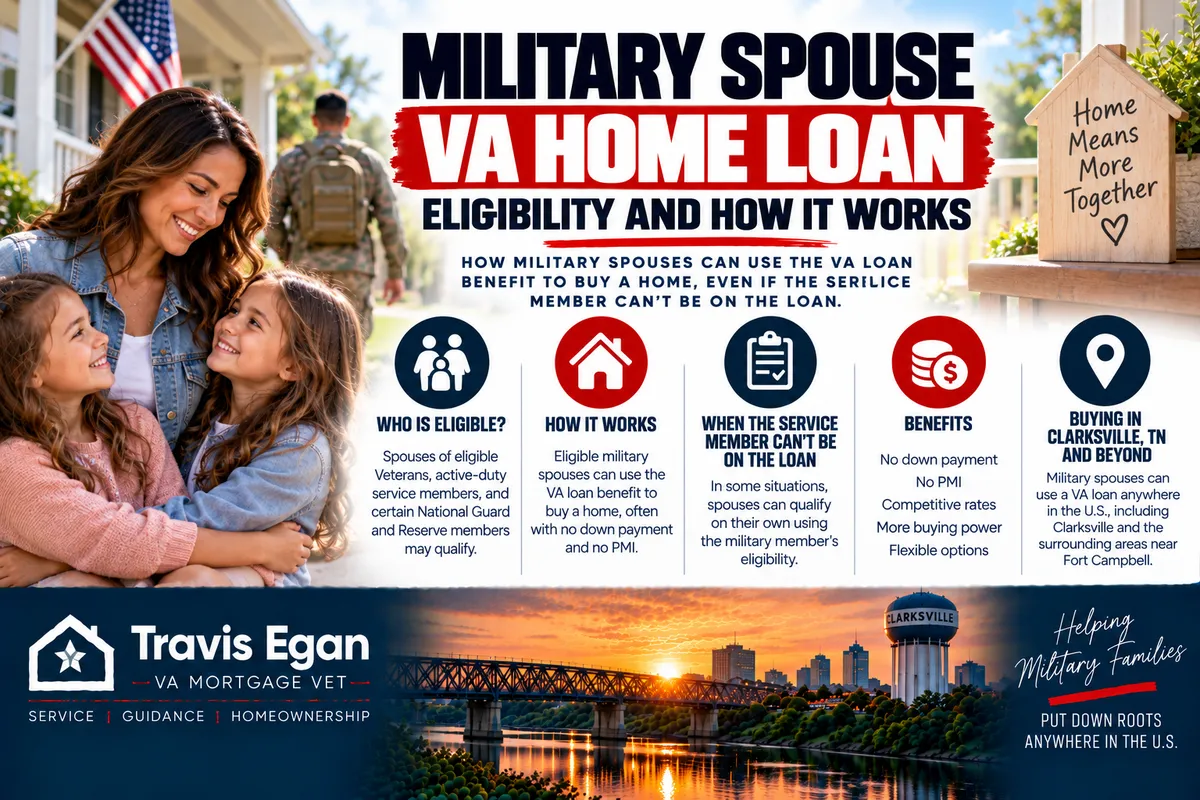
Military Spouse VA Home Loan: Eligibility and How It Works
Marriage to a service member or veteran does not automatically give a military spouse independent VA home loan eligibility. The VA home loan is a government-backed mortgage available to eligible service members, veterans, and qualifying surviving spouses, and the benefit belongs to the person who earned it rather than transferring through a wedding certificate. In most cases, the eligible service member or veteran must be part of the loan. There is one real exception: certain surviving spouses may qualify for VA home loan benefits in their own right if they meet VA eligibility requirements. Nearly every other question about spouse income, credit, and occupancy follows from that distinction.
Military Spouse VA Home Loan: How Does It Work?
The VA home loan is a government-backed mortgage available to eligible service members, veterans, and surviving spouses. That list is the starting point for every conversation about a military spouse VA home loan. If your spouse served and qualifies, the loan is built on their entitlement, not yours. You can absolutely be part of the purchase, live in the home, and be on the title, but the VA guaranty itself comes from the service member or veteran on the application.
There are two situations people tend to blur together, and separating them makes the rest of the process much clearer:
You are married to an eligible service member or veteran. In this case, the VA loan is theirs. You participate in the purchase through the loan structure and household finances, not through your own VA entitlement.
You are a surviving spouse who meets VA requirements. In this case, you may have independent VA loan eligibility and can apply in your own name.
Being Married to an Eligible Service Member Is Not the Same as Having VA Eligibility
VA eligibility is tied to service. A veteran's basic entitlement is $36,000, with additional entitlement available depending on the situation, and the VA issues a Certificate of Eligibility to confirm what a borrower actually has. Nothing in that process transfers to a spouse simply because you are married. A military spouse is not part of the group the VA considers eligible for a standard VA-backed purchase loan.
This matters most when a family assumes both spouses are interchangeable on the application. They are not. If your spouse is alive and has entitlement, the loan still depends on them being the eligible borrower on the file. You do not gain eligibility by marriage, and you do not lose anything by being on the loan as a non-eligible co-borrower when the lender and the transaction allow it.
How Married Couples Commonly Use VA Financing Together
In practice, most military families buy with the eligible service member or veteran as the VA borrower on the application. The spouse may also be included on the mortgage, depending on the transaction, the lender, state law, income, credit, and how the loan is structured in underwriting. Some couples apply jointly. Others keep the VA loan in the veteran's name alone and add the spouse to the title, which in many states is allowed even when that spouse is not a borrower, though state law and lender practice vary.
The choice is not cosmetic. Who appears on the application changes which income counts, which debts are weighed, and how the file is underwritten. Ask your loan officer to walk through both versions before you commit, because the difference can decide whether you qualify for the home you want.
Situation | Who holds the VA eligibility | Can the spouse be on the loan |
|---|---|---|
Married to an eligible active-duty service member or veteran | The service member or veteran | Often, depending on the transaction, lender, state law, income, credit, and underwriting. |
Married, spouse not included as a borrower | The service member or veteran | Not as a borrower; may still be added to title depending on state law |
Qualifying surviving spouse | The surviving spouse, if VA requirements are met | Not applicable; the surviving spouse applies in their own right |
Spouse Income on a VA Loan
A spouse's income may potentially be used to help qualify for the mortgage when the spouse is included appropriately in the loan. That single sentence answers a lot of questions, but the "included appropriately" part is where the details live. If you are a borrower on the application, your income can typically be counted toward the debt-to-income calculation. If you are not on the application, your income generally cannot be used to help the household qualify.
Lenders look at more than a paycheck amount when they evaluate income:
Employment history, including how long you have held the current role and whether the field is consistent
Income stability, since salary, hourly, self-employed, contract, and commission income are all reviewed differently
Existing debts in your name and the minimum payments attached to them
Credit history and scores for every borrower on the file
The overall structure of the loan and which borrowers are tied to it
One common surprise for military families: depending on state law and the lender's guidelines, the debts of a spouse who is not on the loan can still be reviewed as part of the file. That means staying off the application does not always remove your financial profile from the conversation. It is worth asking directly how your debts will be treated if you are not a borrower.
Spouse Credit and Debts
VA eligibility does not override normal mortgage underwriting. The VA guarantees a portion of the loan, but the lender still applies its own standards for credit, income, assets, and debt. If you are part of the transaction, your credit profile and debts matter. A strong entitlement on one side of the marriage does not erase a thin credit file or a heavy debt load on the other.
A few practical points that come up often:
Lenders typically review every borrower on the application and generally use the lowest middle score among borrowers.
Large monthly obligations such as car loans, student loans, and credit card minimums reduce how much house the household can qualify for.
New debt opened during the process, including a car purchase or furniture financing, can change the file before closing.
Credit report errors are common and worth disputing early, not the week before closing.
If your credit needs work, address it months before you start touring homes. Paying down revolving balances, avoiding new accounts, and keeping documentation of any disputes can all help. Your loan officer can usually tell you which items are actually affecting approval, not just which ones look untidy on paper.

PCS Moves and Military Spouse Employment
Relocation is the hardest part of military life to plan around, and it hits spouse income directly. A permanent change of station often means leaving a job, arriving in a new market, and starting over in ways that never show up on a salary sheet. Lenders aren't unsympathetic, but they do need a file that makes sense on paper.
Remote Work
Remote employment is the cleanest scenario for a PCS purchase. If you keep the same employer and pay while your physical location changes, your income history stays continuous, which underwriters prefer. Keep your offer letter or employment agreement, pay stubs, and a letter from your employer confirming that you remain employed and can work from the new location. Some employers adjust pay based on location, so it helps to confirm in writing whether your salary stays the same.
Job Transfer or a New Position at the New Duty Station
A transfer within the same company is smoother than a new employer because your employment history remains unbroken. Starting a new position at the new duty station is workable too, but timing matters. A signed offer letter with a start date, pay rate, and hours can carry weight, particularly when the start date falls before or near the closing date. Ask your loan officer what documentation they want and how far in advance they need it.
Temporary Unemployment and Leaving a Job Because of PCS Orders
Gaps happen. A spouse may leave a position, move across the country, and take a few months to find the right role at the new duty station. Lenders will ask why the gap exists, and PCS orders document it. Because the rules aren't automatic, discuss the gap with your loan officer before you apply, rather than hoping it goes unnoticed. Document the orders, the move dates, and any pending job offers or remote arrangements.
Occupancy Requirements on a VA Purchase Loan
VA-backed purchase loans are intended for a primary residence. The borrower is expected to occupy the home, and that intent is part of what the VA guaranty supports. VA financing can be used within the United States and its territories, including Puerto Rico and the Northern Mariana Islands. Still, it is not designed for a property the borrower never intends to live in.
Military families face occupancy complications that civilian buyers rarely encounter. Deployment can send a service member overseas before closing. PCS timing can mean the family arrives weeks after the paperwork is signed. A duty assignment may keep the service member elsewhere while the family settles into the new home. Under certain military circumstances, VA rules allow a spouse to satisfy the occupancy requirement, and lenders are familiar with these situations. That is not the same as saying a spouse's occupancy always satisfies the requirement. It depends on the specific rules that apply to your circumstance, your orders, and how the lender interprets the file.
Do not leave this to assumption. Describe your timeline to your loan officer in detail, ask them to confirm in writing how you'll satisfy occupancy, and keep copies of your orders. Getting this wrong after closing is far more painful than getting a straight answer beforehand.

Can a Military Spouse Get a VA Loan Without the Service Member?
Being a military spouse alone generally does not make you eligible for a VA home loan. In most cases, the VA loan is for veterans and active-duty service members, and marriage doesn't move a spouse into that group. If your spouse is alive and eligible, the VA loan depends on their participation as the eligible borrower. There is no application path for a spouse to borrow on a living service member's entitlement in their own name.
Qualifying Surviving Spouses
Surviving spouses are the exception most often misreported. A home loan surviving spouse is a spouse who remains eligible to receive VA home loan benefits following the death of a veteran. Surviving spouses of eligible service members may qualify for a VA loan, potentially without private mortgage insurance. Eligibility depends on circumstances such as the veteran's death, whether it was service-connected, the surviving spouse's remarriage status, and other VA requirements. One published summary of eligibility criteria notes service of 181 days of active duty during peacetime or 90 consecutive days of active service as qualifying service thresholds for a spouse. Because the rules are layered, the reliable path is a Certificate of Eligibility rather than an assumption based on someone else's experience. Apply for the COE through the VA and let the official record answer the question.
Joint VA Loans With Someone Other Than a Spouse
VA financing gets more complicated when an eligible veteran buys with someone who is not their spouse, such as a parent, sibling, or friend. The eligible borrower is still the one bringing the VA guaranty to the table, and the other borrower does not gain VA eligibility by joining the loan. Guidelines around who can be on title, how the loan is structured, and what the non-eligible borrower's portion means for the down payment can all differ from a standard veteran-and-spouse purchase. Expect more questions, more documentation, and a longer conversation with your loan officer.
What This Looks Like in Practice
Active-Duty Service Member Buying With a Spouse Who Works Remotely
An active-duty service member at a new duty station applies for a VA-backed purchase loan with no down payment as long as the sales price does not exceed the home's appraised value. The spouse works remotely for a company based in another state and keeps the same salary after the move. Both spouses apply; the spouse's income helps support the debt-to-income calculation, and the continuous employment history keeps underwriting straightforward. The couple still confirms the Certificate of Eligibility and entitlement before making an offer.
A Family PCSing to a New State While the Spouse Changes Jobs
A family receives orders to a new state. The spouse resigns from a local position, applies for roles near the new duty station, and accepts an offer with a start date after the expected closing. The service member remains VA-eligible, and the spouse's new employment is documented with an offer letter, start date, and pay terms. Because the spouse's income has not yet begun, the loan officer structures the file around the veteran's income and treats the incoming job as supporting documentation rather than a guaranteed qualifying stream. The family keeps copies of the orders to explain the gap.
A Qualifying Surviving Spouse Buying on Their Own
A surviving spouse applies for a Certificate of Eligibility and is confirmed as eligible for VA home loan benefits in their own right. The purchase proceeds without a service member on the application, and the loan may come without private mortgage insurance. Because eligibility rules depend on service connection and remarriage status, this borrower confirms everything with the VA before shopping, rather than relying on a general description of the program.
Checklist for Military Spouses Preparing to Buy
Work through this list before you tour homes. Each item takes minutes and prevents weeks of trouble later.
Confirm VA eligibility and entitlement. Determine which spouse has entitlement and how much is available.
Request the Certificate of Eligibility through the VA. Do not assume based on a family member's experience.
Decide who will be on the loan and who will be on the title, and ask your loan officer to explain how each option changes the numbers.
Document both spouses' income and debts where applicable, including recent pay stubs, tax returns, and statements for any obligations.
Discuss PCS timing with your loan officer, including your report date, closing target, and whether the family arrives before or after signing.
Verify employment plans for the spouse, whether that means a transfer, remote continuation, a signed offer letter, or a gap you can explain.
Review occupancy requirements and confirm in writing how they will be satisfied given deployment, duty assignment, or PCS timing.
Ask what documentation you'll need for any employment gap, and gather orders, offer letters, and employer statements early.
Get pre-approved before house hunting so you know your realistic price range and can move quickly on a home.
Review the loan terms with your lender, including whether a down payment is required in your situation and what closing costs to expect.
Mortgage rules are not written for the convenience of military families, and the friction usually shows up in the details: who is on the application, whether a job gap has a paper trail, and whether the occupancy timeline survives a deployment. None of it is unmanageable, but none of it fixes itself either. Ask the questions early, keep your orders and employment documents organized, and work with someone who handles VA files often enough to recognize the patterns. Your spouse earned the benefit. Your job is making sure the file reflects the whole family's situation.
Frequently Asked Questions
Can a military spouse get a VA loan without the service member?
In most cases, no. The VA home loan is available to eligible service members, veterans, and qualifying surviving spouses, and marriage alone doesn't automatically make a spouse eligible. If your spouse is alive and eligible, the VA loan is based on their eligibility. The main exception is a surviving spouse who meets VA requirements and can qualify independently. Confirm your status with a Certificate of Eligibility.
Does a spouse's income count if they are not on the VA loan?
Generally, it won't help you qualify if you are not a borrower on the application, because lenders calculate qualifying income from the borrowers listed on the loan. Depending on state law and the lender's guidelines, lenders may still review a non-borrowing spouse's debts, so your finances can still affect the file. If your income needs to count, ask about being included.
Can a surviving spouse use VA loan benefits after remarriage?
Remarriage status is one of the factors the VA considers, so the answer is not the same for everyone. Eligibility can depend on the circumstances of the veteran's death, whether it was service-connected, and the surviving spouse's current marital status. Instead of guessing based on someone else's situation, apply for a Certificate of Eligibility and let the official record decide.
What happens if my job ends because of PCS orders?
Lenders want to understand the gap. PCS orders give you documentation for why the job ended and when the move occurred. Employment at the new location, a signed offer, or a remote work arrangement can help support the file. Treatment of relocation gaps is not automatic, so talk with your loan officer early about what documentation they want and how the timing lines up with closing.
Can a spouse satisfy the VA occupancy requirement?
Under certain military circumstances, VA rules allow a spouse to satisfy occupancy, and lenders do handle these situations. That is not a blanket rule that spouse occupancy always works. It depends on the rules that apply to your specific circumstances, your orders, and the lender's interpretation. Ask your loan officer to confirm in writing how occupancy will be met before you close.
Missed the last post? What Disqualifies You From Getting a VA Loan? For more on VA home loans.