
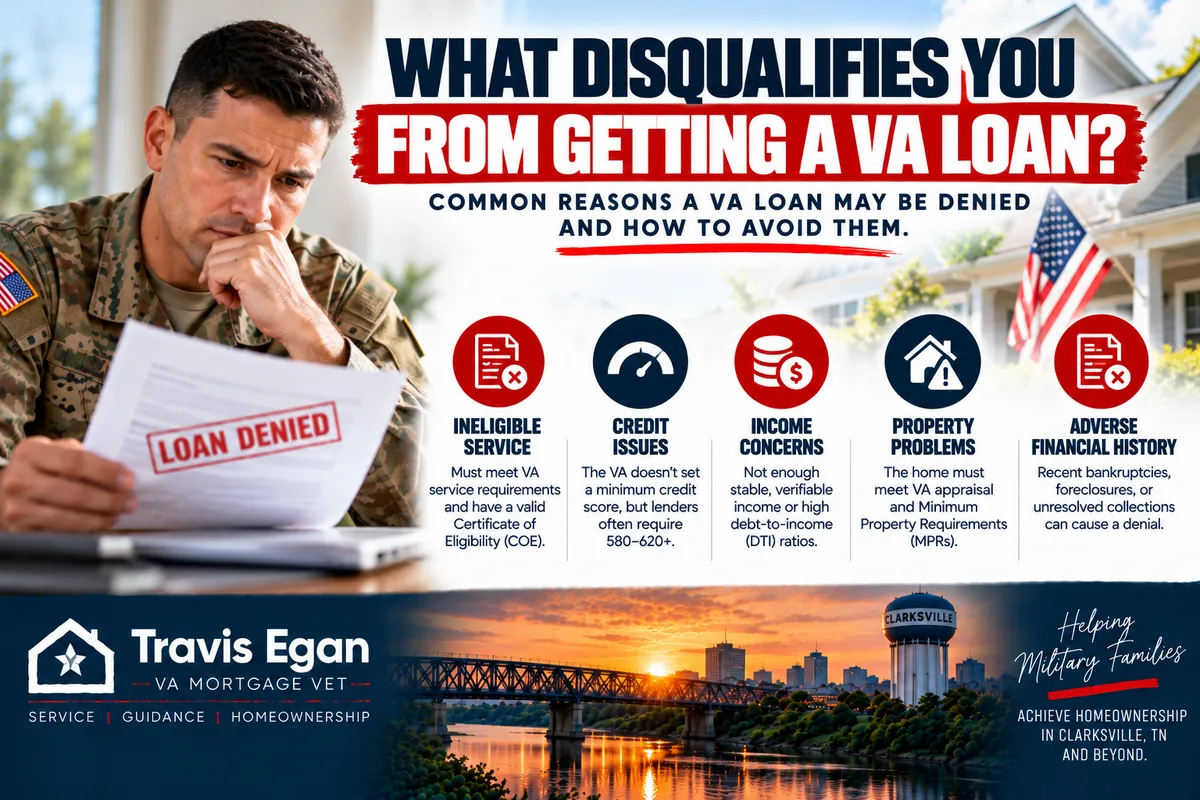
What Disqualifies You From Getting a VA Loan?
There is no single master list of things that automatically disqualify a borrower from a VA loan. A file can break down in a few places: VA eligibility rules tied to your service, the lender's underwriting standards for credit, income, debts, and employment, your remaining entitlement, the occupancy rule, and the property's condition. Some issues are hard stops. Many others only require extra documentation, a correction, or more time. Knowing which is which keeps a denial from feeling permanent when it usually is not.
Two sets of rules apply at the same time. The VA backs the loan and sets eligibility and property standards. A private lender approves the borrower and can layer its own standards on top of the VA's. A borrower who clears one set of rules can still be stopped by the other.
What Disqualifies You From a VA Loan?
Disqualification usually comes from a mismatch between your file and the requirements, not a single checkbox on a form. In practice, the problems fall into a handful of buckets, and each one behaves differently.
VA eligibility: your service history or duty status does not meet the applicable requirements, or your discharge type affects your access to benefits. You can still apply, and the VA will review your circumstances.
Lender underwriting: credit history, insufficient or unstable income, excessive debt relative to income, employment concerns, or a loan file that does not meet that lender's standards.
Entitlement: you have used the benefit before, and the remaining entitlement or an existing VA loan creates an obstacle.
Occupancy: the home is not going to be your primary residence.
Property: the house doesn't meet the VA's Minimum Property Requirements, a condo isn't approved, or the property violates the primary residence rule.
The VA sets eligibility and property standards. The lender sets credit, income, debt, and employment standards, and those standards vary from one company to the next. That difference matters because a lender may turn down a borrower who qualifies at another.
Type of issue | Who applies the standard | What it typically means |
|---|---|---|
Service history and discharge | VA | Determines whether you can get a Certificate of Eligibility. Some discharge types block benefits, and the VA reviews circumstances. |
Credit, income, debts, employment | Lender | Determines whether the loan is approved. Standards vary by lender. |
Entitlement | VA and lender | Affects how much of the loan the VA will guarantee and what options remain. |
Occupancy | VA and lender | The home must be your primary residence. |
Property condition | VA | The home must meet Minimum Property Requirements and condo rules where they apply. |
VA Eligibility Is Not the Same as Loan Approval
A Certificate of Eligibility (COE) shows your lender that you qualify based on your service history and duty status. That is the part the VA controls, and it is the first thing to confirm. A COE does not guarantee a lender will approve the loan.
The VA states plainly that to get financing for a VA-backed home loan, you must meet credit, income, and occupancy requirements from both the VA and your lender. Eligibility gets you into the room. Underwriting decides whether you leave with keys.
What the Certificate of Eligibility Confirms
The COE confirms your service record satisfies the requirements for the program you are applying under, whether that is a VA-backed loan or a VA direct loan such as the Native American Direct Loan. The VA issues it based on your service history and duty status. If your service record is unusual, requesting a COE also gives the VA a chance to review it instead of rejecting it.
What the Lender Still Approves
Your lender looks at credit history and scores, qualifying income, current debts, employment stability, residual income, the overall loan file, and the property. The lender's own credit standards can be stricter than anything the VA publishes. A borrower can be perfectly eligible on paper and still be declined because a specific lender doesn't like the file's shape.
Military Service Eligibility and Discharge Status
To use a VA home loan, you must meet the applicable service requirements for your situation, or qualify as an eligible surviving spouse. Those requirements are not one-size-fits-all. Eligibility can vary based on when and how someone served, so check your specific record rather than assuming a rule you heard applies to you.
One example of how the rules flex: veterans who served during peacetime for at least 181 days of continuous active duty, without a dishonorable discharge, may also qualify for a VA loan.
Discharge type matters. If you received an other-than-honorable, bad conduct, or dishonorable discharge, you may not be eligible for VA benefits. You can still apply, and the VA will review your circumstances. That review process is why a difficult discharge isn't necessarily the end of the conversation.
Credit History Problems
The VA does not set a universal minimum credit score for every VA loan. Individual lenders set their own credit standards, and most credit-related denials come from them. One lender's floor is not another lender's floor.
Insufficient credit history is one of the primary reasons VA loan applications are denied. Lenders want evidence that you handle borrowed money responsibly, and a file with very little activity gives them nothing to read.
Thin or Insufficient Credit History
A thin credit file can look like a red flag even when your finances are in good shape. The issue isn't that you did something wrong; it is that there isn't enough history to evaluate. A lender may ask for additional documentation or accounts that show a payment pattern over time. This is a documentation problem more often than a disqualification.
Late Payments, Collections, and Judgments
Low credit scores, recent late payments, collections, charge-offs, judgments, and other derogatory credit do not automatically mean permanent disqualification. They can absolutely affect approval, depending on how recent the issue is, how large it is, what caused it, and what the lender requires. Recent problems carry more weight than older ones, and a file showing recovery reads differently than one showing ongoing trouble.
Bankruptcy, Foreclosure, Short Sale, and Deed-in-Lieu
A prior bankruptcy, foreclosure, short sale, or deed-in-lieu does not necessarily eliminate VA loan eligibility forever. These events are significant, but lenders evaluate them rather than stamp them as permanent failures.
The outcome depends on applicable waiting periods, how credit has been re-established since the event, the circumstances surrounding it, the lender's requirements, and how much VA entitlement remains. Waiting periods aren't identical for every borrower, and blanket statements about a single fixed timeline for everyone are usually wrong. The right approach is to bring the details to a lender who works with VA files and let the file be reviewed as it actually is.
Debt-to-Income Ratio and Residual Income
A high debt-to-income ratio can make qualification more difficult, because it suggests less room in the monthly budget. It is not a single automatic ceiling that ends the conversation. No single DTI number blocks every VA borrower, regardless of circumstances.
VA underwriting places significant emphasis on residual income, which is the money left after the mortgage payment, other debts, and typical living expenses are accounted for. Residual income gets at the real question: can this household actually cover its obligations month to month and still have something left over? A borrower with a higher DTI but high residual income, reserves, and a stable career can be viewed differently than the raw ratio alone suggests.
Why Residual Income Gets Extra Attention
Residual income is a VA-specific measure, and it is calculated, not guessed. Lenders look at family size, region, and the full picture of monthly obligations. A file that looks tight on ratio can still pass on residual income. A file with a lower ratio can still raise questions if the leftover amount is thin. Both numbers get read together.
Insufficient or Unstable Income
Borrowers must have qualifying income that is stable, reliable, and expected to continue. That last part does the heavy lifting. One-time money is not the same as money that shows up every month and will keep showing up after closing.
Income can exist and still not be usable for mortgage qualification if it does not meet documentation or history requirements. The lender must verify the source, amount, and pattern. If any of those three is unclear, the lender may exclude the income from the calculation even if it lands in your bank account.
Commission, Bonus, and Overtime Income
Commission, bonus, overtime, and seasonal income may require a documented history before it counts toward qualifying income. A strong year alone may not outweigh a consistent multi-year pattern. Borrowers who rely heavily on variable pay should expect more paperwork and should not assume a lender will use the highest recent month.
Self-Employment and Transitioning Service Members
Recent self-employment can raise questions because there may not be enough history to demonstrate stability. Service members leaving active duty and moving into civilian employment face a related issue: the new job is real, but the lender wants to see that the income is established and expected to continue. Gathering offer letters, pay records, and prior military earnings documentation early helps the file tell a coherent story.

Employment Gaps and Job Changes
Changing jobs or having an employment gap does not automatically disqualify someone from a VA loan. Lenders are not looking for a perfect unbroken timeline. They evaluate the reason for the change, overall employment history, current income, and whether that income is expected to continue.
A gap explained by a military transition, a move, a medical situation, or additional education reads very differently from an unexplained stretch with no clear path back to work. Job changes within the same field generally raise fewer questions than a switch into something new. The documentation you provide shapes how the gap is interpreted, so be ready to explain it in plain terms, with records that support the story.
Unresolved Federal Debt
Certain delinquent federal obligations, or other unresolved government debt issues, may affect mortgage approval and can require resolution before closing. This is a category where the specifics of the debt matter a great deal. Not every federal debt automatically disqualifies a borrower, and an obligation exists even if it isn't delinquent or unresolved.
If you know of a federal debt that has gone unpaid or is in dispute, address it before it surfaces late in underwriting. Resolving it early keeps it from becoming a closing problem, and any borrower with questions about how a specific federal obligation is treated should confirm the answer with their lender and the relevant agency.
VA Entitlement Problems
Having used a VA loan before does not automatically disqualify you from using the benefit again. Many borrowers use the benefit more than once. What changes is how much entitlement remains and how the existing loan factors into a new application.
Borrowers with reduced remaining entitlement, an existing VA loan still in place, or a prior loss on a VA loan may face additional requirements or limitations. Entitlement determines how much of the loan the VA will guarantee, so the answer depends on your records, not a general rule of thumb. Requesting your COE and reviewing your entitlement before shopping is the fastest way to know where you stand.

Occupancy and Property Issues
Even a fully qualified borrower can be stopped by the home itself. The VA's Minimum Property Requirements determine whether a house qualifies for a VA home loan and protect buyers from future problems. A property is disqualified if it cannot meet the core Minimum Property Requirements or if other property rules are not satisfied.
The Primary Residence Rule
A property can fail if it violates the primary residence rules. VA-backed financing is built around the borrower living in the home as their primary residence, not around building a rental portfolio. Buyers who intend to buy an investment property or occupy the home only occasionally should expect a standard VA loan to be a poor fit.
Minimum Property Requirements and Condo Approval
Properties can run into trouble for failing Minimum Property Requirements, lacking condo approval, or running into the primary residence rule. Condition issues are often the most workable of the three, since some items can be repaired or addressed rather than treated as permanent defects. Condo projects bring their own approval process, and not every building qualifies. Ask about project approval early if you are shopping in a condo community.
What Usually Is Not an Automatic Disqualifier
Some of the things borrowers worry about most are not automatic disqualifiers. A prior VA loan, a past bankruptcy or foreclosure, student loans or a car payment, a variable-pay job, a job gap, and a thin credit file all require documentation and review, not surrender. The pattern across nearly every category is the same: recent, unresolved, or unexplained problems cause difficulty, while old, explained, and resolved ones are weighed in context.
Frequently Asked Questions
Does a low credit score automatically disqualify me from a VA loan?
No. The VA doesn't set a universal minimum credit score for every VA loan, and individual lenders set their own standards. A low score can make approval harder and may point you toward a lender whose guidelines fit your file. Insufficient credit history is a common denial reason, but it's often a documentation issue that can be worked through rather than a permanent bar.
Can I get a VA loan after a bankruptcy or foreclosure?
Possibly. A prior bankruptcy, foreclosure, short sale, or deed-in-lieu does not necessarily eliminate VA eligibility forever. Waiting periods, how you have re-established credit since the event, the circumstances behind it, the lender's own requirements, and your remaining entitlement all factor in. Because these timelines are not identical for every borrower, have a lender review your specific dates and records.
Will a bad discharge permanently disqualify me from a VA loan?
Not necessarily. If you received an other-than-honorable, bad conduct, or dishonorable discharge, you may not be eligible for VA benefits. However, you can still apply, and the VA will review your circumstances. Eligibility can also vary based on when and how you served, so the answer depends on your service record rather than a general rule.
Can I use a VA loan again if I already used one?
Yes, using a VA loan before does not automatically disqualify you from using the benefit again. The key factors are how much entitlement remains, whether you still have an existing VA loan, and whether you've had a prior VA loan loss. Requesting a Certificate of Eligibility shows your remaining entitlement before you start shopping.
What makes a property ineligible for VA financing?
A property is disqualified if it cannot meet the core Minimum Property Requirements, lacks condo approval where that applies, or violates the primary residence rules. Condition problems are often the most workable, since some items can be repaired before closing. Ask about property condition and condo project approval early so an issue does not surface after you have already fallen in love with a house.
Missed the last post? Can I Use a VA Loan to Move to a Different State? For more on VA home loans.