
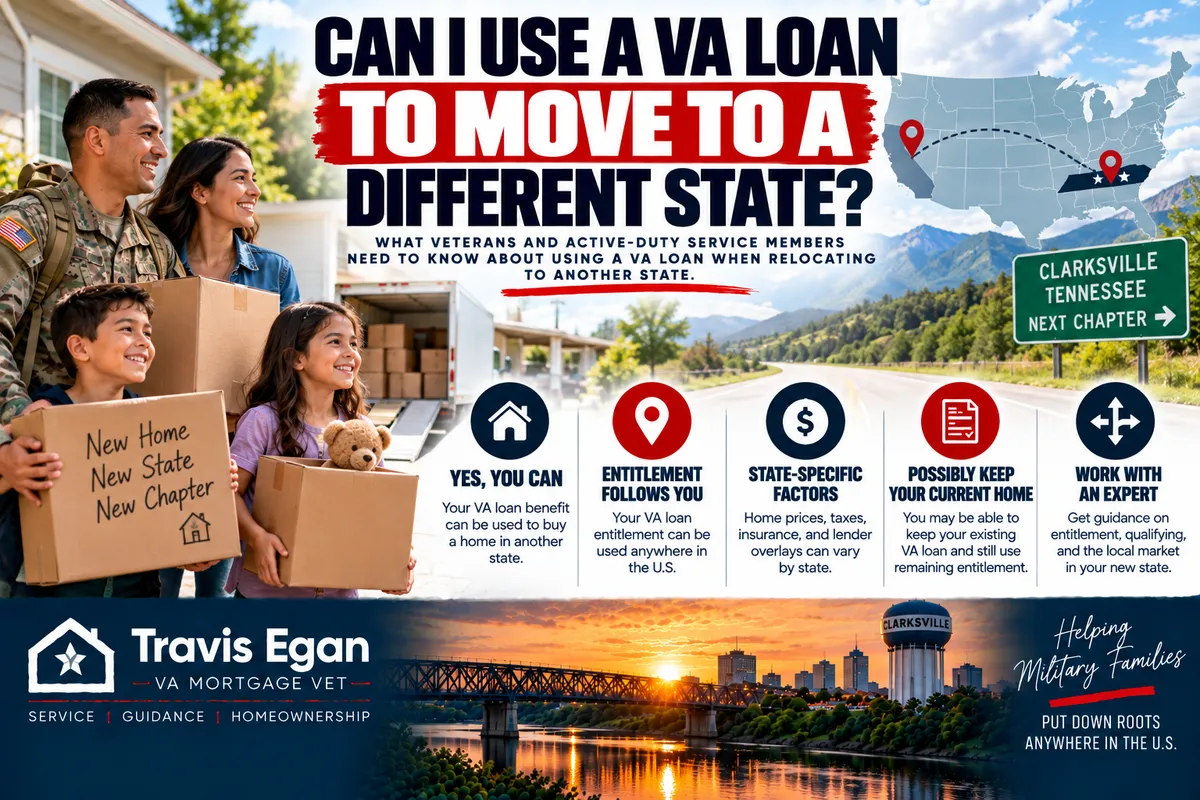
Can I Use a VA Loan to Move to a Different State?
Yes. In most cases, you can use a VA loan to buy a primary residence in a different state. Your VA entitlement is a federal benefit, not a state one, so it travels with you across all 50 states and U.S. territories. The questions that decide your file are not about state lines. They are about whether you intend to occupy the new home as your primary residence, whether your income will continue after the move, whether you meet VA and lender requirements, and whether you have enough entitlement left for the transaction.
The rest of this page covers the occupancy rule, income documentation, and entitlement questions that decide most out-of-state VA files, plus a checklist you can work through before you make an offer on a home in a state you have never lived in.
VA Loan Moving to Another State: How Does It Work?
Your VA home loan benefit isn't tied to the state you live in or the state where you joined the service. The entitlement is federal, not geographic. That means it covers purchases in all 50 states and U.S. territories, and the same core benefits follow you: no down payment required in many cases, competitively low interest rates, limited closing costs, and no private mortgage insurance.
The VA home loan is also a lifetime benefit, so it does not expire when you leave active duty or move away from your first duty station. A borrower may use a VA loan to buy a qualifying primary residence in another state as long as the loan, property, and occupancy requirements are met.
In practice, this looks less like a state-by-state approval process and more like a standard VA purchase file with a few extra questions. Your lender still verifies eligibility, entitlement, credit, income, and the property itself. The difference is that the lender must also be satisfied that you are genuinely relocating and that the new home will be your primary residence, not an investment property or a place you plan to visit a few times a year.
Occupancy Requirements: The Rule That Matters Most
VA loans require you to occupy the property as your primary residence. In most cases, that means moving into the home within 60 days of closing and intending to make it your primary residence going forward. That timeline anchors nearly every other question about an interstate move.
A few details are worth having straight before you start house hunting from a distance:
The occupancy requirement is about intent and use, not state borders. Moving far from where you live now is fine if the home will be your primary residence.
The VA does not require you to remain in the home for a full 12 months after moving in. Some lenders may apply a different requirement, so ask your loan officer what the specific program and investor guidelines say.
Limited occupancy exceptions exist for active-duty service members, which is why military orders carry so much weight in a VA file.
Guidance on taking a second VA loan suggests planning to live in the new home full time, generally at least six months out of the year.
PCS Orders and Occupancy
For active-duty borrowers, military orders do much of the work. They document why you are moving, where you are going, and when. A lender reviewing an out-of-state purchase can see the reason for the relocation on paper rather than taking your word for it, which matters because the occupancy rule is tied to intent, and intent is hard to prove without documentation.
Orders, reporting dates, and a clear plan for when your household arrives all support the story. The VA allows limited occupancy exceptions for service members, but not every situation fits neatly into an exception. If your family will move before you do, or you will arrive weeks after closing, talk through the timing with your lender before you write an offer rather than after.
Retirement, Separation, and Civilian Moves
Not every interstate VA move involves orders. Veterans retire, separate from service, take civilian jobs, move closer to family, or relocate for a lower cost of living. You can still finance those moves with a VA loan as long as the new home will be your primary residence.
Without orders, the lender relies more on your stated occupancy plan and income documentation. A retirement date, a job offer, a transfer letter, or a lease termination notice can all help show that the move is real and that you intend to live in the home.

Photo by cottonbro studio on Pexels
Buying Before You Physically Move
You may be able to close on a home in another state before you relocate. The VA program doesn't require you to be in the new state on closing day. The lender does require a credible plan to occupy the home within the required timeframe.
That plan usually includes some combination of the following:
A clear move date or reporting date
Documentation of the income that will support the new payment
Confirmation of how the current housing situation gets resolved, whether that means selling, renting, or finishing out a lease
An occupancy statement signed at closing
Buying in another state without a genuine plan to occupy the property as your primary residence may not satisfy VA requirements. A second home, a rental, or a property held for someone else to live in does not fit the VA primary residence standard. If your situation is unusual, get the lender involved before you make an offer.
How Employment and Income Affect an Interstate VA Move
Income is where many out-of-state files get interesting, because the lender must determine whether the income you used to qualify will continue after the move. The answer depends on your specific job situation.
Same job, remote work. If you keep the same employer and continue working from the new state, the income may still count, but expect documentation requirements.
Transfer with the same employer. A transfer letter or written confirmation of the new location helps show continuity of income.
New job in the new state. A signed offer letter with a start date and compensation details is the usual starting point.
Separating from active duty. Retirement pay, disability compensation, and a confirmed civilian job can all factor into the income picture, depending on documentation.
Retiring or changing careers. These situations usually require more documentation. Stable, documented income matters more than the job title.
Remote Work and Employer Documentation
Remote work has made interstate moves more common, and lenders have adapted, but they still want proof. If your employer is based in one state and you plan to work from a home in another, the lender may ask for a letter or written confirmation that the arrangement is allowed and expected to continue.
Be ready to answer a few questions. Does your employer permit you to work from the new state? Is there a tax or payroll implication for the employer? Is the arrangement permanent or temporary? A short letter on company letterhead can usually address all three. If your employer has a policy on which states it can employ people in, resolve that early, before you sign a contract.
How VA Entitlement Works Across State Lines
Entitlement is the amount the VA will guarantee on your behalf, and it travels with you. It does not reset or change based on which state you move to.
If you have full entitlement and no active VA loan, you may be able to purchase in another state with no required down payment, subject to qualification. That is the cleanest version of an interstate VA purchase.
If you already have a VA loan or only a portion of your entitlement available, the math changes. A lender will look at your remaining entitlement and the loan amount to determine whether a down payment is needed. Borrowers with reduced remaining entitlement may still qualify, but the structure may differ from a first-time, full-entitlement purchase.
Because entitlement calculations depend on your specific loan history and the size of the loan you need, confirm this with a lender early. Get the numbers in writing early, before you start touring homes in another state.

Selling Your Current Home or Keeping It
You do not always have to sell your current home before using a VA loan again. Some borrowers keep the first home and rent it out. Others sell. Either path can work, but the decision affects the new loan in a few ways.
Entitlement. If your existing VA loan is still active, part of your entitlement is tied up, and that can change whether a down payment is required on the new purchase.
Debt-to-income ratio. Keeping the old home usually means keeping the old mortgage payment in the calculation, at least until rental income can be documented.
Rental income. Lenders may let you count rental income, but documentation and rules vary. Ask before you assume it offsets the payment.
Occupancy. The new home must still be your primary residence. Renting out the old one is generally the better option than trying to treat the new one as a rental.
When the Current Home Has a VA Loan
In certain circumstances, you may keep the existing property and obtain another VA loan if you have sufficient entitlement remaining. A borrower is not limited to one VA loan for life, and a new VA loan is not disqualified simply because another VA loan already exists.
Two common structures involve using remaining entitlement while keeping the first loan in place, or paying off the first VA loan so the entitlement is restored for the next purchase. Which one fits depends on your numbers. Have that conversation with your lender before you list or rent the current home, because the order of operations can affect what you qualify for.
Four Interstate VA Relocation Scenarios
Every file is different, but most interstate VA moves look something like one of these.
Scenario | What the lender looks at |
|---|---|
Active-duty service member PCSing from one state to another | Orders, reporting date, occupancy timing within 60 days, continuity of military income |
Veteran moving for a civilian job | Signed offer letter or transfer confirmation, start date, whether the new income is stable and likely to continue |
Remote employee relocating to a lower-cost state | Employer letter confirming remote work is permitted from the new state, plus continuity of the same income |
Veteran keeping a previous VA-financed home and buying a new primary residence | Remaining entitlement, debt-to-income ratio with both payments, rental income documentation, occupancy of the new home |
In the PCS example, the orders do most of the explaining. In the civilian job example, the offer letter does. In the remote work example, the employer letter does. In the keep-and-buy example, the entitlement and debt calculations do. Different paperwork, same underlying questions about occupancy and income.

Interstate VA Move Checklist
Work through this list before you get too far into the search. Most delays on out-of-state VA files trace back to one of these items being handled late.
Confirm eligibility and entitlement. Get your Certificate of Eligibility and confirm your entitlement amount.
Talk to your lender early about the move. Share the destination state, the timeline, and whether you plan to keep or sell the current home.
Document continued or new employment. Gather offer letters, transfer confirmations, remote work letters, or retirement and separation paperwork.
Confirm your occupancy plan. Know your move date and make sure it fits within the required timeframe after closing.
Review taxes and insurance in the destination state. Property taxes vary widely by state and county, so budget with real numbers instead of guesses.
Line up homeowners insurance. Coverage needs to be in place before closing, and shopping early avoids a last-minute scramble.
Verify property eligibility. The home has to meet VA property standards, and the lender will order the required appraisal.
Coordinate the current home. Decide whether you are selling, renting, or holding it, and get the documentation in order.
Ask about anything unusual. Long-distance moves, delayed arrivals, and nonstandard income go more smoothly when the lender knows in advance.
If you are working with a loan officer who handles VA files regularly, several of these steps can run at the same time. If you work with someone who treats a VA loan like a conventional loan, expect more back-and-forth.
Frequently Asked Questions
Does my VA loan benefit change if I move to another state?
No. Entitlement is federal, not geographic. The same core benefits apply whether you buy in your current state or across the country: no down payment required in many full-entitlement cases, competitively low interest rates, limited closing costs, and no private mortgage insurance. What does change is the property tax and insurance picture in the new location.
Can I buy a home in another state before I actually move there?
Often yes. You can close on a home in another state before relocating if the lender is comfortable with your occupancy plan and income. VA loans generally require you to move into the home within 60 days of closing and intend to make it your primary residence. Buying out of state without a genuine plan to occupy the property may not satisfy that requirement.
Can I keep my current home and still get another VA loan?
It depends on your remaining entitlement. In certain circumstances, you may keep your existing property and still get another VA loan if you have enough entitlement remaining. Entitlement, debt-to-income ratio, rental income documentation, and occupancy of the new home all factor in. A borrower is not limited to one VA loan for life, but the numbers have to work.
Do I need PCS orders to use a VA loan in another state?
No. Orders help active-duty borrowers because they document why and when you are moving, and service members have limited occupancy exceptions. Veterans moving for civilian jobs, retirement, family reasons, or a lower cost of living can still use a VA loan as long as the new home will be their primary residence and the income qualifies.
How long do I have to live in the home after closing?
The VA does not require you to remain in the home for a full 12 months after moving in. However, some lenders may have a different requirement, so confirm the specifics with your loan officer. Guidance on a second VA loan suggests planning to live in the new home full time, generally at least six months out of the year.
Missed the last post? TEXT. For more on VA home loans.