VA Loan Benefits No PMI: Lower Rates Explained
Most conversations about VA home loans start and stop at the down payment. Zero down gets the attention because it answers the biggest question a buyer has: how much cash do I need to bring? It is a real advantage, and for many service members, it is the difference between buying now and waiting another year.
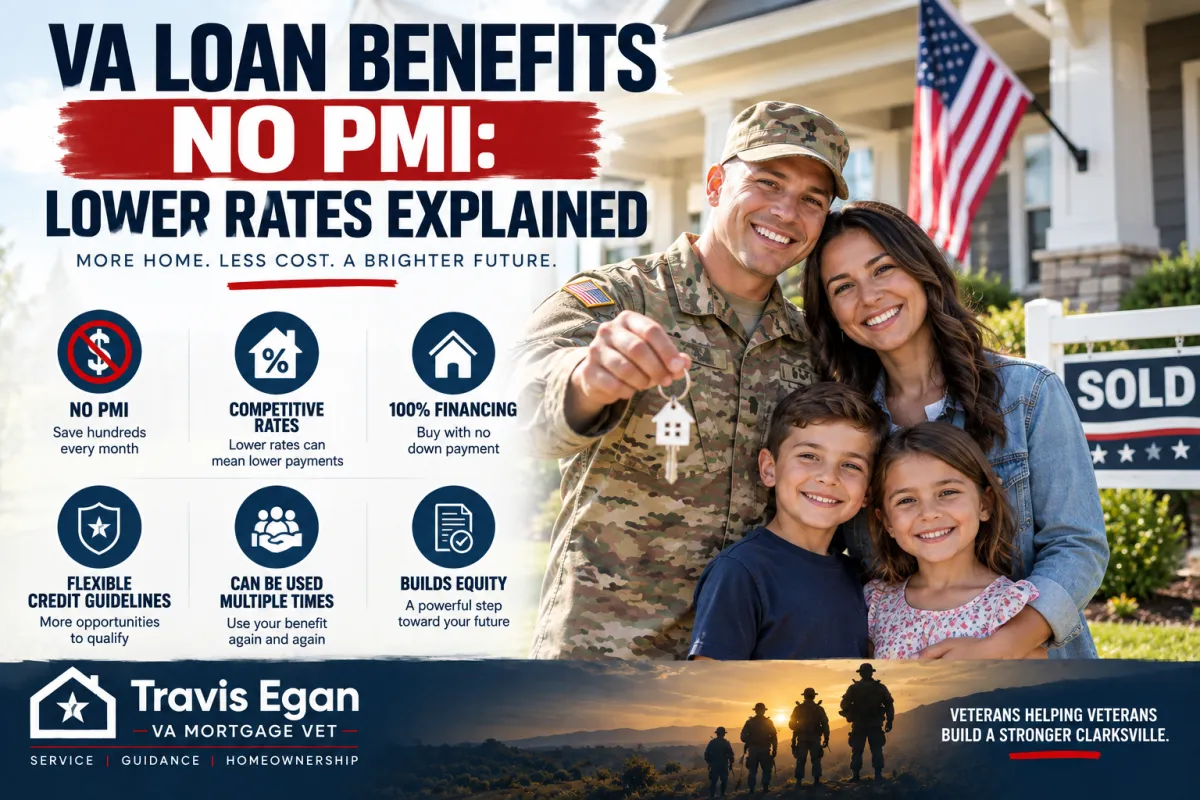
The quieter benefits show up every month for the life of the loan. A VA loan does not carry private mortgage insurance, and VA-backed purchase loans come with competitive interest rates. Put those two together, and the monthly payment gap between a VA loan and other financing options can widen fast. Here is how each piece works and what it means for your budget.
What No PMI Actually Means on a VA Loan
Private mortgage insurance protects the lender, not the borrower. It exists because a conventional lender takes on more risk when the down payment is small. That risk gets priced into a monthly premium and added to the payment. VA-backed loans are structured differently. The Department of Veterans Affairs backs a portion of the loan through its guaranty, so lenders don't need to layer private mortgage insurance on top.
The result is simple: no PMI line item on your statement and no monthly mortgage insurance premium weighing on your budget. The payment you agree to at closing is closer to the payment you keep.
PMI, MIP, and the VA Difference
Different loan programs handle mortgage insurance differently. This is where the VA structure separates itself from the alternatives.
Loan type | Mortgage insurance treatment |
|---|---|
Conventional | PMI is typically required when the down payment is small |
FHA | Mortgage insurance premiums (MIP) apply |
USDA | Mortgage insurance applies |
VA | No PMI and no monthly mortgage insurance premium |
That last row is the whole point. Veterans who use a VA home loan don't have to pay private mortgage insurance, and no monthly mortgage insurance premium is attached to the loan.
Why the Savings Repeat Every Single Month
Mortgage insurance is not a one-time fee. It is a recurring cost, which means removing it changes your budget every month, not just at closing. VA sources note that no PMI can save Veterans hundreds of dollars each month compared with conventional, FHA, or USDA loans.
The effect on buying power matters as much as the effect on the payment. In one VA News illustration, a buyer using a VA loan could afford a home worth $30,000 more with the same monthly payment, simply by eliminating PMI. Same budget, more house, because the money that would have gone to insurance is going toward the purchase instead.
Treat any example as an illustration rather than a quote. Your actual numbers depend on the loan amount, the rate, the term, your credit profile, and the lender. To see your real numbers, ask for Loan Estimates and compare the monthly totals side by side.
Lower Rates: The Other Half of the Advantage
VA.gov points out that lenders offer competitive interest rates on VA-backed purchase loans, which help buyers purchase, build, or improve a home, especially when they would rather not make a down payment. Industry comparisons commonly show VA rates running slightly below conventional rates for comparable borrowers.
Even a small rate difference compounds over time. A lower rate reduces the monthly principal and interest payment and the total interest paid over the life of the loan. Pair that with no mortgage insurance, and the comparison between two loans of the same size becomes much less close.
How to Compare a VA Loan With a Conventional Loan
Ask for Loan Estimates on both options on the same day, using the same loan amount, term, and closing timeline.
Put the rate and the monthly PMI figure next to each other so you are comparing total payment, not just interest rate.
Look at the five-year cost, not only the first payment, since mortgage insurance on a conventional loan can run for years depending on the structure.
Account for the VA appraisal process and any property requirements in your timeline.
Work with a loan officer who closes VA files regularly, so the certificate of eligibility, appraisal, and underwriting steps move together.
Zero Down Is Still Part of the Package
The no-PMI benefit does not replace the zero-down benefit. They work together. VA-backed purchase loans are designed for buyers who do not want to make a down payment, and the program offers 100% financing for qualified borrowers. Eligibility generally requires a Certificate of Eligibility plus meeting VA and lender standards.
That combination is what makes the VA loan hard to match. No down payment gets you into the home. No mortgage insurance keeps the payment manageable once you are there. A competitive rate ties it all together.

The Benefit Does Not Run Out After One Use
A VA home loan is a lifetime benefit. You can use the guaranty multiple times rather than spending it once and losing it. For military families, that matters because moves rarely happen once. Buy at one duty station, sell or rent when orders arrive, and buy again at the next assignment, and the same no-PMI structure can follow you each time.
Around Fort Campbell, that cycle plays out constantly. Households arrive on PCS orders, buy in Clarksville or on the Kentucky side, then face another set of orders a few years later. Knowing the benefit is reusable changes how you plan those moves.
What to Know About VA Property Requirements
VA loans carry stricter inspection requirements than some other loan types. The appraisal confirms that the property meets VA standards before the loan moves forward. That can add a step to the timeline and occasionally lead to repair conversations with a seller.
For buyers, it verifies the home's condition. For sellers, it is a known part of accepting a VA offer. The practical takeaway is to build the appraisal into your schedule, especially during a compressed PCS window, and to keep your loan officer and real estate agent aligned on dates.

Where This Shows Up Around Fort Campbell
Clarksville and the surrounding Fort Campbell area run on military timelines. Buyers often have a narrow window between orders and a move, which makes the VA loan the default choice for many local purchases. In that setting, the no-PMI structure and competitive rate matter most, because the monthly payment has to work on a military paycheck that may shift with the next set of orders.
Travis Egan is a VA mortgage specialist and Marine Corps veteran based in Clarksville, Tennessee, serving active-duty service members, veterans, and military families connected to Fort Campbell. Through his affiliation with Loan Factory, he works VA purchase and refinance files, including PCS relocation scenarios, and offers tools such as mortgage calculators and a free VA Homebuyer's Guide for families who want to run their own numbers before deciding.
Frequently Asked Questions
Do VA loans require PMI?
No. Veterans who use a VA home loan don't have to pay private mortgage insurance, and the loan doesn't include a monthly mortgage insurance premium. That differs from conventional loans, where PMI is typically required with a small down payment, and from FHA and USDA loans, which also carry mortgage insurance costs that VA loans avoid.
How much does skipping PMI save each month?
VA sources indicate that not having PMI can save Veterans hundreds of dollars each month compared with conventional, FHA, or USDA loans, and one VA News illustration showed a buyer affording a home worth $30,000 more with the same monthly payment after eliminating PMI. Your exact savings depend on the loan amount, rate, term, credit profile, and lender, so ask for a side-by-side Loan Estimate.
Are VA loan rates always lower than conventional rates?
VA.gov states that lenders offer competitive interest rates on VA-backed purchase loans, and industry comparisons commonly show VA rates edging slightly below conventional rates for comparable borrowers. Rates change daily and depend on your credit and lender, so the best approach is to compare Loan Estimates for a VA loan and a conventional loan on the same day using identical loan terms.
Can I use my VA loan benefit more than once?
Yes. The VA home loan is a lifetime benefit, and you can use the guaranty multiple times. For military families who move between duty stations, that means the no-PMI structure and competitive rate can apply to more than one purchase over a career. Confirm your remaining entitlement with the VA or your lender before you start shopping.
Does a VA loan have any downsides?
The trade-offs are mostly procedural, not financial. VA loans have stricter inspection requirements than some other loan types, and the appraisal step can add time or trigger repair discussions during a purchase. Eligibility also requires a Certificate of Eligibility along with VA and lender standards. Working with a lender who handles VA files regularly keeps those steps predictable.
Zero down gets a VA buyer in the door, but no mortgage insurance and competitive rates are what make the payment sustainable after closing. Add the fact that you can use the benefit again, and the case for running a VA loan comparison before you choose a loan type becomes clear. Start by pulling your Certificate of Eligibility, then put a VA Loan Estimate and a conventional Loan Estimate side by side, with the PMI line visible. Hence, the decision rests on your actual numbers rather than a general assumption about which loan is cheaper.
Missed the last post? Check out VA Cash-Out vs. Rate-and-Term Refinance: Which Is Right? For more on VA home loans.