
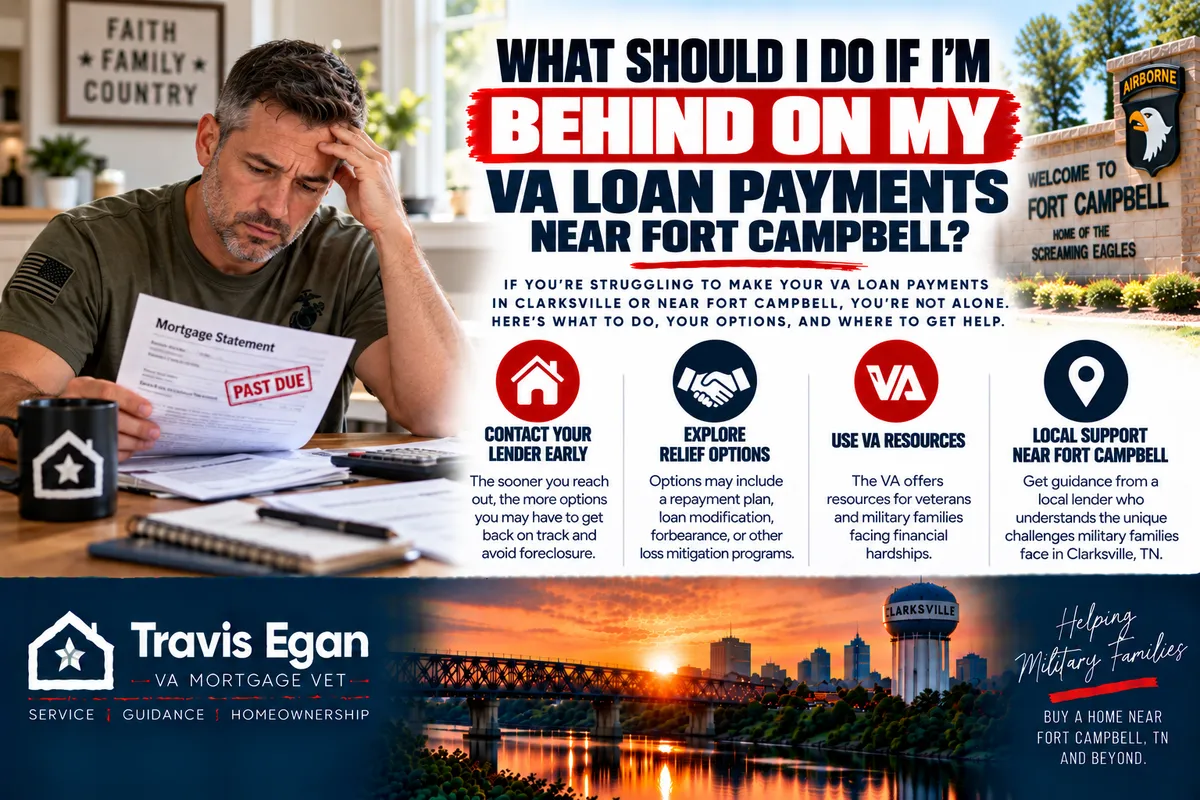
What Should I Do If I’m Behind on My VA Loan Payments Near Fort Campbell?
If you are behind on your VA loan payments, or you know you are about to miss one, the most important thing you can do is contact your mortgage servicer before the problem gets worse. Falling behind does not automatically mean you will lose your home. Depending on what caused the hardship and what you can afford now, there may be ways to catch up, temporarily reduce the pressure, modify the loan, or address past-due payments.
For Fort Campbell families, financial trouble can show up fast. A PCS, separation from active duty, divorce, loss of a spouse's income, medical expenses, a reduction in BAH, or an unexpected civilian job change can turn a manageable mortgage into a problem in a matter of months.
The good news is that VA borrowers have foreclosure-prevention options, and in 2026 a new program called the VA Partial Claim Program may help certain borrowers who can afford their regular payment again but can't pay all missed payments at once.
What Should I Do First If I Am Behind on My VA Loan Payments?
Start with your mortgage servicer.
Your servicer is the company that collects your mortgage payment each month. Its phone number should appear on your mortgage statement.
Tell them you are experiencing a financial hardship and ask what loss-mitigation options are available on your VA-guaranteed loan.
Do not wait until you receive a foreclosure notice.
The VA specifically tells borrowers having trouble making their mortgage payments to contact their servicer right away. If you are uncomfortable contacting the servicer or aren't getting the help you need, you can also speak with a VA Loan Technician at 877-827-3702.
The earlier you start the conversation, the more time everyone has to figure out whether the problem is temporary, whether your normal payment is still affordable, and which options may apply.
That matters around Fort Campbell because a financial hardship can sometimes be tied to a much larger transition. If you are also dealing with a relocation, employment change, or military separation, it helps to understand how PCSing to Fort Campbell affects your VA loan timeline and how income changes can affect your mortgage.
What Help Is Available If I Cannot Make My VA Mortgage Payment?
No single solution applies to every borrower.
Your servicer looks at why you fell behind, how far behind you are, what you can afford now, and whether the hardship is temporary or permanent.
Possible solutions can include:
A repayment plan
Special forbearance
A loan modification
A VA Partial Claim
Selling the property
A short sale in appropriate circumstances
A deed-in-lieu of foreclosure when other options do not work
VA currently identifies repayment plans, special forbearance, modifications, partial claims, and foreclosure alternatives as options to consider, depending on the borrower's circumstances.
The important distinction is whether you can afford the house in the future.
If your income has recovered and you can resume your normal payment, your situation is very different from someone whose household income permanently dropped by $2,000 per month.
What Is a VA Repayment Plan?
A repayment plan allows you to catch up on missed payments over time instead of paying the entire delinquent amount at once.
For example, suppose you are two payments behind after a temporary loss of income. Your normal mortgage payment is affordable again, and your household finances have stabilized.
The servicer may determine that you can make your regular mortgage payment plus an additional amount each month until the missed payments are repaid.
This works when the hardship is over, and your monthly budget can handle the extra payment.
It is less useful when the regular mortgage payment itself has become unaffordable.
Can My VA Loan Go Into Forbearance?
A special forbearance may let you temporarily reduce or pause payments while you deal with a short-term hardship.
The important thing to understand is that forbearance is not forgiveness.
Missed mortgage payments do not simply disappear. You will still need to work with your servicer on how those payments will eventually be resolved. VA specifically warns borrowers that missed payments are not automatically added to the end of the loan.
This is one reason you should know exactly what happens when forbearance ends before you agree to it.
Ask the servicer:
What will I owe when this ends?
Will I have to repay everything immediately?
Will I be evaluated for a repayment plan, modification, or another option?
Those answers matter more than simply getting temporary payment relief.
Can My VA Mortgage Be Modified?
Possibly.
A VA loan modification changes certain terms of the existing mortgage to resolve the delinquency and create a payment the borrower can maintain.
The exact modification depends on the loan and the servicer's loss-mitigation review.
VA's current loss-mitigation structure includes different modification options before and after a partial claim evaluation. The point is not that every borrower receives a modification. The point is that modification is one tool a servicer may consider when trying to resolve a delinquent VA loan in Clarksville, TN.
If your hardship has permanently changed your finances, this part of the conversation matters most.
What Is the VA Partial Claim Program in 2026?
This is one of the most important changes for VA borrowers who are behind on payments.
The VA Partial Claim Program launched on June 15, 2026, as a new foreclosure-prevention option for qualifying VA borrowers.
The program is designed primarily for borrowers who have fallen behind but can now afford to resume their regular mortgage payments.
The basic process works like this:
Your servicer evaluates your loan under VA's loss-mitigation process.
If you meet the Partial Claim requirements, you are generally offered a three-month trial payment plan.
You demonstrate that you can make the required payments during that trial period.
After you complete it successfully, the servicer advances the eligible amount needed to bring the mortgage current.
VA reimburses the servicer for that amount.
The partial claim generally becomes repayable later when the first mortgage is paid off, refinanced, or the home is sold.
In plain English, imagine you can afford your regular $2,000 mortgage payment again, but you are $8,000 behind.
The problem is no longer the $2,000 monthly payment.
The problem is finding another $8,000 immediately to become current.
A Partial Claim may help certain qualifying borrowers solve that specific problem without requiring the entire past-due amount to be paid out of pocket at once.
It is not debt forgiveness, and not everyone qualifies.
There is another important 2026 detail. VA allowed servicers to begin submitting Partial Claim trial-payment-plan events on June 15. Still, servicers were given 180 days from June 1, 2026, to implement the new program and loss-mitigation waterfall fully. As a result, a borrower contacting a servicer during the implementation period may find that the company is still completing its procedures.
That is another reason to contact VA if you are struggling to get a clear answer.
Is VASP Still Available for VA Borrowers?
No.
This matters because a lot of articles and videos about VA mortgage assistance still mention the Veterans Affairs Servicing Purchase Program, or VASP.
VASP ended on May 1, 2025. VA stopped accepting new VASP submissions then.
If you are reading older information telling you to apply for VASP in 2026, that information is outdated.
The newer VA Partial Claim Program and VA's updated loss-mitigation process are what borrowers and servicers need to discuss now.
What If I Can Afford My Normal Payment but Cannot Catch Up?
Tell your servicer exactly that.
There is a major difference between:
“I cannot afford this mortgage anymore.”
and
“I can afford the mortgage again, but I cannot come up with the money to cover the payments I missed.”
That distinction can affect which options make sense.
The VA Partial Claim was created to give certain borrowers another path to resume scheduled mortgage payments when they can't immediately cure the delinquency.
Do not try to solve this by draining every dollar of savings before you know what the servicer can offer.
Cash reserves matter when you own a home. You still have utilities, repairs, insurance, transportation, food, and every other expense your family carries.
The same financial discipline that matters when qualifying for a VA loan through VA residual income requirements still matters after you own the house.

What If My Financial Problem Is Temporary?
Temporary problems often call for temporary solutions.
Consider a Fort Campbell family that spends more than expected during a PCS. The spouse leaves a job during the move, deposits and moving expenses hit at once, and the household falls two payments behind.
Three months later, the spouse is working again, and the household income is back to normal.
That family may have a delinquency problem, but not necessarily a permanent affordability problem.
Compare that with a service member who separates from active duty and takes a civilian job paying substantially less than their previous military compensation.
If the normal mortgage payment no longer fits the household budget, simply catching up on missed payments doesn't solve the underlying problem.
That is why military families planning a transition should contact the lender and servicer early. A PCS, military separation, or job change can affect everything from BAH to household income.
What Documents Should I Gather Before Calling My Servicer?
Your servicer will tell you exactly what it requires, but being organized helps.
You may need:
Recent pay stubs or Leave and Earnings Statements
Bank statements
Documentation of other household income
Your mortgage statement
A list of monthly expenses
Unemployment or job-loss documentation
Information about a PCS, divorce, disability, medical expense, or other hardship
Copies of notices already received from the servicer
Tax documents when requested
The goal is to establish two things:
Why did you fall behind?
and
What can you realistically afford now?
Give the servicer accurate numbers.
Trying to make the household finances look better than they really are may only push the problem down the road.

Can the VA Help If My Mortgage Servicer Is Not Helping?
Yes.
VA Loan Guaranty has Loan Technicians who assist veterans and service members with delinquent VA-guaranteed mortgages.
VA says its Loan Technicians can work with borrowers and mortgage servicers to explore options intended to avoid foreclosure. Borrowers can call 877-827-3702 for assistance.
This is not a substitute for communicating with your mortgage company.
Your servicer still controls the servicing of the loan and performs the loss-mitigation review.
But if you are getting nowhere, don't understand what you have been offered, or believe available VA options haven't been properly considered, contacting the VA is a reasonable next step.
What If I Can No Longer Afford to Keep the House?
Sometimes the numbers say the house is no longer sustainable.
That is difficult, but ignoring the situation won't improve the outcome.
If keeping the home is no longer realistic, your servicer may discuss alternatives to foreclosure.
A normal sale is usually the first option when there is enough equity to sell the property and pay off the mortgage.
If the property cannot be sold for enough to satisfy the debt, other possibilities may include a short sale or deed-in-lieu of foreclosure, depending on the circumstances.
VA lists short sales among the possible foreclosure alternatives available through the servicing process.
Before choosing an option, find out how it could affect your credit, finances, and future VA loan eligibility.
Using a VA loan once does not necessarily mean you will never use the benefit again. But a loss to the VA can affect entitlement, and that should be understood before you make a decision.
How Many VA Loan Payments Can I Miss Before Foreclosure?
No responsible answer says every VA borrower can miss a specific number of payments before foreclosure.
Foreclosure timing depends on the loan's status, the servicer's process, federal servicing requirements, applicable state law, loss-mitigation activity, and the borrower's circumstances.
The better question is not:
How many more payments can I miss?
It is:
What can I do today to stop this from getting worse?
If you already know the next mortgage payment will be a problem, call before you miss it.
VA specifically encourages borrowers to ask for help as soon as they have trouble making payments, rather than waiting until foreclosure is imminent.
Watch Out for VA Mortgage and Foreclosure Scams
Financial pressure makes homeowners vulnerable to people offering miracle solutions.
Be careful when someone promises they can immediately stop foreclosure, asks for a large upfront payment, tells you to stop communicating with your mortgage servicer, asks you to send the mortgage payment somewhere else, or pressures you to transfer ownership of your home.
VA specifically warns borrowers who are behind on mortgage payments to work with their servicer, VA, and other trusted organizations rather than falling for foreclosure-rescue scams.
If someone claims they have access to a special VA program your mortgage company does not know about, verify it.
A legitimate solution should survive a phone call to the VA.
What Should Fort Campbell Families Do Next?
If you are behind on your VA loan near Fort Campbell, start with the mortgage servicer.
Explain exactly what changed.
Find out what loss-mitigation options are available.
Provide the requested documents quickly.
If you don't get answers, call the VA Loan Guaranty program at 877-827-3702.
Then look beyond the missed payment and ask the harder question: Can this household comfortably afford the mortgage going forward?
That answer determines whether the goal should be catching up, changing the loan, or making a larger housing decision.
If your hardship is tied to a PCS, an employment transition, or a future move, understanding your VA home loan options now can help you avoid a decision that creates a bigger problem later.
If you are a Fort Campbell or Clarksville-area veteran or military family and want to understand how the situation could affect your future mortgage options, call Travis Egan, VA Mortgage Vet, at (931) 208-6280 or visit TravisEgan.com.
As a Marine veteran with 30 years of service to military families, I can help you understand the mortgage side of the situation and what today's decisions may mean for your ability to use your VA home loan benefit in the future.
Frequently Asked Questions
What happens if I miss one VA loan payment?
One missed payment does not automatically mean you will lose your home, but your mortgage becomes delinquent, and the problem can become more serious if additional payments are missed. Contact your mortgage servicer as soon as you know there is a problem and ask what options are available.
Can the VA help me if I am behind on my mortgage?
Yes. Veterans and service members with VA-guaranteed loans can contact a VA Loan Technician for assistance at 877-827-3702. VA Loan Technicians can help borrowers understand available options and may work with the mortgage servicer when appropriate.
What is the VA Partial Claim Program?
The VA Partial Claim Program is a foreclosure-prevention option launched in June 2026 for certain qualifying VA borrowers in default. Eligible borrowers generally complete a three-month trial payment plan. After successful completion, the borrower may address the eligible past-due amount through the Partial Claim process rather than paying the entire delinquency immediately. The amount is generally repaid later when the mortgage is paid off, refinanced, or the property is sold.
Is VASP still available in 2026?
No. The Veterans Affairs Servicing Purchase Program ended on May 1, 2025, and VA no longer accepts new VASP submissions. Borrowers seeing VASP recommended in older articles should contact their servicer or VA about the loss-mitigation options currently available.
Can my VA loan be modified if I am behind?
Possibly. Loan modification is one of the home-retention options that may be considered for a delinquent VA-guaranteed loan. Whether you qualify and what the modified terms look like depend on your loan, your financial situation, and the servicer's loss-mitigation review.
Do I have to repay missed payments after a VA loan forbearance?
Generally, you still have to resolve missed payments. VA specifically warns that payments missed during forbearance are not automatically added to the end of the mortgage. Your servicer should explain how the delinquency will be addressed when the forbearance ends.
Can foreclosure still happen on a VA loan?
Yes. A VA loan guaranty does not prevent foreclosure if a mortgage remains delinquent and no workable solution is reached. VA borrowers have access to VA servicing assistance and loss-mitigation options intended to help eligible borrowers avoid foreclosure when possible.
Who should I call if I am behind on my VA loan?
Call your mortgage servicer first. If you need additional help with a VA-guaranteed mortgage, call the VA Loan Guaranty program at 877-827-3702. VA currently lists representatives as available Monday through Friday from 8:00 a.m. to 6:00 p.m. Eastern Time.
Missed the last post? VA Loan Funding Fee 2026: Fort Campbell Exemptions. For more on VA home loans.