
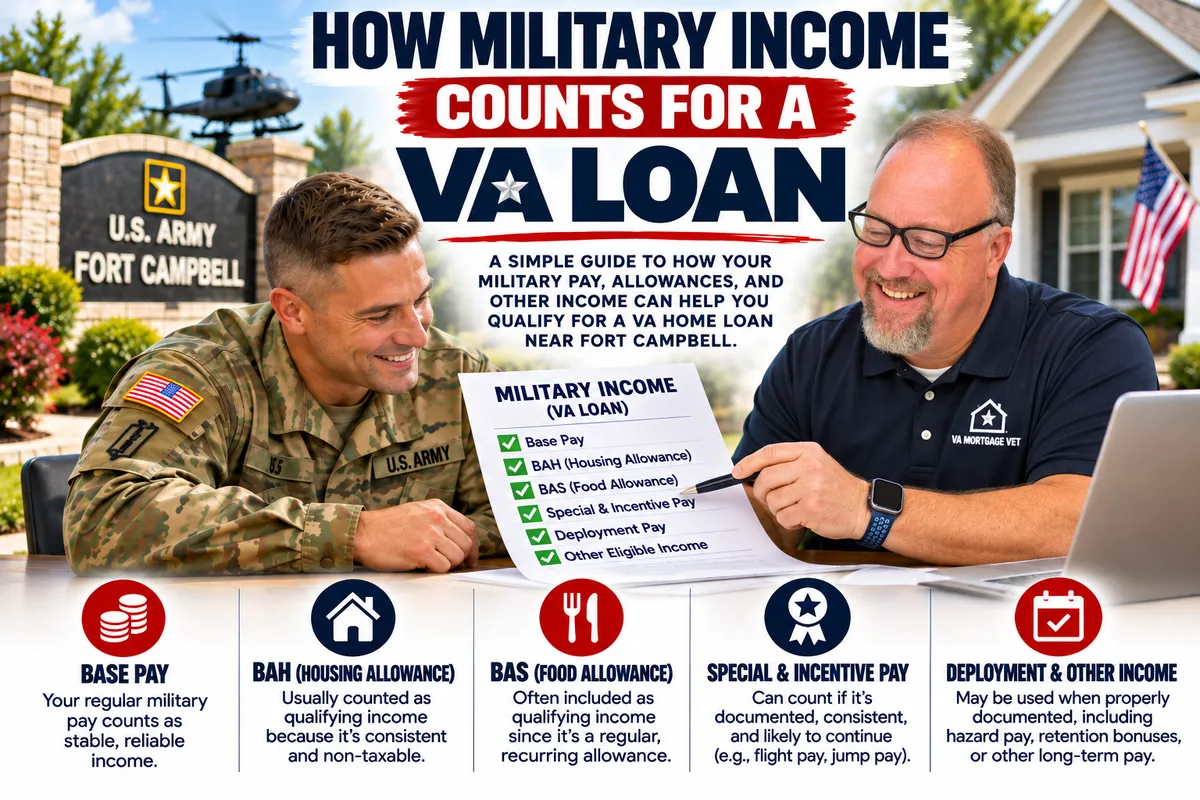
How Military Income Counts for a VA Loan
Your base pay is the number most service members think of as their salary, but it usually is not the number a VA lender uses to approve a mortgage. Allowances and certain types of special pay can be counted too, and because some of that money is not taxed, a lender may count it as more than the dollar figure on your leave and earnings statement. Knowing which pay types qualify, and how they get verified, is the difference between guessing at your budget and knowing what you can afford.
The basic rule: verified, stable, and likely to continue
VA-backed loans require borrowers to meet credit, income, and occupancy requirements set by the VA and by the lender. On the income side, the standard is straightforward. You need sufficient income to cover expected monthly obligations, satisfactory credit, and a valid Certificate of Eligibility.
Military income counts when it is verified, stable, and expected to continue. That is the filter every pay type passes through. A recurring allowance that appears on every statement and will keep coming meets the test. A one-time payment does not.
Which pay types count toward qualification?
Basic pay
Basic pay is the foundation of your qualifying income. It is documented, predictable, and expected to continue for the length of your contract or career, which makes it the easiest piece for an underwriter to accept. Base pay alone is often enough to support a loan, particularly for borrowers carrying modest other debt.
Basic Allowance for Housing
BAH is typically counted as stable qualifying income when three things line up: you receive it consistently, the amount is documented, and your leave and earnings statement supports it. Because BAH varies by duty station and dependency status, the lender looks at what you actually receive, not a published rate. A PCS move that changes your BAH will change the amount a lender can count, so timing matters when you are buying around a move.
Basic Allowance for Subsistence
BAS is commonly counted as well. Like BAH, it is an allowance rather than taxable wages, and lenders treat it much the same way: consistent receipt plus clean documentation equals qualifying income. Officers and enlisted members receive BAS differently, but the underwriting treatment follows similar lines.
Special pay
Some service members can also count certain types of special pay, including flight pay, hazard pay, and combat pay. These get more scrutiny than base pay because they depend on assignment, deployment, or orders that can end. Expect the lender to ask how long you have received the pay and whether anything in your orders or assignment suggests it will continue. Special pay documented over time is far easier to use than pay tied to a single deployment or temporary duty.
Pay type | Typically counts | What the lender reviews |
|---|---|---|
Basic pay | Yes | Contract or orders, pay stability, time remaining |
BAH | Yes | Consistent receipt, LES documentation, duty station |
BAS | Yes | Consistent receipt, LES documentation |
Flight, hazard, combat pay | Often | History of receipt and likelihood of continuation |
One-time or sporadic payments | Rarely | Whether the payment can be shown as recurring |
How the non-taxable gross-up works
BAH, BAS, and many types of special pay are not subject to federal income tax. Lenders recognize that a tax-free dollar stretches further than a taxed one, so they may gross up non-taxable income when calculating your debt-to-income ratio. The commonly cited adjustment is up to 25 percent, with some guidance placing the range at roughly 15 to 25 percent. In practice, $2,000 of BAH might be counted as something closer to $2,500 for qualifying purposes.
The exact figure depends on the lender and how the income is documented, so ask your loan officer how your specific allowances are being treated rather than assuming. This is one reason two households with identical base pay can qualify for very different loan amounts. A borrower with dependents receiving BAH at a higher rate may show more qualifying income than a single borrower at the same grade. The gross-up does not create money, but it does change the math a lender uses.
Stability, continuation, and timing around ETS
VA loans don't have a blanket income limit, and no single minimum income figure applies to every borrower. What matters is whether your income is sufficient for the specific mortgage you are applying for. That calculation runs through your debt-to-income ratio, which compares your expected monthly housing payment plus other debts against your qualifying monthly income.
Time remaining on your contract or orders becomes important for active-duty borrowers. A lender wants reasonable confidence that the income will continue after closing. If your separation date is close, expect questions about your plans, whether you intend to reenlist, and whether you have a job offer or other income lined up. Buyers separating soon are not automatically excluded, but the file needs a clear explanation of what comes next. Raising the topic early keeps it from becoming a late-process surprise.
Income that is harder to count
Not all money on your LES carries the same weight. Bonuses, one-time incentive payments, and pay tied to a temporary assignment usually need history before an underwriter will use them, and some will not be counted at all. If you rely on special pay to reach a target payment, plan for the possibility that a lender counts less than you expect. Building your budget on base pay plus allowances, then treating special pay as a cushion, tends to produce a more comfortable mortgage payment.
Spouse income, retirement pay, and disability compensation can also factor into a VA loan file, but each has its own documentation rules. Ask how each is treated if it's part of your household budget.
Documents that make verification fast
Income verification is where files move or stall. Having the paperwork ready before you apply shortens the timeline, which matters when a PCS move is already setting your schedule.
Your most recent leave and earnings statements showing base pay, BAH, BAS, and any special pay
Your Certificate of Eligibility, which confirms your VA entitlement
Orders or contract documentation showing your current assignment and separation date
W-2s or tax returns for prior years when the lender asks for them
Documentation for any additional income you want counted in the file
If your pay has changed recently, such as after a promotion, a change in dependency status, or a PCS move that adjusted your BAH, say so up front. A lender who understands why a number moved will document it correctly the first time. That single habit prevents more delays than almost anything else on the paperwork side.

Getting the numbers right before you shop
Pre-approval tells you what a lender will count, and that number is often different from the figure a borrower has in mind. The gap usually comes from allowances that were not documented, special pay that cannot be shown as ongoing, or a debt-to-income ratio that leaves less room than expected. Getting pre-approved before touring homes means you are shopping with a real number instead of an estimate.
For buyers around Fort Campbell, the practical question is often how a PCS timeline lines up with a closing date. Income documentation and entitlement confirmation drive that schedule, and both are easier to handle early. Verify current program details with the VA and confirm your specific income treatment with your lender, since individual files vary and underwriting decisions rest on the documentation in front of them.
Frequently Asked Questions
Do BAH and BAS count toward VA loan approval?
Yes. Both allowances are typically treated as stable qualifying income when you receive them consistently, and your leave and earnings statement supports the amount. Because neither is taxable, lenders may gross up the counted figure by up to 25 percent for debt-to-income purposes, with some guidance citing a range of roughly 15 to 25 percent.
Does flight pay, hazard pay, or combat pay count as income?
It can. Lenders may count certain special pay types,s including flight pay, hazard pay, and combat pay. The deciding factors are how long you have received the pay, whether it is documented, and whether it is expected to continue. Pay tied to a temporary assignment or a single deployment is harder to use than pay you have received consistently over time.
What credit and income requirements does a VA loan have?
You need satisfactory credit, sufficient income to meet expected monthly obligations, and a valid Certificate of Eligibility. Both the VA and your lender apply their own requirements, so qualifying means clearing both sets. Active-duty borrowers generally need at least 90 days of active-duty service, and other service history paths exist for veterans and Guard or Reserve members.
Do VA loans have income limits?
VA loans do not have a blanket income limit, and no single minimum income requirement applies to every borrower. What matters is whether your verified, stable income supports the specific mortgage you are applying for. Not every dollar you receive qualifies, so the calculation depends on which pay types a lender will count.
Missed the last post? VA Loan vs. Conventional Loan 2026: Which Saves Fort Campbell Buyers More. For more on VA home loans.