
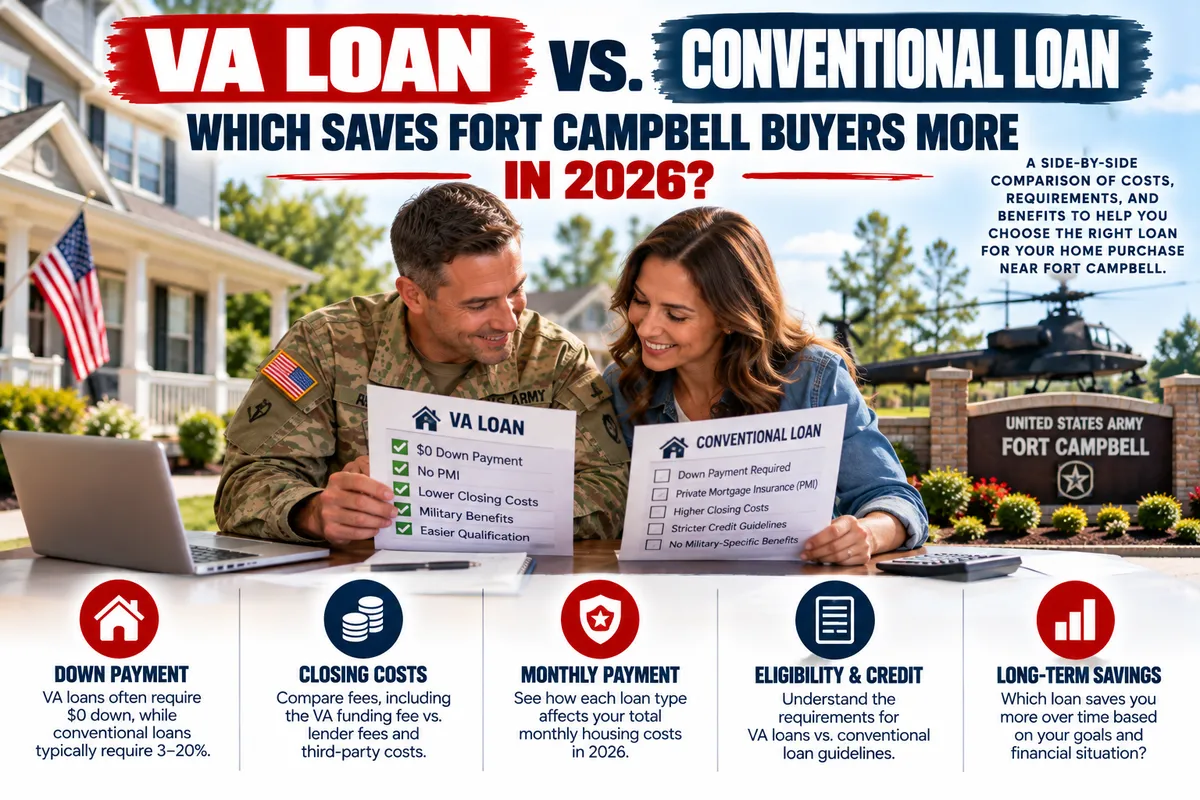
VA Loan vs. Conventional Loan 2026: Which Saves Fort Campbell Buyers More
Most buyers around Fort Campbell have two realistic financing paths: a VA loan backed by the Department of Veterans Affairs or a conventional loan. The better choice depends less on which program sounds stronger and more on your down payment, your credit profile, your long-term plans for the property, and how fast you need to close. This breakdown covers the numbers that actually move a monthly payment for military families in the Clarksville area.
The short answer for Fort Campbell buyers
For most eligible active-duty service members and veterans buying a primary residence in 2026, the VA loan costs less at closing and less each month. You can finance 100% of the purchase price with no down payment and no monthly mortgage insurance, and VA rates have been running below conventional rates in early 2026.
Conventional financing wins in specific situations. Buyers who want a second home or a vacation property cannot use a VA loan for that purpose. Buyers with a large down payment and strong credit may find that a conventional loan without mortgage insurance competes well, particularly once the VA funding fee is factored in. The rest of this article breaks those cases apart so you can see which one fits your situation.
Down payment: 0% versus 3% to 5%
VA loans offer 100% financing with zero cash down. Conventional loans typically require 3% to 5%. On a $450,000 home, a 3% down payment works out to $13,500, and that is money a VA borrower keeps in reserve.
That gap matters most right after a PCS move, when moving costs, temporary housing, and setting up a household have already pulled from savings. Keeping that cash as an emergency fund is often worth more to a military family than a marginally different loan structure.
Buyers who bring 20% down on a conventional loan avoid mortgage insurance entirely, but that requires a substantial sum upfront. For most Fort Campbell families buying in 2026, the zero-down option gets them into a home without draining their accounts.
Mortgage insurance and PMI
VA loans do not require mortgage insurance. Conventional loans with a low down payment typically carry private mortgage insurance, which adds to the monthly payment on top of principal and interest.
This is the line item buyers most often overlook when comparing quotes. A conventional loan can show a competitive interest rate and still cost more per month once mortgage insurance is included. Ask every lender for the full monthly payment, not just the note rate, and ask whether mortgage insurance is part of that figure.
Interest rates in 2026
In early 2026, VA rates are consistently averaging 0.25% to 0.50% lower than conventional rates. On a loan size typical for the Clarksville market, that spread translates into real money over the life of the loan.
Rates move daily and vary by lender, credit profile, and loan structure, so treat any published average as a starting point, not a quote. The spread between VA and conventional pricing is the piece worth tracking, because it tends to hold even as both rates shift up or down.
Credit requirements
The VA does not set a minimum credit score, so the program is often more forgiving on credit than conventional financing. Individual lenders can still apply their own requirements on top of the VA's rules, which is one reason the lender you choose matters as much as the program.
Conventional loans typically carry stricter credit expectations, and pricing adjusts based on score. A buyer who qualifies for both programs may get a better rate on one and a better overall structure on the other. Comparing both side by side, with your actual credit profile, is the only way to know.
The VA funding fee and when conventional wins
VA loans carry a funding fee, a cost conventional loans do not have. While VA loans do not require a down payment or mortgage insurance, the funding fee can make conventional loans a better option for certain borrowers.
That is especially true for buyers who plan to put significant money down anyway and whose credit is strong enough to avoid mortgage insurance on a conventional loan. Run both scenarios with real numbers instead of assuming the VA option always wins on cost. Confirm your own funding fee situation with the VA or your lender before you commit, since the amount depends on your circumstances.

Occupancy rules: primary home versus second home
VA loans require the property to be your primary residence. Conventional loans allow second home purchases with 10% down.
For Fort Campbell families, this usually is not a limitation. You are buying a home to live in while stationed at the installation, or putting down roots in the Clarksville area after service. The rule only matters if you are considering a rental or vacation property, because those move you into conventional or investor financing.
Side-by-side comparison
Feature | VA loan | Conventional loan |
|---|---|---|
Down payment | 0% for eligible borrowers | Typically 3% to 5% minimum |
Mortgage insurance | Not required | Typically applies with a low down payment |
Credit score minimum | No VA minimum; lender requirements apply | Stricter expectations, pricing tied to score |
Occupancy | Primary residence only | Second home allowed with 10% down |
Rate environment, early 2026 | Averaging 0.25% to 0.50% below conventional | Higher average than VA |
Upfront fee | VA funding fee applies | No funding fee |
How PCS timing changes the math
A PCS timeline puts a premium on speed and cash preservation. A VA loan with zero down keeps your savings intact for the move itself, and the absence of monthly mortgage insurance lowers the payment you carry during a stretch when household income may be in transition.
Conventional financing makes more sense when you have time to shop, a large down payment already set aside, and credit strong enough to avoid mortgage insurance. If you are closing in weeks rather than months, ask each lender how their process handles a compressed timeline before you commit to a program.

Questions to ask before you choose
What is the full monthly payment, including mortgage insurance if it applies?
What will the funding fee be, and how does that total compare with a conventional structure?
Does this loan require the property to be my primary residence?
What credit score does this specific lender require for the program?
How much cash will I need at closing after down payment, fees, and reserves?
What this means for a 2026 purchase
For the typical Fort Campbell buyer putting little or nothing down on a primary residence, the VA loan is the lower-cost path in 2026. Zero down, no mortgage insurance, and a rate advantage of 0.25% to 0.50% combine into a payment that conventional financing struggles to match at the same price point.
Conventional financing earns its place for buyers with a large down payment, strong credit, or plans that involve a second home. The funding fee is the one variable that can flip the comparison, so it deserves a real number, not an assumption. Get both scenarios quoted with your actual credit profile and cash position, then choose the structure that leaves your family with the most breathing room after closing.
Frequently Asked Questions
Is a VA loan always cheaper than a conventional loan in 2026?
No. The VA loan usually wins for a low-down-payment purchase of a primary residence, because there is no down payment and no mortgage insurance. A conventional loan can be cheaper for buyers who put down substantial money, have strong credit, and want to avoid the VA funding fee. Compare both with real numbers.
Can I buy a second home with a VA loan?
No. VA loans require the property to be your primary residence. If you want a second home or vacation property, conventional financing lets you buy with 10% down. Keep this rule in mind if you are planning to keep a home as a rental after a future PCS move.
What credit score do I need for a VA loan?
The VA does not set a minimum credit score, so the program is often more forgiving on credit than conventional financing. Individual lenders can still apply their own requirements on top of the VA's rules. Ask your loan officer directly what their company requires before you assume you do or do not qualify.
Does the VA funding fee ever make a conventional loan the better choice?
It can. While VA loans don't require a down payment or mortgage insurance, the funding fee can make conventional loans a better option for certain borrowers, especially those putting down a significant amount and having credit strong enough to skip mortgage insurance. Confirm your own funding fee amount with the VA or your lender before deciding.
How much down payment do I need for a conventional loan?
Conventional loans typically require 3a minimum down payment of % to 5%. On a $450,000 home, a 3% down payment is $13,500. Second home purchases under conventional financing generally require 10% down. Putting 20% down is what typically removes mortgage insurance from the payment.
Missed the last post? Oak Grove, KY vs. Clarksville, TN: Choosing Your Side of Fort Campbell. For more on VA home loans.