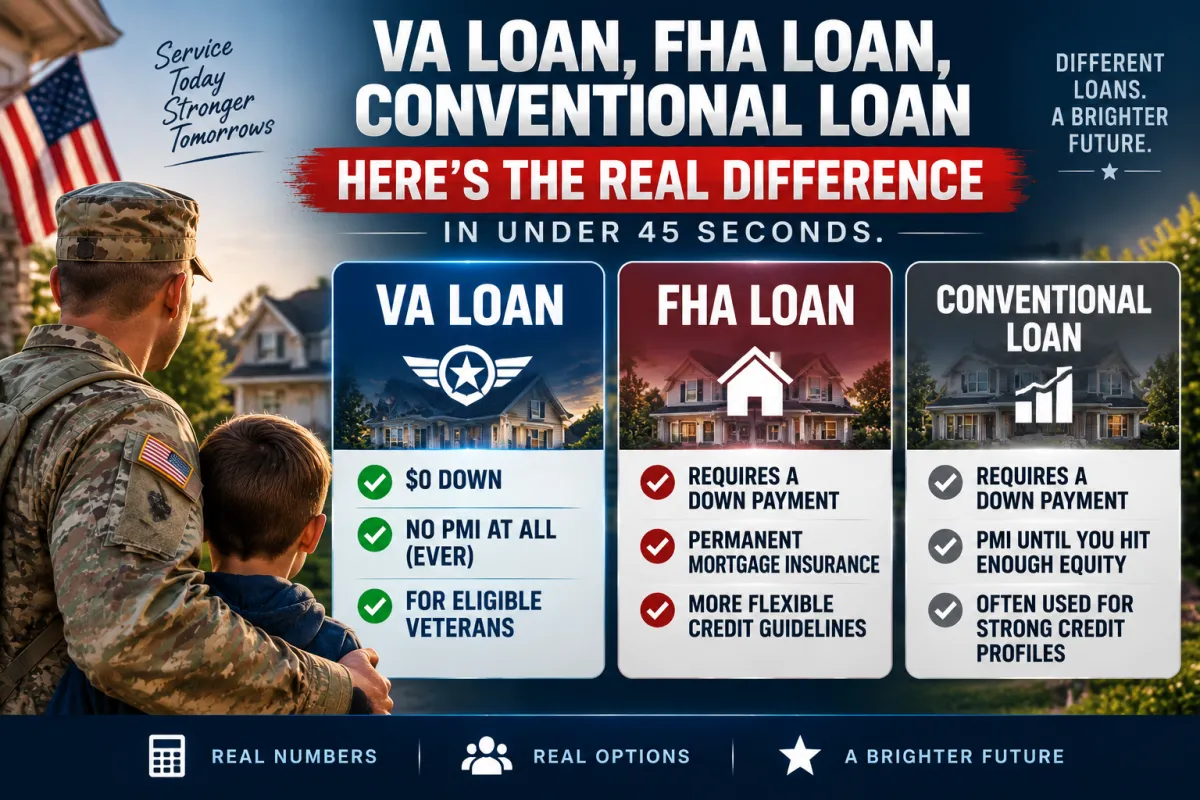
VA Loan FHA Loan Conventional Loan and Here Is the Real Difference Every Veteran Should Understand
Three Loan Programs and Why One of Them Usually Wins for Veterans
VA loan. FHA loan. Conventional loan. Most veterans have heard all three mentioned but not everyone has seen them compared side by side with actual dollar figures attached. Travis Egan runs those numbers so veterans can see the difference in dollars rather than talking points.
What FHA Actually Requires
FHA financing requires a down payment. The minimum is three and a half percent for qualifying borrowers. FHA also requires mortgage insurance and unlike some other programs that mortgage insurance is permanent for the life of the loan in most cases. It does not fall off when you reach a certain equity threshold. You pay it for as long as you hold that FHA loan.
What Conventional Actually Requires
Conventional financing also requires a down payment. The minimum can be as low as three percent for qualifying first-time buyers but most conventional loans require more. Conventional loans also carry private mortgage insurance when the down payment is below twenty percent. The difference from FHA is that PMI on a conventional loan can be removed once sufficient equity is established. It is not permanent. But until you get there you are paying it every month.
What VA Actually Requires
Zero down payment for eligible veterans. No PMI at all. Not until you reach a certain equity level. Not for a defined period. Never. For an eligible veteran the VA loan eliminates both of the upfront barriers that FHA and conventional put in front of buyers.
Why the Side-By-Side Comparison Usually Is Not Close
When you run the actual numbers on what a veteran pays monthly and at closing under each of the three programs the VA loan typically produces a meaningfully better outcome. No down payment means more cash stays in the veteran's pocket at closing. No mortgage insurance means a lower monthly payment for the entire life of the loan. That is not a marginal advantage. On a typical loan amount it represents thousands of dollars over time.
Travis Egan runs actual numbers for each veteran's specific scenario so the comparison is in dollars rather than general statements about which program is better in theory. Got questions about what the numbers look like for your situation? DM Travis Egan directly. He is here to help. Semper Fi.
Sources
VA.gov
HUD.gov
FannieMae.com
ConsumerFinancialProtectionBureau.gov
MortgageNewsDaily.com