
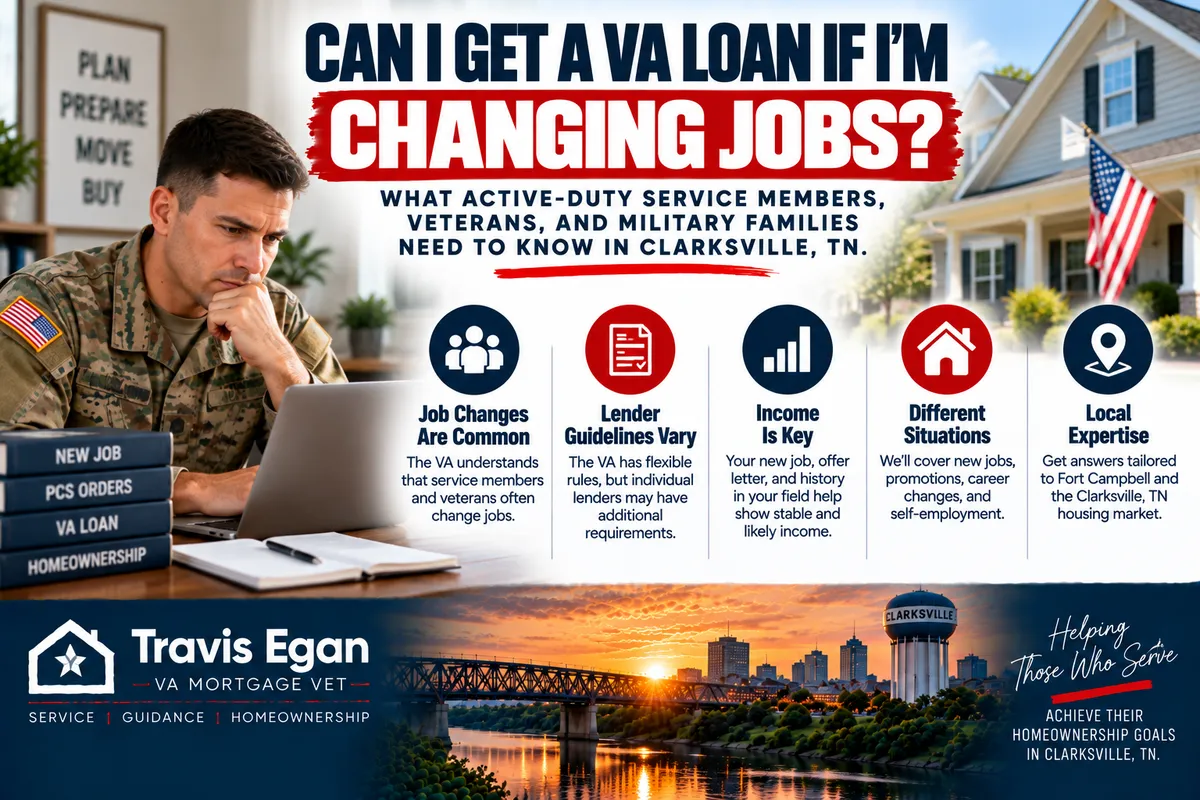
Can I Get a VA Loan If I'm Changing Jobs?
Yes, you can still get a VA loan when you change jobs. A new employer, a promotion, a relocation, or a move from active duty to civilian work doesn't automatically disqualify you. The lender must determine whether your new income is stable, reliable, likely to continue, and acceptable under VA and lender underwriting guidelines.
Borrowers rarely run into trouble because of the job change itself. It is the timing, the paperwork, and the silence. A loan already sitting in underwriting can slow down or require new documents when employment changes and nobody tells the loan officer.
VA Loan Changing Jobs: Can You Still Qualify?
Qualifying after a job change depends on how your employment and income history reads as a whole. Lenders review your complete work history, not just your latest pay stub. There is no blanket rule that you must spend a set number of years with one employer before a VA loan becomes available to you.
VA guidelines generally require two years of stable income, and that income doesn't have to come from the same employer or position. Frequent job changes don't automatically disqualify you, especially if you have stayed in the same field or industry. Lenders are looking for a pattern of steady work with consistent or rising earnings.
Staying in the same occupation or line of work makes a transition easier to document than switching into an entirely different career. A nurse who moves from one hospital to another is still a nurse, and the new salary can be measured against a clear history. A career pivot into unfamiliar work has no track record to back up the new income.
How Underwriting Views Common Job Changes
Not every job change carries the same weight. Underwriting tends to sort them by how much history supports the new income and how continuous the work remains.
Scenario | How it is typically viewed |
|---|---|
New salaried job in the same industry, equal or higher pay | Often low risk. An offer letter and future employment verification are commonly needed. |
Promotion with your current employer or within the same field | Generally viewed favorably because the work history stays continuous. |
Relocating with the same employer | Employment continues, so the income story stays intact. |
Moving from hourly to salaried employment | Often seen as more stable, as long as the new income is documented. |
Switching from W-2 employment to commission income | Higher scrutiny. Commission income may need a two-year history before it can be used. |
Moving into self-employment or 1099 contractor work | Higher scrutiny. New self-employment income usually needs a longer history. |
Starting a job with significant bonus or overtime income | Base pay is straightforward. Bonus and overtime may need an established history to count fully. |
Separating from active duty into civilian employment | Military income cannot simply be assumed to continue. A confirmed civilian job changes the picture. |
Two patterns sit behind that table. Industry continuity protects you, while variable or self-generated income takes time to prove. If a new role shifts a large share of your pay into commission, bonuses, tips, or overtime, plan to qualify with the guaranteed portion until the rest has a track record.
Leaving Active Duty: What Service Members Should Know
Separating from the military is one of the most common job changes a VA lender sees, and also one of the most misunderstood. Your military income generally cannot be assumed to continue after separation. A lender cannot simply project active duty pay forward as though nothing is changing.
What helps is a confirmed civilian job offer or documented new employment with a clear start date, a defined salary, and an employer willing to verify the details. When that exists, underwriting can evaluate a real income source instead of an assumption.
If you are approaching ETS, retirement, or another separation date, tell your lender as early as possible. The sooner the loan officer knows, the sooner they can gather paperwork and the fewer surprises you'll face during underwriting.
How Employment Gaps Affect a VA Loan
A gap in your work history does not automatically disqualify you from a VA loan. Lenders regularly handle employment gaps, contract work, and military leave. Lenders may need to understand why the gap occurred and evidence that your current employment and income are stable.
General industry guidance treats short and long gaps differently. A gap of roughly 30 days or less is typically acceptable without much explanation. A gap stretching beyond six months may require several months back on the job before the new income can support the file. If you took time off for school, caregiving, health reasons, or a deployment-related absence, be ready to explain it plainly and support it with documentation.
Job Offer Letters and Employment Contracts
In some circumstances, a lender may be able to use income from employment that begins shortly before or after closing. That is usually the real question behind whether an offer letter is enough.
The honest answer depends. Requirements vary by loan type, lender guidelines, how far out the start date is, what the employer provides, and whether you have enough funds available to cover expenses before the new income begins. An offer letter alone is not guaranteed to satisfy underwriting. Treat it as one piece of evidence and confirm what your specific file needs.

What If I Change Jobs During the VA Loan Process?
Tell your loan officer before you make the change whenever that is possible. Even a quick heads-up beats being asked about it at the closing table.
Lenders commonly verify employment again near closing, sometimes verbally and sometimes in writing, to confirm nothing changed since the file was underwritten. An undisclosed job change can delay underwriting, trigger a request for new documentation, or affect the approval itself. If you do switch mid-process, expect to supply an offer letter, an employment contract, or recent pay stubs.
Why Income Type Matters
A new fixed salary is usually the easiest income to qualify with because it is predictable. The lender knows what arrives each pay period, and the amount doesn't change.
Income that depends heavily on commission, overtime, bonuses, tips, or self-employment behaves differently. Industry guidance often requires a two-year history of commission income before it can be counted, and the same logic applies to other variable pay. You may still qualify, but the guaranteed portion of your pay carries more weight until the rest has proven itself.
Three Borrowers, Three Different Outcomes
A nurse leaves one hospital for another across town at higher pay. Same occupation, same industry, better compensation, continuous employment. The lender needs an offer letter and verification that the job is real and starting on schedule. Files like this tend to move smoothly.
A service member separates from active duty with a signed civilian job offer. Military pay is ending, so it cannot be projected forward. Underwriting evaluates the new job as income, along with the start date and the gap between the last military paycheck and the first civilian one. Timing and documentation carry this file.
A salaried W-2 employee leaves that job to become a newly self-employed contractor. The income may be real, but it has no history. Underwriting typically wants to see how self-employment income performs over time before using it to qualify. That borrower may need to wait, qualify on another income source, or rely on a co-borrower's documented income. The job change was not the problem. The missing history was.

Checklist for Changing Jobs During the Mortgage Process
Talk to your loan officer before you resign, not after.
Provide the offer letter or employment contract as soon as you have it.
Confirm your start date and compensation structure in writing.
Do not assume bonuses, overtime, or commissions will qualify immediately.
Keep enough funds available for closing costs and any required reserves.
Stay reachable, since lenders often verify employment again before closing.
Share your ETS, retirement, or separation date early.
None of this is meant to discourage a career move. It is meant to keep your loan on schedule while you make it. A short call before the change usually costs nothing and prevents a great deal of rework later.
Frequently Asked Questions
Can I get a VA loan if I am changing jobs?
Yes. A job change does not automatically disqualify you from a VA loan. The lender evaluates whether your new income is stable, reliable, likely to continue, and acceptable under VA and lender guidelines. Moves within the same industry with equal or higher pay are generally treated as low risk, and an offer letter plus future employment verification is commonly required.
Does a VA loan require two years with the same employer?
No. VA guidelines generally require two years of stable income, but that income doesn't have to come from the same employer or position. Frequent job changes don't automatically disqualify you, especially if you have stayed in the same field or industry. Lenders care more about the continuity of your work than about the name on your pay stub.
Can I qualify for a VA loan using a job offer before I start?
Sometimes, but only when the new income can be documented the way the lender requires. Requirements vary by loan type, lender guidelines, start date, documentation, and whether you have funds available to cover expenses before the new income starts. An offer letter alone is not guaranteed to be enough, so confirm the specifics with your loan officer first.
Will an employment gap disqualify me from a VA loan?
No. Employment gaps do not automatically disqualify you. The lender may want to understand why the gap happened and confirm that your current employment and income are stable. Short gaps of roughly 30 days are typically acceptable, while a gap beyond six months may call for several months back on the job before that income can be used.
Missed the last post? VA Loan Lender Requirements vs. VA Minimums Explained. For more on VA home loans.