
Why Does Dave Ramsey Not Recommend VA Loans?
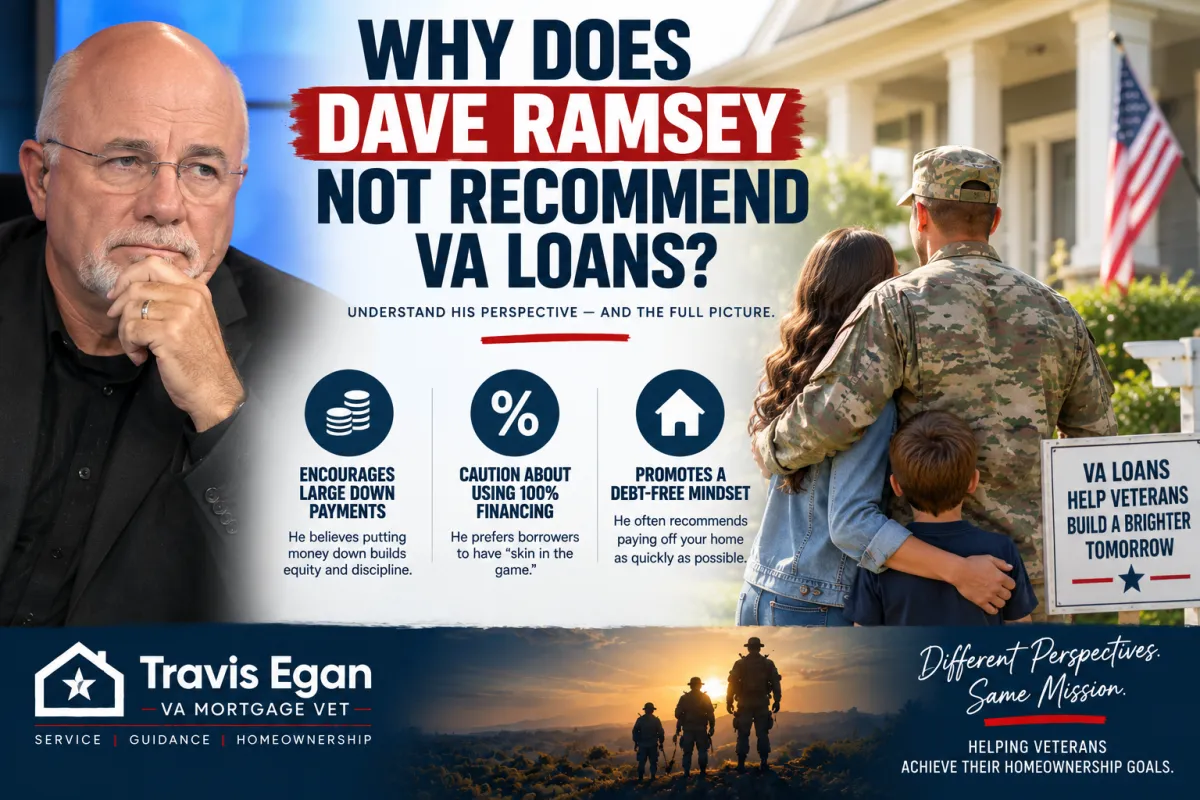
Dave Ramsey and Ramsey Solutions generally do not recommend VA loans. Their published reasoning rests on two objections: a VA loan can be taken with no down payment, which means a buyer may start with little or no equity, and many VA borrowers pay a VA funding fee. Ramsey's broader advice favors a 15-year fixed-rate conventional mortgage, a substantial down payment, housing costs kept low relative to take-home pay, and paying the loan off quickly. That position flows from his debt-avoidance philosophy, not from VA eligibility or underwriting rules.
Why Does Dave Ramsey Not Recommend VA Loans?
The short answer is that his objection isn't really about veterans or the VA program itself. It is about how the loan is structured relative to the way he believes people should handle money. Two features of the VA loan directly conflict with that framework.
Zero down payment. A VA loan lets an eligible borrower buy with no down payment. Ramsey Solutions frames this as risk, writing that "the zero down payment leaves you vulnerable." In his view, a buyer who puts nothing down owns no equity on day one and has no cushion if the market shifts.
The VA funding fee. Ramsey Solutions' own VA loan guide lists a funding fee it describes as between 1.4% and 3.6% of the loan amount. From Ramsey's perspective, that is an added cost attached to a loan he already considers less attractive than a conventional mortgage.
Ramsey has also argued in his syndicated column that VA loans "are usually more expensive, with the interest rate and all the fees, than FHA or conventional loans." Mortgage professionals have disputed that claim, noting that VA interest rates aren't automatically higher than conventional rates and that pricing depends on the lender, the borrower, and the market on any given day.
It helps to separate two things that often get blended. Ramsey's position is a personal finance philosophy about debt, equity, and payoff speed. VA loan rules are eligibility and underwriting standards set by the Department of Veterans Affairs. An eligible veteran can follow Ramsey's philosophy inside a VA loan by making a down payment, or follow a different philosophy by using the 0% down feature. The program permits both.
Dave Ramsey's Mortgage Philosophy
To understand the VA loan advice, it helps to see the framework it comes from. Ramsey's standard mortgage guidance has been consistent for years.
Pay off all consumer debt and build a fully funded emergency fund before buying a home.
Use a 15-year fixed-rate conventional mortgage rather than a longer term or an adjustable structure.
Keep the monthly payment at or below roughly 25% of take-home pay, a guideline Ramsey Solutions applies even while noting that "you can probably qualify for a much larger loan than what 25% of your take-home pay will give you."
Make a substantial down payment, ideally 20% or more, to avoid mortgage insurance and build equity.
Pay the mortgage off as quickly as possible.
Notice what that framework rewards: a large upfront cash commitment, a short loan term, and a payment that feels small relative to income. A VA loan with nothing down does the opposite on the cash side. It asks for less money upfront and stretches the balance over a longer term, which is exactly the pattern Ramsey warns against in other areas of personal finance.
What Ramsey Solutions Says About VA Loans
Ramsey Solutions has addressed VA loans in several places. In an October 2021 syndicated column, Ramsey argued that better options exist than a VA loan, listing higher cost as the first reason. In its VA loan guide, published in November 2021 and later updated, the drawbacks section highlights the zero-down-payment vulnerability and the funding fee.
Two things are true at once here. First, those are real features of the program, and any veteran comparing loans should understand them. Second, the framing is general rather than borrower-specific. It does not account for whether a particular veteran is exempt from the funding fee, whether a seller is covering closing costs, whether the borrower plans to make a down payment anyway, or how the VA loan prices against a conventional offer on the same day with the same credit profile.
Critics push back hardest on the interest rate claim. VA loans are not inherently higher-rate loans. Lenders price them in a competitive market, and VA pricing is often competitive with conventional pricing for borrowers with similar credit. That does not mean VA always wins. It means you have to run the comparison with actual loan estimates rather than assumptions.
What Ramsey Gets Right About VA Loan Risk
Some of the caution is legitimate, and veterans should not dismiss it just because they disagree with the conclusion.
Short-horizon risk is real. If a veteran buys with nothing down and has to sell within a year or two, transaction costs and any drop in value can leave the borrower owing more than the home is worth. That is a genuine exposure, and military life includes unexpected moves.
Financing the funding fee increases the balance. When the fee is rolled into the loan rather than paid in cash, the borrower owes more from the start, which compounds the thin-equity issue.
Pre-approval is not a budget. Being approved for a large amount does not mean the payment will feel comfortable alongside childcare, fuel, or the cost of a PCS.
Housing costs should stay proportional. A payment that eats too much of take-home pay creates stress whether the loan is VA or conventional.
None of those points argue that VA loans are bad. They argue that the amount borrowed and the holding period matter more than the loan label.
Where VA Loans Can Be Different for Veterans
This is where the general advice and the specific program start to separate. Several features of the VA loan work differently from how they are often described.
A VA Loan Does Not Require Zero Down
This is the most common misunderstanding. The VA allows a 0% down payment option, but it doesn't require one. An eligible veteran can put down 5%, 10%, 20%, or any other amount the lender allows. A veteran who agrees with Ramsey's philosophy can use a VA loan, put 20% down, and still keep the features that make the VA program valuable. Nothing about the loan type forces a thin-equity purchase.
No Monthly Private Mortgage Insurance
Conventional loans with less than 20% down typically carry private mortgage insurance, an added monthly cost that protects the lender, not the borrower. VA loans do not require monthly private mortgage insurance. For a veteran weighing a small down payment, that difference can matter more to the monthly budget than the funding fee, which is a one-time cost.
The VA Funding Fee Depends on the Borrower
The funding fee isn't a flat charge every veteran pays. It varies by eligibility category, down payment size, and whether the borrower has used the VA benefit before. A larger down payment generally reduces the fee. Many veterans who receive VA compensation for a service-connected disability are exempt from paying it at all. Any veteran should confirm their specific status with the VA or their lender rather than assuming the fee applies.
Underwriting, Residual Income, and Credit Flexibility
VA underwriting includes a residual income calculation, which looks at how much money remains after major obligations are covered. That is a different lens than a pure debt-to-income cutoff, and it can help borrowers whose profile might otherwise be tight. VA guidelines also tend to allow more flexibility on credit history than some conventional programs, depending on the lender's own overlay. On the closing cost side, VA rules limit certain fees a veteran can be charged, and sellers can often contribute toward a buyer's closing costs. Specifics vary, so ask your lender to walk through the details for your file.
Interest Rate Considerations
VA loans may offer competitive interest rates, but they are not guaranteed to beat conventional pricing. Rates move with the market, and the final number depends on credit score, loan amount, down payment, and lender. The honest approach is to request loan estimates for both options on the same day and compare the rate, the total cost, and the monthly payment side by side.

VA Loan vs. Conventional Loan for a Veteran
The table below compares the two structures for an eligible veteran. Neither column is automatically better. The right answer depends on the borrower's cash position, timeline, and goals.
Feature | VA loan | Conventional loan |
|---|---|---|
Down payment | 0% allowed for eligible borrowers; larger down payments permitted | Typically 3% to 20%; 20% avoids mortgage insurance |
Monthly mortgage insurance | None required | Usually required when down payment is under 20% |
Upfront fee | VA funding fee, range described by Ramsey Solutions as 1.4% to 3.6%; varies by down payment and prior use; many disabled veterans exempt | No VA funding fee; lender fees and standard closing costs still apply |
Equity at closing | Zero if no down payment is made; more if the buyer puts money down | Rises with the size of the down payment |
Interest rate | Priced by the lender in a competitive market; not automatically higher | Priced by the lender; often similar for comparable borrowers |
Credit and underwriting | VA guidelines plus residual income analysis; flexibility varies by lender | Lender guidelines; mortgage insurance rules apply below 20% down |
Closing costs | VA rules limit certain fees; seller contributions are common | Negotiable with the seller; no VA-specific limits |
Loan term | 15 or 30 years typical | 15 or 30 years typical |
Occupancy | Intended for a primary residence | Available for primary, second, and investment properties |
If you are a veteran comparing offers, the fair test is not "VA versus conventional" in the abstract. It is your VA loan estimate versus your conventional loan estimate, with your actual numbers, on the same property.
What the Numbers Look Like: 0% Down VA vs. 20% Down Conventional
Consider a $300,000 purchase price and two paths. These figures are illustrative math, not quotes.
On the VA path with no down payment, the cash required at closing comes from closing costs and prepaid items, not a down payment. If the funding fee applies and is financed into the loan, the balance grows by an amount within the range Ramsey Solutions describes, roughly $4,200 to $10,800 on a $300,000 loan, depending on the applicable percentage. The veteran keeps cash in reserve, the monthly payment carries no private mortgage insurance, and the loan balance starts at or near the full purchase price.
On the conventional path with 20% down, the buyer brings $60,000 in cash plus closing costs. The loan balance is $240,000; there is no mortgage insurance, and the buyer starts with $60,000 of equity. The trade-off is liquidity. That $60,000 is no longer available for an emergency fund, a PCS, a vehicle, or a home repair.
Now change one variable. A conventional buyer who puts 5% down brings $15,000 in cash and usually pays private mortgage insurance every month until the loan reaches the required equity threshold. The VA borrower with nothing down pays no such monthly premium. That is a meaningful difference in monthly cost, and it is a point the general "VA loans are more expensive" framing tends to miss.
A third path arguably satisfies both philosophies: a VA loan with a down payment large enough to reduce or eliminate the funding fee, retain no monthly mortgage insurance, and start with real equity. Eligible borrowers can use that structure, and it's worth pricing.
The Equity Question: Should a Veteran Buy With No Money Down?
Buying with 0% down increases exposure to short-term market declines. If values fall and the veteran has to sell quickly, the proceeds may not cover the loan balance and selling costs. That risk is real, and it deserves a direct answer, not a sales pitch.
The counterweight is that cash has value too. A veteran with limited savings and a PCS on the horizon may be better served by keeping reserves than by draining them for a down payment, especially if the alternative is a conventional loan that carries monthly mortgage insurance. A veteran with strong savings and a long holding period may prefer to put money down and start with equity.
Both answers can be correct for different people. The decision comes down to how long you expect to own the home, how stable your income is, how much cash you want to keep in reserve, and how the two loan estimates compare on total cost.

When a VA Loan May Make Financial Sense
Sometimes the VA structure lines up well with a veteran's actual circumstances.
Limited savings but high income. A veteran who can comfortably cover the payment but not $60,000 upfront may build equity over time without weakening their emergency fund.
Funding fee exemption. Veterans who receive VA compensation for a service-connected disability and are exempt from the fee remove Ramsey's second objection entirely.
Seller-paid closing costs. In markets where sellers contribute, a veteran can reduce upfront cash even further.
No mortgage insurance. On a low-down-payment purchase, avoiding a monthly insurance premium can offset other costs over the life of the loan.
Short time to a PCS. Keeping cash liquid through a move can be worth more than early equity, as long as you plan the holding period carefully.
A down payment on a VA loan. Veterans who want Ramsey-style equity can put money down and still use the VA program.
For veterans and military families around Fort Campbell, the practical answer is to run both scenarios with a loan officer who regularly handles VA files and can explain where the numbers land for your specific situation.
Frequently Asked Questions
Why does Dave Ramsey say the VA loan is a trap?
His stated concerns are that a zero down payment leaves a buyer with no equity and that many VA borrowers pay a funding fee. Critics argue the word trap overstates the case, since the VA program allows a down payment, does not require monthly mortgage insurance, and exempts many disabled veterans from the funding fee. His advice reflects a debt-avoidance philosophy rather than a claim that veterans should not use their benefit.
Are VA loan interest rates higher than conventional rates?
Not automatically. Ramsey Solutions has claimed that VA loans are usually more expensive. Still, mortgage professionals have disputed it, noting that VA rates are set by lenders competing in the same market as conventional loans. Pricing depends on credit, loan amount, down payment, and lender. The best way to know is to compare loan estimates for both options on the same day.
Do all VA borrowers pay the VA funding fee?
No. The fee varies based on eligibility category and down payment size. Whether the borrower has used the VA benefit before, and it is often waived for veterans receiving VA compensation for a service-connected disability. Ramsey Solutions describes the range as 1.4% to 3.6%. Confirm your specific status and current figures with the VA or your lender before assuming a fee applies.
Can I put money down on a VA loan?
Yes. The VA allows a 0% down payment option, but it does not require one. An eligible veteran can put down 5%, 10%, 20%, or more, depending on the lender. A larger down payment can start the buyer with equity, may reduce the funding fee, and still keep VA features such as no required monthly mortgage insurance.
Does Dave Ramsey recommend VA loans?
Generally, no. Ramsey and Ramsey Solutions steer borrowers toward a 15-year fixed-rate conventional mortgage with a substantial down payment and a payment near 25% of take-home pay. That guidance is consistent with his broader approach to debt. It does not change VA eligibility rules, and an eligible veteran can still choose a VA loan based on their own cash position, timeline, and long-term plans.
For an eligible veteran, the useful conclusion is not that one loan type wins every time. It is that the VA program gives you options, including the option to put money down, and that the right choice comes from comparing real loan estimates against your timeline, reserves, and goals rather than applying a general rule to every borrower.
Missed the last post? Check out How Much Income Do You Need for a $500,000 VA Loan? For more on VA home loans.