
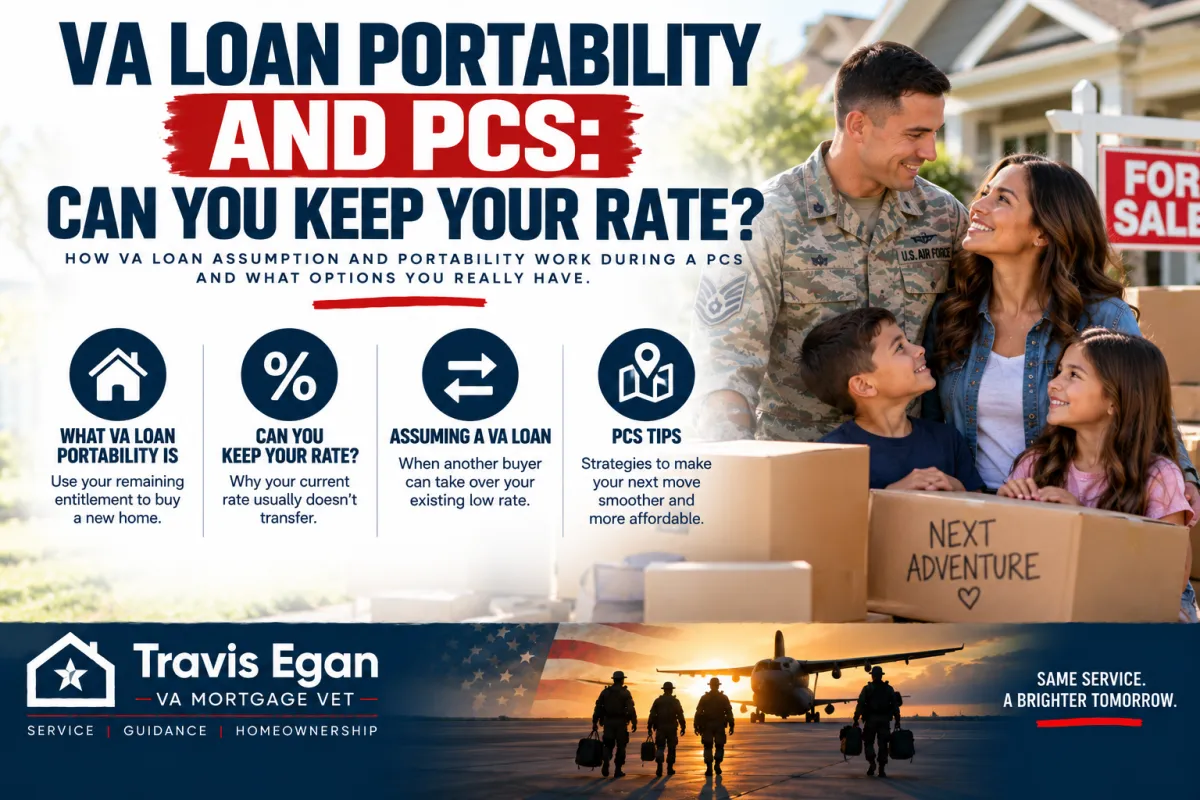
VA Loan Portability and PCS: Can You Keep Your Rate?
PCS orders show up, the moving truck gets scheduled, and somewhere on the checklist sits a question without a clean answer. What happens to the VA loan on the house you are leaving behind, and can you carry that low rate to the next duty station?
The short answer is that VA loan portability does not work the way most people assume. You cannot unbolt a mortgage from one house and reattach it to another at the same rate. You can use your VA entitlement again and, in specific situations, transfer your existing loan and its interest rate to a buyer through an assumption.
What VA Loan Portability Actually Means
In everyday language, portability means the loan follows you. VA loans don't work that way. A mortgage is tied to a specific property, and the rate, term, and payment schedule live inside that loan agreement. When you sell the property, the loan is either paid off or transferred to whoever takes over the home.
What is portable is your VA entitlement, the guarantee that lets a lender offer a VA loan in the first place. When you move on to your next PCS and your next home, you can apply for another, brand-new VA loan. The entitlement you used at your last duty station does not permanently disappear after a single purchase.
That distinction changes the question you should be asking. Instead of figuring out how to keep your rate, the practical decision becomes:
Do you keep the old home and rent it out?
Do you sell it and pay off the loan?
Do you sell it to a buyer who assumes the VA loan and takes over your existing rate?
Each path leaves you in a different financial position at your next duty station.
Can You Keep Your Interest Rate When You PCS?
Not on a new home purchase. Your existing VA loan rate stays with your existing VA loan. If you buy again at your new duty station, you take out a fresh mortgage priced at whatever the market offers when you close. A rate you locked years ago does not travel with you to a new address.
One scenario lets a VA interest rate carry forward, and it has nothing to do with you moving. VA loans are assumable, which means the assuming borrower takes over the original terms, payments, and any legal responsibility associated with the loan. If you sell your home to a qualified buyer who assumes the loan, that buyer inherits your rate instead of financing at today's rate.
That can be a real advantage when rates have climbed since you bought. It can also be the selling point that moves your home faster in a soft market, especially if your rate sits below what a new buyer could get on their own.
Three Ways to Handle a VA-Financed Home When You PCS
Moving with PCS orders leaves homeowners with a few established paths: convert the home to a rental, sell through an assumption, or sell traditionally. Refinancing can also make sense in certain situations, though it doesn't, by itself, answer what happens to the property after you leave.
Option | What happens to the loan | Typically considered by |
|---|---|---|
Rent the home out | The mortgage stays in your name and payments continue after you leave | Owners with rental demand, a manageable payment, and reserves for vacancies and repairs |
Sell with a VA loan assumption | The buyer takes over the original terms, payments, and legal responsibility, subject to loan holder or VA approval. | Sellers whose existing rate is attractive and who have time for an approval review |
Traditional sale | The loan is paid off at closing, and the debt leaves with the house | Sellers who want a clean break and do not need to keep the property |
How a VA Loan Assumption Works
For all VA loans committed on or after March 1, 1988, you may sell your home to someone who agrees to assume your loan if the loan holder or VA approves it. That approval step is the part sellers underestimate. An assumption is not automatic just because a buyer is willing to sign.
VA loans are transferable as long as your lender allows it, and the process is formally called a loan assumption. Some servicers handle assumptions routinely, while others move slowly. The buyer generally must qualify, and the loan must meet whatever requirements the servicer and the VA apply. Once approved, the buyer steps into your original terms and payments and assumes legal responsibility for the debt.
After the move, confirm your entitlement status with your servicer and the VA. Restoration questions depend on your specific loan history and the details of the assumption, so treat your lender and the VA as the final word rather than a forum post.
Using Your VA Loan Again at Your Next Duty Station
Veterans can use VA loan entitlement to buy a new primary residence when they relocate, subject to lender approval. In plain terms, a PCS move gives you a legitimate reason to buy again with a VA loan, and your entitlement is built to support that.
Two things make the second purchase smoother. First, start the conversation before you have orders in hand. A lender can review your entitlement and walk you through what is available. Second, be clear about the status of the home you are leaving. If the old mortgage is still in your name, that payment stays part of your financial picture when a lender reviews your next application, whether the house is rented or sitting empty.
This is where an experienced guide matters. The order in which you sell, rent, assume, and buy affects what you can qualify for, and getting the sequence wrong can cost you the home you want at the new duty station.
Assumption or a Brand-New VA Loan?
The two paths solve different problems, and mixing them up leads to bad decisions.
A loan assumption keeps the old mortgage and its rate alive for a buyer. You exit the debt, but you don't get a new low rate.
A brand-new VA loan is how you finance your next primary residence. It comes with current market pricing and its own closing process.
PCS orders do not cancel your current mortgage. Until you sell or refinance the home, you still manage that payment.
Military Protections and Options During a PCS
Active-duty service members have special military protections and options that can help manage a mortgage during a transition. What fits your situation depends on your timeline, your budget, and your long-term goals.
A short tour that ends with a return to the same duty station looks very different from a move you expect to be permanent. Renting the home can preserve an asset and cover the payment. Selling through an assumption can move the loan off your file while giving a buyer a rate they could not get today. A traditional sale closes the chapter cleanly. None of these is universally right, and the wrong one can leave you carrying two housing costs at once.
Planning the Timeline Around Your Orders
Assumptions and sales both take time, and PCS timelines rarely cooperate. If you need an assumption to work, start early. A buyer must be found, qualified, and approved by the loan holder or the VA, and that review doesn't happen overnight.
If you plan to rent, run the numbers before you leave. A property manager, a realistic rent estimate, and a cushion for vacancies and repairs matter more than a hopeful projection.
If you plan to buy at the new duty station, get your pre-approval moving as soon as you have orders. Fast approval timelines exist for VA borrowers, but they still depend on documents, and documents are harder to gather from a hotel room or temporary lodging.

Working With Someone Who Knows the PCS Cycle
Travis Egan is a VA mortgage specialist and Marine Corps veteran based in Clarksville, Tennessee, serving military families connected to Fort Campbell and the surrounding area. Through Loan Factory, he works with buyers and sellers on VA purchase loans and IRRRL refinances, including $0 down options and PCS relocation planning. If your orders are in hand and the clock is running, the free VA Homebuyer's Guide and the mortgage calculators on the site are a good first stop before you talk numbers with anyone.
Frequently Asked Questions
Can I keep my VA loan interest rate when I PCS?
Not on a new home. Your rate stays attached to the existing loan and property. When you buy at your next duty station, you take out a new VA loan priced at the market at that time. Your current rate only benefits someone else through a loan assumption, where a buyer takes over your original terms.
Are VA loans assumable?
Yes. VA loans are assumable, meaning the assuming borrower takes over the original terms, payments, and legal responsibility for the loan. For loans committed on or after March 1, 1988, you may sell your home to someone who agrees to assume the loan if the loan holder or the VA approves it.
Can I rent out my VA-financed home after a PCS?
Converting the home to a rental is a standard option when you move with PCS orders, alongside selling through an assumption or selling traditionally. The mortgage stays in your name and payments continue, so plan for property management, tenant turnover, and repair costs before you commit.
Will my PCS orders cancel my existing mortgage?
No. PCS orders do not cancel your current mortgage, so you still need a plan for the payment while you transition. Active-duty service members do have military-specific protections and options that can help, and the right choice depends on your timeline, budget, and long-term goals for the property.
Do I have to sell my home to use my VA loan again?
You do not have to sell to reuse your entitlement. Veterans can use VA loan entitlement to buy a new primary residence when they relocate, subject to lender approval. Keep in mind that any mortgage still in your name remains part of your financial picture, so review your options with a lender before you make an offer.
Missed the last post? Check out Why Does Dave Ramsey Not Recommend VA Loans? For more on VA home loans.