
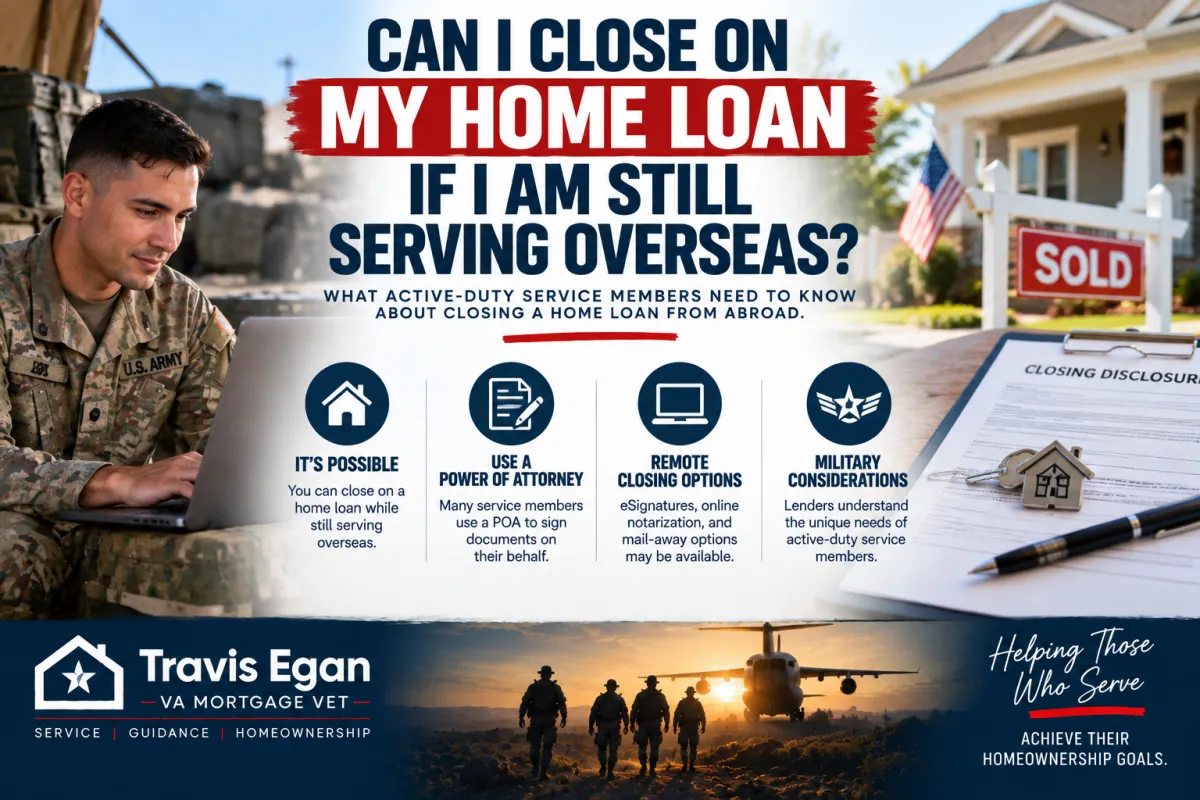
Can I close on my home loan if I am still serving overseas?
Yes, in many cases an eligible service member can complete a VA loan closing while overseas. Depending on the lender, title company, state law, and the specific transaction, you may close through a properly executed power of attorney, approved remote or electronic signing procedures, or other arrangements coordinated well before closing day. The key word is coordinated. You don't spring a closing from another country on a mortgage company in the final week.
This matters most for active-duty service members, deployed personnel, and military families buying a home with a VA loan while still stationed abroad. The property itself still has to be located in the United States or its territories, but your physical location at closing is a separate question from where the house sits. A VA loan closing overseas is possible in many situations, and the rest of this page walks through how it works.
VA Loan Closing While Overseas: How Does It Work?
The VA allows a Veteran or active-duty service member to use an attorney-in-fact to execute the documents necessary to obtain a VA-guaranteed loan. An attorney-in-fact is a person you legally appoint to sign on your behalf. That person does not have to be a lawyer, though some borrowers choose one. You make the appointment through a power of attorney document.
Three conditions have to line up for that to work:
The power of attorney must be legally valid where it is executed and where the closing takes place.
It must comply with applicable state law, which varies considerably from state to state.
It must meet VA requirements and the lender's own requirements, which are not always identical.
Signing through an attorney-in-fact transfers the legal effect to you. Your representative signs your name on a promissory note and mortgage, and you remain responsible for the loan. That is why lenders review power of attorney language closely rather than accepting whatever form a legal website produces. A document that looks fine on its face can be rejected at the closing table if it does not clearly authorize the specific act of obtaining this particular mortgage.
Some transactions are handled without a power of attorney at all, through remote or electronic signing when the lender, investor, title company, and state all allow it. Which path fits your situation depends on the parties involved, not on a single nationwide rule.
General, Specific, and Military Powers of Attorney
The type of power of attorney you create determines how much authority you hand over and how likely a lender is to accept it for a mortgage closing.
General power of attorney
A general power of attorney grants broad authority across many types of financial and legal matters. That breadth is exactly why lenders often hesitate. A general POA says nothing specific about the house, the loan, or the VA entitlement being used. Some lenders and title companies will accept one, and some will not, so a blanket document is a gamble when a closing deadline is looming.
Specific power of attorney
A specific, or limited, power of attorney authorizes a narrow set of acts, usually tied to one transaction. For a VA purchase, this version is most likely to satisfy an underwriter because it names the property and the loan being closed. To avoid surprises, ask your lender and closing agent what they need to see before you sign anything.
Military power of attorney
Service members can prepare a military power of attorney, often through legal assistance on base. These documents are drafted with military requirements in mind and are widely recognized. Even so, a military power of attorney must still include the right language for a mortgage closing. Calling it a military POA does not automatically make it acceptable to every lender or in every state.
What a Specific Power of Attorney Should Include
A specific power of attorney for a VA mortgage closing may need to identify several details so the person signing on your behalf is clearly authorized to do so. Details commonly requested include:
The property being purchased, identified by address or legal description.
The purchase price and transaction terms.
Your intention to use VA entitlement on this loan.
The loan purpose, such as a purchase rather than a refinance.
Your occupancy intention for the home.
Authority to sign the note, the mortgage or deed of trust, and the closing documents.
Coordinate the power of attorney with your lender and closing agent before you sign it. Send a draft and ask them to review it. This one step prevents the most common disaster in this process: a signed, notarized POA that arrives on closing day and gets rejected because it is missing a required phrase. Rewriting a document already notarized overseas can take days or weeks, and a purchase contract may not wait that long.
The Lender's Alive and Not Missing in Action Verification
When a power of attorney is used to close a VA loan, the lender must verify that the service member is alive and, when applicable, not missing in action. This is a routine protection, not an accusation. It exists so a loan isn't closed in the name of someone who can no longer authorize it.
In practice, the check usually involves a simple verification step coordinated through the lender or closing agent. Ask your loan officer what they will need from you and when, so you're available when the request comes through. For a service member on deployment, knowing the timing in advance makes it far easier to respond promptly.
Remote Online Notarization and Electronic Closing
Remote online notarization and electronic signing have made a remote closing VA loan transaction more common, but availability is not universal. Whether you can close entirely online depends on several factors: the state where the property is located, the lender, the investor who will hold or back the loan, the title company, the closing agent, the type of document, and sometimes the country where the service member is located.
Because those variables change from deal to deal, nobody can promise that every VA loan can be closed completely online. Some states authorize remote online notarization broadly, and others restrict it or handle it differently. Some lenders accept electronic signatures on most documents but still require certain pages to be signed with ink.
The practical takeaway is simple. Ask early, get the answer in writing, and build a backup plan. If your lender confirms electronic signing is available, confirm which specific documents you can sign that way. If a wet signature is required, find out which pages and plan the logistics from there.
Practical Challenges of Closing From Overseas
Closing on a house while deployed or stationed abroad involves logistics that do not come up for a buyer living twenty minutes from the title company. Common hurdles include:
Time-zone differences that make it hard to reach lenders, title officers, and attorneys during their business hours.
Unreliable or restricted internet access, particularly in austere locations.
Wet-signature requirements that cannot be satisfied electronically.
Notarization, which may require access to a notary authorized to act where you are stationed.
U.S. embassy or consular services when no notary is available, along with the appointment wait that can come with it.
Document shipping time in both directions, which can add days to a deadline.
Military operational restrictions that limit when and how you can communicate.
Delays caused by incomplete power of attorney language, which is the most preventable item on this list.
None of these are reasons to give up on a purchase. They are reasons to start the conversation months earlier than a stateside buyer would and to keep a cushion in your timeline.
Occupancy Requirements When You Are Stationed Abroad
Being overseas at closing does not automatically prevent a borrower from meeting VA occupancy requirements. VA loan borrowers generally have up to 60 days past closing to move into and occupy the new home. The VA refers to this period as a reasonable time.
Active-duty service and deployment create situations that fall outside a simple move-in timeline. In some cases, a spouse occupies the home, and the rules can account for that when the service member's duty location makes immediate occupancy impossible. That is different from assuming any overseas borrower automatically satisfies the requirement. Occupancy depends on your orders, your intent, who will live in the home, and how the loan is structured.
Do not guess here. Tell your loan officer your duty station, your expected orders, and who will physically occupy the property, then get the answer confirmed for your specific file before you remove contingencies.
Three Ways to Close a VA Loan From Overseas
Most overseas closings follow one of three paths. The right one depends on your location, your timeline, and what the lender and title company will approve.
Closing method | How it works | Best suited for | Plan for |
|---|---|---|---|
In-person signing before departure | You sign the closing documents in person while still in the United States, before you leave or before your orders take effect. | Service members with a known departure date and a purchase timeline you can move up. | Coordination between the lender, title company, and your travel dates. Not every purchase can be accelerated. |
Attorney-in-fact with an approved power of attorney | A person you appoint signs the closing documents on your behalf using a power of attorney that the lender, title company, and state accept. | Borrowers who cannot sign in person or electronically, or whose lender requires wet signatures. | Specific POA language, notarization, and enough lead time to deliver documents. |
Remote or electronic closing | Documents are signed and notarized electronically where remote online notarization is permitted, and all parties accept it. | Borrowers with reliable internet, a supporting state, and a lender set up for the process. | Confirmation that every document qualifies. Some pages may still require wet signatures. |
Some transactions use a combination. You might sign part of the package electronically and have an attorney-in-fact handle the pages requiring a wet signature. Ask what your specific package will look like rather than assuming it will match a friend's experience.

Step-by-Step: What to Do Before Closing
Working through these steps in order removes most of the friction from a VA loan closing overseas.
Notify your lender early. Tell your loan officer about your duty station, deployment schedule, and communication limits as soon as you start shopping, not after you are under contract.
Confirm how closing will be handled. Get a clear answer on whether the transaction will close in person, through a power of attorney, electronically, or through a combination.
Determine whether you need a power of attorney. If you can sign before leaving or sign remotely, you may not need one at all.
Have the title or closing company approve the POA language. Send the draft for review and get written confirmation before notarizing.
Arrange notarization. Use a notary whose authority will be accepted where the property is located, and use embassy or consular services if your situation requires it.
Review the Closing Disclosure. Compare it against the Loan Estimate, ask about anything that changed, and do this while you still have time to get answers.
Confirm wiring instructions securely. Call the title company or lender using a phone number you independently verified. Never rely on wiring instructions sent by email without confirming by phone.
Remain reachable on closing day. Even with a power of attorney, questions come up. Make sure your lender and closing agent know how to reach you and when.
Buying a House While Stationed Overseas
Many service members use VA mortgage loans while stationed abroad, and Veterans who live overseas remain entitled to the benefits and services they earned through military service. The property must be located within the United States or its territories, since you can't use a VA loan to buy a home in another country. You can live abroad and still use the benefit as long as the home you are financing is stateside.
That combination is more common than people expect. Families stationed in Europe or Asia often buy near a future duty station, a hometown, or a base they expect to return to. The financing works. It just takes more planning on the logistics side.
Frequently Asked Questions
Can my spouse sign my VA loan documents for me?
Your spouse can sign for you only if you have legally appointed them as your attorney-in-fact through a power of attorney that the lender, title company, and applicable state law accept. Being married does not automatically give a spouse authority to sign a mortgage on your behalf. Have the POA reviewed and approved before closing day.
Can I use a military power of attorney to close on a house?
You can if it contains language that specifically authorizes the mortgage transaction. Military powers of attorney are widely recognized, but a general military POA may not satisfy a lender or title company that wants the property, loan purpose, and signing authority named. Have the draft reviewed before you sign and notarize it.
Can I close remotely from another country?
Sometimes, but it depends on the state where the property sits, the lender, the investor, the title company, the document type, and the country where you are located. Remote online notarization is not available everywhere, and some documents may still require wet signatures. Ask each party to confirm in writing what they will accept.
Do I have to be physically present at a VA loan closing?
No. In many cases, an eligible service member can close without being present. Documents may be signed by an attorney-in-fact under an approved power of attorney, through remote or electronic signing where permitted, or through another arrangement the lender and title company approve. The lender will still verify that you are alive and, when applicable, not missing in action.
Can I buy a house while deployed?
Yes, many deployed service members buy a home with a VA loan. The property must be in the United States or its territories, and you'll need to work out the logistics of signing, notarizing, and delivering documents ahead of time. Start with your lender early, confirm the closing method, and give yourself more lead time than a stateside buyer would.
Missed the last post? Check out Why Does Dave Ramsey Not Recommend VA Loans? For more on VA home loans.