
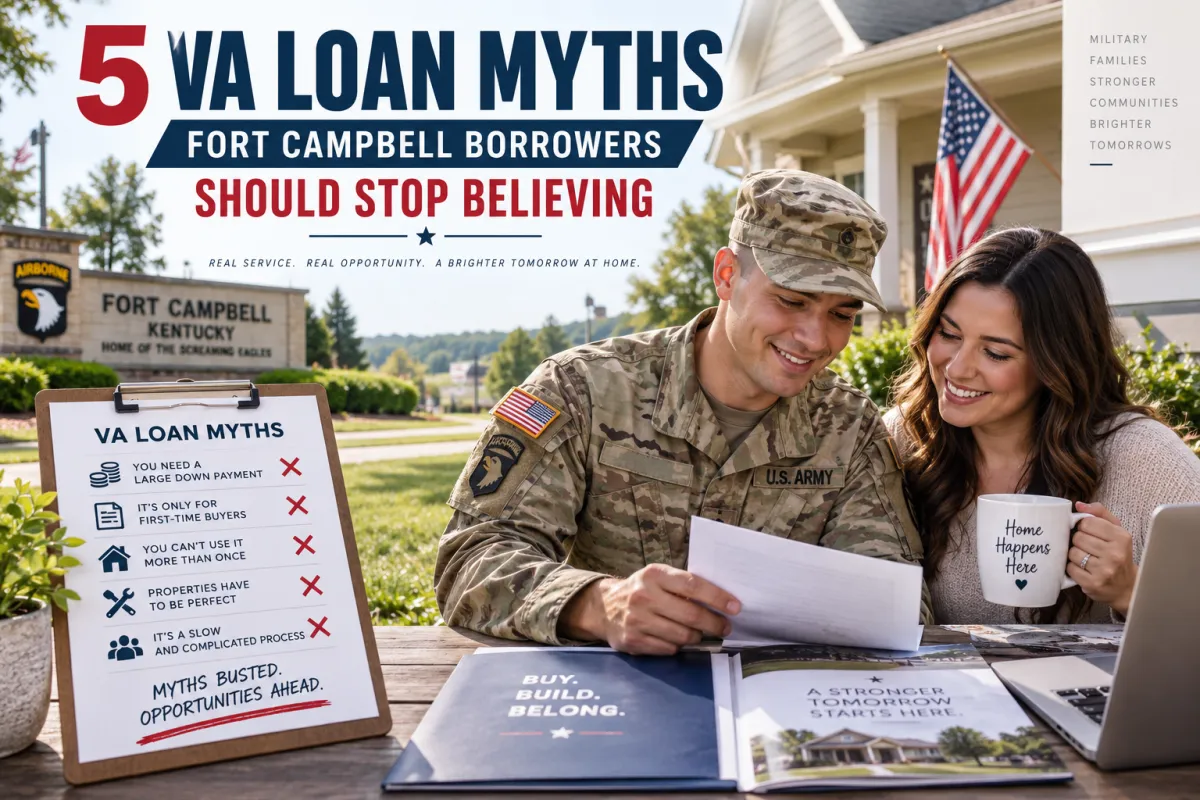
5 VA Loan Myths Fort Campbell Borrowers Should Stop Believing
Around Fort Campbell, VA loan rumors travel fast. They move through unit hallways, spouse groups, and base Facebook pages, and by the time they reach a first-time buyer, they can sound like hard rules. Most of them are not.
The VA loan is a mortgage backed by the U.S. Department of Veterans Affairs and available to people who qualify through their service. The VA has pushed back on the worst misinformation, describing the program as one of the best loan options on the market while noting that it does not require perfect credit or, in most cases, a down payment.
If you are buying in Clarksville or anywhere in the Fort Campbell area, here are five myths worth clearing up before you talk to a seller.
The Five Myths at a Glance
The table below pairs each myth with what the record actually shows. The sections that follow explain why each one keeps circulating and what it means for your house hunt.
Myth | What is actually true |
|---|---|
You need perfect credit | The VA loan does not require perfect credit. Lenders apply their own standards on top of program rules. |
You need 20 percent down | In most cases, you don't need a down payment. |
Sellers will not accept a VA offer. | Sellers do not automatically get stuck. The idea that VA loans are slower and riskier than they really are is a belief, not a rule. |
Only combat veterans qualify. | Eligibility is broader than combat service alone. |
VA loans cost more than traditional mortgages.s | The VA has called its own program one of the best loan options on the market. |
Myth 1: You Need Perfect Credit to Get a VA Loan
The VA loan does not require a perfect credit score. That single line clears up one of the most stubborn myths in military lending, and it is worth repeating because so many service members disqualify themselves before anyone ever looks at their file.
The program does require you to qualify through a lender, and lenders set their own credit standards. Two companies can review the same borrower and reach different conclusions. That is why a denial from one lender is not the end of the road, and why a conversation with a loan officer who handles VA files every week is more useful than secondhand advice.
If your credit has some bruises, ask what would need to change before you apply. Sometimes the answer is a specific payoff, sometimes it is time, and sometimes it is simply a different lender. Don't assume you are out of the running before anyone pulls your report.
Photo by George Pak on Pexels
Myth 2: You Have to Put 20 Percent Down
Nothing in the VA program requires a 20 percent down payment, and most qualified buyers need no down payment at all. The 20 percent figure comes from conventional lending, where it is a common way to avoid mortgage insurance. Applying that rule to a VA loan is where the myth starts.
A no-down-payment loan still has costs. Closing costs, prepaid items, and any negotiated repairs do not disappear. The point is that the down payment itself is usually not one of them, which matters when you are trying to keep cash available for a move, a rental deposit, or the gap between two duty stations.
Ask your loan officer for a written breakdown of what you would bring to closing. Seeing your own numbers on paper is the fastest way to separate the myth from your actual situation.
Myth 3: Sellers Won't Accept a VA Loan Offer
This one gets repeated so often that some buyers stop writing VA offers altogether. The belief behind it is that VA loans are slower and riskier than they actually are, which is a belief rather than a rule.
Sellers do not automatically get stuck when they accept a VA offer. Sellers care about a clean contract, a qualified buyer, and a closing date they can plan around. When a listing agent has worked with VA loans before, the conversation is usually short. When they have not, the education falls to your agent and your lender.
That's why you need a lender who answers the phone and can speak directly to the other side. A quick call confirming your pre-approval and expected timeline often does more than any pamphlet. If a seller still resists after that, you have learned something about the seller, not about your benefit.
Some hesitation comes down to how the offer is structured, or a misunderstanding about who pays for what. Those are negotiable details, not walls.
Myth 4: Only Combat Veterans Qualify
Combat service is not the entry requirement for a VA loan. Eligibility is tied to your service history, and the group of people who can use the benefit is wider than the myth suggests.
This myth does real damage inside units because service members hear it and quietly decide the benefit isn't meant for them. They never check. Years later, they find out an entitlement was sitting there the whole time.
If you are not sure where you stand, treat it as a question to answer rather than a conclusion to accept. Your loan officer can review your service details with you, and the VA is the final authority on who qualifies. Nobody should opt out of a benefit based on a rumor they heard a decade ago.

Myth 5: VA Loans Cost More Than Traditional Mortgages
When the VA talks about its own program, it does not describe it as a consolation prize. A VA news release written to bust home loan myths called it one of the best loan options on the market. That is a strange thing to say about a loan that supposedly costs more across the board.
Cost is not a single number. It depends on the loan structure, the terms you are offered, and how the loan is serviced. Two borrowers with the same house and a similar credit profile can see different numbers depending on which lender they call.
That is why comparison shopping matters for VA loans as much as it does for conventional ones. Get your offer in writing. Ask what makes up the monthly payment. Then decide. A myth that says VA loans always cost more can push you toward a different product that costs you more in reality.
How to Check a VA Loan Claim Before You Act On It
Old articles are part of the problem. A 2015 VA news release, written specifically to bust home loan myths, referenced a purchase amount of $417,000 for qualified buyers. That number was accurate at the time, which reminds you that program figures get updated. If you read a number in an article with no recent date, verify it before you build a plan around it.
A short checklist helps keep you out of trouble:
Check the date on the source. Confirm anything older than a couple of years.
Go to the VA directly for program rules and eligibility questions.
Ask your loan officer for answers in writing, tied to your file rather than to a general scenario.
Talk to someone who closes VA loans regularly, not just someone who has one.
Be skeptical of any claim that starts with always or never.

Why Local Guidance Matters Around Fort Campbell
Fort Campbell buyers face a timeline most civilian buyers do not. Orders arrive, dates shift, and the house hunt gets compressed into leave or a short window after a PCS. A myth that costs you a week of hesitation can cost you a house.
Working with a loan officer who treats VA files for military families as a specialty, not an occasional favor, changes the pace. Documents get requested once. Questions get answered without a research project. When the listing agent on the other side has concerns, someone can address them the same day.
Travis Egan is a Marine Corps veteran and VA mortgage specialist based in Clarksville, Tennessee, serving military families connected to Fort Campbell through Loan Factory. The work covers VA purchase loans, IRRRL refinances, and PCS relocation timelines, along with conventional, FHA, and USDA options when a VA loan is not the right fit. Free tools like rent-versus-own and affordability calculators can help you set a target before you start touring homes.
Frequently Asked Questions
Can I use my VA loan benefit more than once?
Yes. There is no limit on how many times you can take out a VA loan. There is a limit tied to how much entitlement you can use, and that is where the confusion usually starts. Buyers hear the word once and assume the benefit is spent after the first purchase. If you have used a VA loan before, your loan officer can review what remains.
Does a VA loan require a down payment?
In most cases, no. The VA loan does not require a down payment for qualified buyers, which is one reason it works so well for military families managing a move. Closing costs and prepaid items still apply, and some situations may call for a down payment. Ask for a written estimate of what you'll need to bring to closing.
What credit score do I need for a VA loan?
The VA does not require perfect credit, and no single score applies to every borrower. Lenders set their own credit standards on top of the VA program rules, so the answer depends on who you work with. If your credit needs work, ask what would move the needle before you apply again.
Do sellers really get stuck with VA loans?
No. Sellers do not automatically get stuck when they accept a VA offer. The idea that VA loans are slower and riskier than they really are is a belief that circulates in real estate, not a contract rule. A qualified buyer, a clean offer, and a lender who communicates well resolve most resistance before it becomes a problem.
Is a VA loan a worse product than a conventional loan?
The VA has described its home loan as one of the best loan options on the market, and for many military families it is. What matters is how the numbers look for your situation. Compare written offers, look at the full monthly payment, and ask questions. Test any claim that one loan type always wins or always loses against your own file.
Missed the last post? Check out Can You Keep a VA Loan on a Previous Home? For more on VA home loans.